
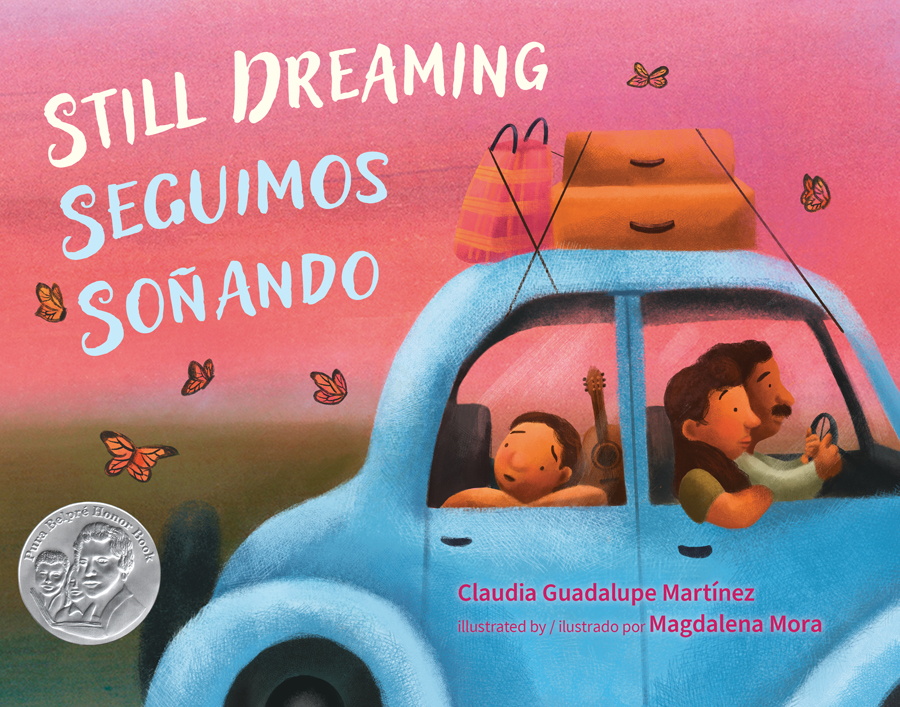
 Still Dreaming / Seguimos soñando
Written by Claudia Guadalupe Martinez
Illustrated by Magdalena Mora
Translated by Luis Humberto Crosthwaite
Children’s Book Press, 2022, 40 pp (unpaged)
ISBN: 978-0892394340
Muted pinks and soft earth tones, combined with the fluid lines of the illustrations, set the tone in Still Dreaming / Seguimos Soñando, a bilingual Spanish/English picturebook that was awarded a Pura Belpré Honor for Illustration. This is a moving story that speaks of historical injustice, cultural strength, and the lasting power of dreams. A Latinx family is forced to leave the United States to move to Mexico during the Mexican Repatriation in the 1930s. The unnamed narrator of the story is a young boy who we follow from the only home he has known in Texas to the border of Mexico. Along the way he shares his fears and hopes on this forced journey, comforted by his parents and their strong family bonds. The young boy meets fellow travelers from across the United States who are also being forced to migrate to Mexico. His narration portrays the work Mexican Americans did in the 1930s; from picking pecans in Texas to farming sugar beets in Minnesota to laying down railroad tracks in Kansas (to name a few). We learn how hard these people worked to help build and maintain the United States.
Claudia Guadalupe Martínez’s gentle, poetic text offers just enough language to anchor the reader emotionally and historically within the journey. By telling the story through a child’s voice, she brings a subtle intimacy to a moment of historical trauma that turns the political into something deeply personal. The bilingual format deepens the themes of identity, memory, and belonging, creating space for both English and Spanish-speaking readers to connect with the heart of the story.
Magdalena Mora’s illustrations gently guide readers through the family’s journey, passing through dusty towns with shuttered Mexican shops and barren stretches of land. The landscapes often open into vast, empty spaces that make the family appear small and isolated, visually expressing the emotional distance from home and the uncertainty ahead. As the story unfolds, the color palette shifts to pale yellows and dusty browns that reflect the harsh desert sun, while touches of turquoise and red represent the family’s cultural identity. The characters are softly outlined in minimal detail with their quiet and pensive expressions capturing the unspoken fear, confusion, and hope that shape their journey.
As the boy’s world is uprooted, dreams become a recurring visual motif seen in the floating faces above train cars and the blooming flowers in night skies. These dreamscapes are textured and abstract, often spilling beyond the edges of the page, symbolizing the freedom of imagination even in the face of hardship. Mora’s use of layered media, blending hand-drawn and digital techniques, mirrors the complex emotions of the story, including hope, grief, confusion, and resilience, while offering visual depth to an already emotional and difficult journey.
Inspired by the real-life history of forced repatriation of Mexican Americans in the 1930s, Still Dreaming / Seguimos Soñando invites deep reflection, empathy, and a reexamination of an often forgotten past, one that remains incredibly relevant today in different, yet familiar, ways. Books that echo the themes of memory, displacement, and cultural identity include La Frontera: El viaje con papá / My Journey with Papa (Deborah Mills, Alfredo Alva, and Claudia Navarro, 2018), Migrant: The Journey of a Mexican Worker (José Manuel Mateo and Javier Martínez Pedro, 2014), and My Two Border Towns ( David Bowles and Erika Meza, 2021). While these titles vary in storytelling style, they each center around a child’s perspective as they navigate the challenges of migration and belonging. Like Still Dreaming, they invite readers to see migration not as an abstract concept, but as a deep human experience shaped by family, place, hope, and resilience.
Claudia Guadalupe Martínez, originally from El Paso, Texas, is an award-winning author who often writes stories that highlight Mexican American history and identity. Some of her titles include The Smell of Old Lady Perfume (translated by Luis Humberto Crosthwaite, 2008) and Not a Dog (illustrated by Laura González, 2025). Martínez has received many literary awards including two Texas Institute of Letters Best Young Adult Book Awards, a Paterson Prize for Books for Young People and Américas Award Commendations. She also teaches writing at the university level. You can find out more about her on her website.
Illustrator Magdalena Mora grew up in Mexico, Chicago, and Texas and is now based in Minnesota. She brings underrepresented voices to life through her art, blending hand-drawn textures with digital techniques to create illustrations where children can feel seen and represented. You can read more about her and her work on her website.
Luis Humberto, the book’s translator, was born in Tijuana, Mexico. He is also a journalist, editor, and writer. His own writing focuses on the complexities of the Mexico/United States border.
Kristian Rana, Texas Woman’s University
© 2025 by Kristian Rana
