
“Life is a Journey and an Iceberg”: Creating a Context for Conceptual Thinking
by Amy Edwards, Fifth Grade Teacher, Van Horne Elementary School
Sometimes we need an outside perspective to fully see our students and appreciate the growth they have made as thinkers. Lane Wallace, a friend and a columnist/editor for Flying Magazine, visited our classroom to share her experiences in Sudan, Chad, and the Republic of Congo. She had also been mountain climbing in Nepal, a region we were reading about in Zangbu’s Story by Ang Zangbu Sherpa (1997). As she shared her slide show of Nepal, she allowed students to linger on each picture and to ask many questions. Afterwards, she expressed her amazement at the depth and thoughtfulness of their thinking and commented on the uniqueness of this thinking for ten and 11 year-old children. She remembered not being valued or encouraged as a conceptual thinker as a child in school. She found it refreshing that kids were being taught to think conceptually and felt good about the state of education, at least for kids at Van Horne. Being a true intellectual, Lane felt there was hope for us all.
Changes in technology and globalization are having a huge impact on the way we live. Although students were being trained a generation ago as accountants to crunch numbers, lawyers to write contracts, and computer programmers to design computer codes, a massive shift in thinking is required for graduates to be competitive in our global market. David Pink (2005) argues that we have moved from an information age to a conceptual age and so the future belongs to a new kind of thinker. These creators, empathizers, pattern recognizers, and meaning makers will be highly valued and rewarded in contemporary society. Our students will benefit from the global focus on conceptual thinking that they are developing through their work.
Students at our school participate in the Learning Lab once a week, working with our Instructional Coach, Lisa Thomas, and Kathy Short from the University of Arizona to explore intercultural understandings through literature, art, and discussion. Instructional engagements in the lab are connected to the learning in our fifth grade classroom through big ideas that cut across social studies and science units and the literature studies within these units. Teachers also meet after school in a study group to discuss and plan the teaching and learning taking place in the lab and ways of connecting lab experiences to the curriculum in individual classrooms.
Conceptual thinking is important for students because there are just too many facts in life to remember. Facts are important, but they need to be connected to something bigger to be accessible and useful for learners. Concepts are mental constructs, organizing ideas that categorize a variety of examples or facts. They are timeless, universal, abstract, and broad (Erickson, 2002). In exploring our big idea during the fall semester we were eager to encourage conceptual thinking. Strategies for exploring conceptual thinking included discussion of metaphors, creation of life journey maps, use of graffiti boards to sort through the details of the story and encourage collaboration of thinking, and sorting text sets to create categories and identify issues within big ideas or concepts. In the first semester, we asked our students to use Journey as a metaphor to think about their world conceptually throughout our various studies.
In teaching any concept, it is best to begin with students’ personal experiences. We planned initial engagements that helped our students to make connections to what they already knew, because we learn more effectively by building on our life experiences (Short & Harste, 1996). We asked students to focus on their life journeys, a focus that also encouraged them to continue exploring their cultural identities. In the Learning Lab, students were asked to create life journey maps to start developing their conceptual thinking about journeys using subject matter they were very familiar with–themselves. We then built on the concept of journey on a larger scale to explore many other types of journeys and issues associated with journeys, such as migration, competition, death, emotions, and learning.
To introduce the life journey maps, Lisa read aloud The Pink Refrigerator by Tim Eagan (2007) and talked with students about the life journey of the main character, Dodsworth. They noticed Dodsworth’s need to continue learning and came up with “Keep Trying New Things” as the big idea. Students were asked to find ways to depict Dodsworth’s journey using pictures and words as possibilities to consider for their own life journey maps. Lisa also shared life journey maps created by teachers as further demonstrations of the possibilities for how one’s life could be visually represented. Conceptual thinking was supported by encouraging students to think together about the ideas through discussion and by looking at others’ work.
Perspective is an important concept in understanding our world. Lisa read Once There Were Giants (Waddel, l989) to demonstrate different points of view and the concept of metaphor before students were asked to share their life journey maps with one another. They noticed that the book was not about giants, but instead described the main character’s view of adults when she was a child who then grew up to become a “giant” or grown up. They also noticed that the book moved in a circular journey since the girl had a baby of her own at the end of the story, thus starting the cycle all over again. Looking at their lives from their own perspectives was unique and personal. Being able to share these events with other students gave them an opportunity to view their own life journeys and those of classmates through different eyes.
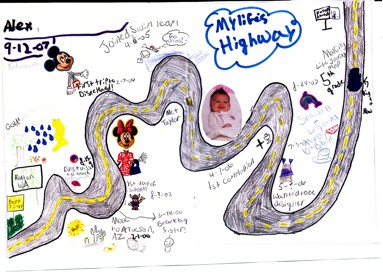
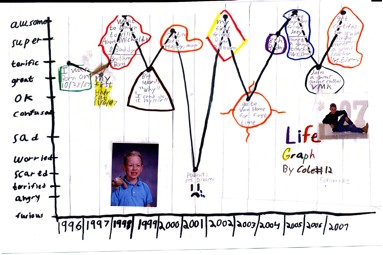
Students represented their lives in creative ways on their life journey maps. Andres created his life journey map in the form of a computer-generated timeline with pictures imported for each year. The caption under each picture highlighted the events important to him that year. Alex organized her information along a hand drawn highway showing all the stops as highlights in her life’s journey. Cole showed his life journey on a line graph with the vertical axis showing emotions and the horizontal axis the years of his life. He started with the label “furious” on the bottom of the graph and then listed emotions getting more positive as they went up to the top of the axis. He labeled furious, angry, terrified, scared, worried, sad, confused, ok, great, terrific, super, and finally awesome. The line graph showed the ups and downs of Cole’s life in a way that was unique from any other student. Especially noteworthy is the dip in the line graph showing “scared” at the time of his parents’ divorce. Having students record their own life journeys helped them to start thinking conceptually about journeys at a personal level.
After sharing their maps with the class, students were asked, “How is your life like a journey?” The ensuing dialogue, where students built meaning by listening to each other and adding their own ideas to those of other students, is an example of how these fifth graders were using metaphors to think conceptually about important events in their lives.
This dialogue is exciting because students made connections with one another’s thinking by building on each other’s comments and engaging in metaphorical thinking. Metaphors depend on conceptual understanding for connections between the two dissimilar items within the metaphor to make sense. Metaphors such as path, cartoon story strip, puzzle, and iceberg were raised during this discussion.
To give students further opportunities to think conceptually, a large set of related texts were pulled together after teachers spent time in study group examining student-created webs on types of journeys. The books were selected based on the ideas about journeys generated by students. We encouraged students to read from these journey text sets over the next several weeks to broaden and deepen their understandings. The themes of the text sets included:
Before asking students to choose a theme to read more about, Lisa talked about the cognitive strategies we use to understand concepts. We knew that students already engaged in these strategies, but at an unconscious level. We wanted to explicitly talk with students about their strategies so they would develop metacognitive awareness and more effectively use the strategies as thinkers. The strategies that she identified included:
Students were asked to choose a theme that interested them and go to a table for an extended time to read freely in the text set around that theme. I settled in with the set of books about Growing and Learning and read along with the students. This text set included Math Curse by Jon Scieszka (1995), Inch by Inch by Leo Lionni (1960), Fly Away Home by Eve Bunting, (1991), Running the Road to ABC by Denise Lauture (1996), I Lost my Tooth in Africa by Penda Diakite (2006), How Big is the World by Britta Teckentrup (2007), Cooper’s Lesson by Sun Uyng Shin (2004), Tibili by Marie Leonard (2002), and Lotus Seed by Tatsuro Kiuchi (1993). The students were engrossed in the books.
Later students returned to the Story Floor to discuss what they had noticed about journeys in their reading.
Our class ran out of time as we had to go to lunch, so we were not able to finish the discussion. Christian’s thinking is conceptual, connected, and amazingly deep for an 11 year old. I knew that we needed to build on this thinking.
After the students had several weeks to read the books in their selected text set, we asked them to sort the books in their set into categories based on different connections or patterns across the books. We noticed that they enjoyed the individual books, but not making connections across the texts and wanted to encourage them to raise their level of thinking. They were asked to sort the books in multiple ways to take their thinking from obvious connections to deeper connections across the books. Students were told that this type of conceptual thinking was intertextuality, the process of making meaning through connections with past and present texts and life experiences (Beaugrande, 1980). Making connections is a natural way for young children to learn. Since schools are typically organized around isolated subjects, children often stop searching for connections that facilitate learning (Short & Harste, 1996). We wanted to give our students the opportunity to make these connections to deepen their understanding. To demonstrate the process of sorting and creating categories, Lisa displayed multiple items to sort, including a hammer, glass, light bulb, calculator, brush, pen, and other items. She asked the children how the items should be grouped so that every object went with something else and that nothing was left out. They ended up with:
Lisa talked about physical characteristics and how it wouldn’t challenge our thinking to sort the books by color, and that instead we wanted to think about the big ideas and meanings across the books. She pointed out that the size of a book didn’t help us to think about the concept of journey. Students went to the tables to use this strategy to sort the books in each of their text sets in multiple ways. They were asked to follow the following steps:
Moving from table to table it was evident that conceptual thinking was taking place as students justified why they were sorting the texts in a particular way. Some of the concept categories students came up within each text set included:
Finally, students were asked to web the concepts from each text set and how these concepts were related. We were interested in finding evidence of conceptual thinking and would later look at their work in study group to see where this inquiry would take us next.
At our next Learning Lab time, students spent a little more time with their sets of books and added any new ideas to their webs that emerged from their conversations. They were also asked to sort the books one more time into new categories. Students then came together at the Story Floor to discuss their understandings about journeys as a whole group. Thinking conceptually was still hard but getting easier for these students as they were asked to push their thinking. We began the study with students’ own life experiences, but now wanted to challenge them to go further as thinkers. We knew that if students stay too close to what they already know, they are not challenged as learners into new understandings (Short, 1993). Even students who typically did not have to challenge themselves in order to complete work in school found this text sorting and categorizing engagement difficult and admitted that they really had to think hard. Christian said he pushed his thinking until his brain hurt!
Lisa encouraged the students to look for issues hiding in the texts. We wanted students to look for issues rather than topics so they would dig more deeply into meanings. Concepts support abstract thinking and encourage the development of interpretations about issues instead of just naming topics (Santman, 2005). Students were asked to look for good/bad or fair/unfair issues within their text sets and to then choose the issue they thought was most complex and interesting for their literature circle discussions. The following webs show how the students’ thinking shifted from their initial webbing about their text set to their web on the issue they identified and discussed.
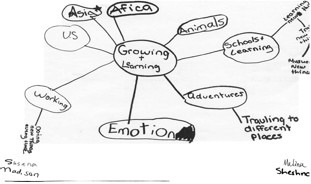
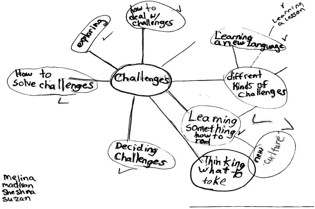
We looked at the webs in our study group to identify the issues that were significant to students. We noticed the concept of power coming up over and over again and decided to focus on that issue in our next lab session so that students could experience focusing a discussion around an issue rather than a topic to encourage more depth in their talk. At our next lab, Lisa asked, “What’s good or bad about power in school, home, or on the playground?” It was apparent these students knew a lot about power and had strong opinions:
Students were told they would be creating a visual representation of their thinking about their text sets through some type of graphic organizer to show the connections and issues that they had explored in their discussions. Kathy showed a range of student charts from fifth graders in another school as examples of how they organized their thinking about different text sets. These students had used large butcher paper in a variety of ways to display how their books were similar or different and to highlight the issues that emerged from their discussions. Some work was represented using a matrix while others used a quilt-like pattern. These examples were a demonstration of possible ways for students to show their thinking concretely without assigning one specific type of chart. Some of them used these ideas exactly, while others came up with innovative ways to show their connections between the texts.
Several lab sessions were spent working on these charts before students were asked to share with the whole group. Groups were encouraged to come up with the one most significant idea relating to the meaning of their text set to share with the class. They were not allowed to read off of their charts but were asked to share one aspect of their group’s thinking. They highlighted the following ideas in their sharing:
Students struggled with expressing what they saw as the most significant idea or issue in their discussions. Some groups seemed surprised that they had to really think in order to share. They had to be selective, when it would have been much easier to share everything they had discussed. We saw evidence of Mayce and others thinking out loud as they shared to work through this process of finding the one most significant idea. With support from the adults in the room, students were able to verbalize the thinking from their small groups. Synthesizing was difficult for them, but they did it!
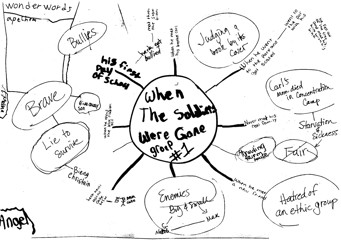
In our classroom students were reading Literature Circle books relating to WWII and the Holocaust. Novels included When the Soldiers Were Gone (Propp, 1999), Number the Stars (Lois Lowry, 1989), The Devil’s Arithmetic (Yolen, 1988), and a non-fiction selection, Hitler Youth (Bartoletti, 2005). Students read and discussed in small groups as well as participated in whole group discussions of books that included common themes connected all the texts.
In small group discussion several response strategies were used to facilitate conceptual thinking. One strategy was a graffiti board, where small groups of students respond to literature using pictures or words written randomly on a large piece of brainstorming paper. Graffiti boards let students respond to a story before and during their discussion in their literature circles. As the discussion unfolds, the events of the story take a back seat to the issues, tensions, and problems that students connect to within a book. I like this strategy because it allows even the most reluctant students to share their thoughts on the paper for others to see.
In whole class discussions students shared concepts and ideas from the graffiti boards and created a web showing how these thoughts were related. I encouraged them to dig deep to find the big ideas of the story, asking, “Why did this author write this text? What are they trying to teach us?” Some of the ideas students discovered and wanted to know more about were fair/unfair issues concerning treatment of ethnic groups, issues of power, bravery, genocide, and issues of prejudice, and propaganda, which took them far deeper than facts about the Holocaust. As student discussed the eventual end of WWII, they seemed to believe that the issues of the Holocaust had been resolved and were sure the world had solved the problems of racism since Dr. Martin Luther King had had his dream. Other students, however, asked about the fighting in Darfur and problems in the Middle East. Weren’t these some of the same problems?
Thinking conceptually led students to more questions and inquiries. What I saw as significant was that students were taking an active role in their thinking, not just learning facts in isolation. They were seeing patterns in how their world was connected and the value of digging deeper for meaning.
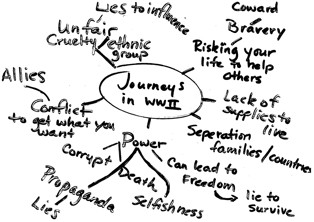
Building on the conceptual thinking from our lab experiences with text sets, our librarian pulled together text sets related to the ideas represented on the class web. The books were mostly picture books, however, some were novels. Topics ranged from the Negro baseball leagues, to Japanese internment camps, to playground issues at school. Students were encouraged to read widely before books were sorted into categories according to the big ideas and themes found on the class web. Students were able to do this quickly and much more easily than the first time. It was great to see the students working hard to get at the big ideas represented by books that at first glance seemed to have nothing to do with the Holocaust. Quickly it became apparent that teaching children to think conceptually has many benefits, particularly in encouraging them to think more deeply about their world and how to make their own connections instead of trying to make sense of someone else’s thinking (Short, 1993). They were asking hard questions about difficult social issues and to see the complexity of those issues.
Conceptual thinking allows students to reflect more broadly about issues in our world instead of just learning about topics that are much narrower in scope. There is simply too much information in our world today for teachers to teach facts in isolation from the concepts that bring meaning to those facts. As we move from the Information Age to the Conceptual Age (Pink, 2005), we know that the students at our school have had the opportunity to view the world from a global vantage point and to think conceptually in order to be ready for this shift. This thinking has supported students in making connections to ideas and issues that go beyond what I had previously encouraged in our discussions of literature. More importantly, I know that children like Lane will be valued for thinking about the big picture instead of simply being asked to memorize the snapshot.
Professional References
Children’s Literature References
WOW Stories, Volume I, Issue 2 by Worlds of Words is licensed under a Creative Commons Attribution-NonCommercial-ShareAlike 4.0 International License.
Based on a work at https://wowlit.org/on-line-publications/stories/storiesi2/.
One thought on “WOW Stories: Connections from the Classroom”