WOW Recommends: Vida
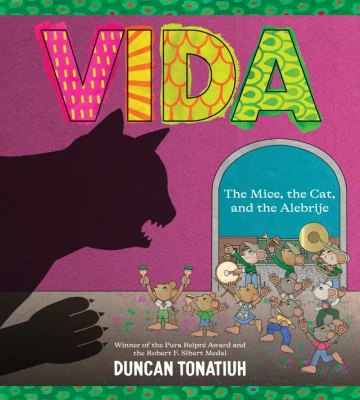
Duncan Tonatiuh's latest picturebook, Vida: The Mice, the Cat, and the Alebrije, exemplifies the power of community. Vida tells the story of a small community of mice in a town called Mousetepec. This community is colorful, vibrant and alegre until a dark shadow appears, the shadow of a cat that begins to terrorize the community. The life and vibrancy of the community are quickly dispelled. Everyone lives in fear until Vida, a young mouse, has a dream and devises a plan to confront the shadow of the cat. Working with her community, they build an enormous alebrije, a fantastical creature to drive away the cat and return alegría to their community.
Vida is a modern-day fable. In the author's note, Tonatiuh shares that his idea for this story came from Aesop's fable of the belling of the cat. He took this allegory of the cat and created Vida to metaphorically address the violence that casts shadows over various communities in Mexico. This metaphor and commentary on the shadow of violence imposed on communities struck me deeply. Communities across the United States have faced challenges to stability and violence as well. The news of care extended by community members across the country and especially within cities like Minneapolis has brought attention to the importance of solidarity and the true meaning of community. The word community combines the Latin prefix com meaning together with the Latin word munis meaning duty or service (New World Encyclopedia). The allegory of Vida profoundly connects with recent events and challenges readers to consider the moral and ethical commitment of living in community and the duty to stand united to maintain the vibrancy, safety, and joy of life together.
Those familiar with Tonatiuh's distinctive pre-Columbian illustration style reflecting the early Mixtec and Mayan drawings will quickly recognize his artistic style in this picturebook. Throughout the book, Tonatiuh incorporates metaphor and symbolism in both text and illustrations. The end papers appear to be scales, like those on the fantastical creature, the alebrije. The left side of the endpapers are gray colored scales containing shadowy Spanish words written forwards and backwards. These words look to be newspaper headlines and stories. Stories of the atrocities faced by communities. Within the gray area, there are also shadowy figures of people. The endpapers gradually begin to change to the vibrant colors of fuchsia, orange, and green without any dark messages. As in the end papers, the use of color throughout the story carries symbolism. When the shadow of the cat comes, the color of the book turns gray. Bright colors appear in both the beginning and the end of the story reflecting the vibrancy of community life free from shadows.
The endnotes to the book provide the history of the sculptures or wood carvings of fantastical creatures called alibrijes. These fantastical creatures have become a popular form of folk art in Mexico. Alebrijes can be found in many museums in Mexico City and Oaxaca, Mexico.
Tonatiuh has written and illustrated many award-winning books including Separate is Never Equal: Sylvia Méndez & Her Family's Fight for Desegregation, Funny Bones: Posada and His Day of the Dead Calaveras and the Princess and the Warrior. He lives in San Miguel de Allende, Mexico with his family. The young mice characters in the story, Vida and Maximo, are named after his two children. Vida: The Mice, the Cat, and the Alebrije is also available in Spanish. --Recommended by Cynthia Ryman, Cal State Monterey Bay
Reference
New World Encyclopedia. (n.d.). Community. In New World Encyclopedia. Retrieved February 25, 2026, from https://www.newworldencyclopedia.org/entry/Community
Title: Vida: The Mice, the Cat, and the Alebrije
Author: Duncan Tonatiuh
ISBN: 978-1419764592
Pub Date: November 11, 2025
Publisher: Harry N. Abrams
Each month a committee of Worlds of Words advisors recommends a book published within the last year. Our hope is to spark conversations on our website and on social media about the book that expand global understandings and perceptions. Please join us by leaving a comment. You can also share your thoughts with us by using the hashtag #WOWRecommends on social media.