
A Sea of Lemon Trees: The Corrido of Roberto Alvarez written by Maria Dolores Águila provides an intensely emotional look into the events leading up to the 1931 court battle in which twelve-year-old Roberto Alvarez stood up against racism and school segregation in Lemon Grove, CA. This historical novel in verse unequivocally shines a light on issues of discrimination and inequity that to this day undermine human rights in the United States. Reading this novel is a challenge and inspiration to not fall into apathy when confronted with injustice, but to remember that each individual plays a role in shaping the narrative of our time. Continue reading
The Partition: 1947, Part 1
By Seemi Aziz, University of Arizona, Tucson, AZ
Mass movements of large groups of people from one global region to another is not new, but there are certain instances that are etched in the memory of people. August of 1947 was a pivotal point in people’s lives who existed in that certain region and era, i.e., India. It was an impact that touched colonial global relations. Its history needs to be explored to understand the context and content of the group of books being explored in this blog. Continue reading
Worlds of Words Center Exhibit Asks, “Who Are You as a Reader?”
By Rebecca Ballenger, Associate Director, Worlds of Words Center
Literary Identities, a new exhibit in the Worlds of Words Center featuring the De Natura Libris project, offers people the opportunity to examine themselves as readers. The exhibit of altered photographs about books and reading also includes picturebooks where reading is central to the book or characters’ identities along with hands-on activities to encourage visitors explore their own identities as readers.
“While public media overemphasizes the mechanics of reading, this exhibit highlights our identities and joy as readers — how we view ourselves as a reader, what we enjoy reading, where we like to read and what stories have changed our lives,” says Kathy Short, director of Worlds of Words and Regents Professor.
WOW Recommends: Just in Case
In this time of severe changes in weather, international conflicts and concern about the environment due to man made interferences, have you considered the complex challenges confronted by plants? More specifically, what happens to the seeds that hold the future of our physical environment, food sources and economic survival amidst a crisis that could endanger and make extinct these valuable resources? The notion of seed banks in general and their importance to our future is a topic not often pursued, even in circles of those concerned about the environment. The focus of Just in Case: Saving Seeds in the Svalbard Global Seed Vault is on the building and use of this amazing creation. Continue reading
The Popularity of Dystopian Novels
By Holly Johnson, Emeritus Professor, University of Cincinnati, Cincinnati, OH
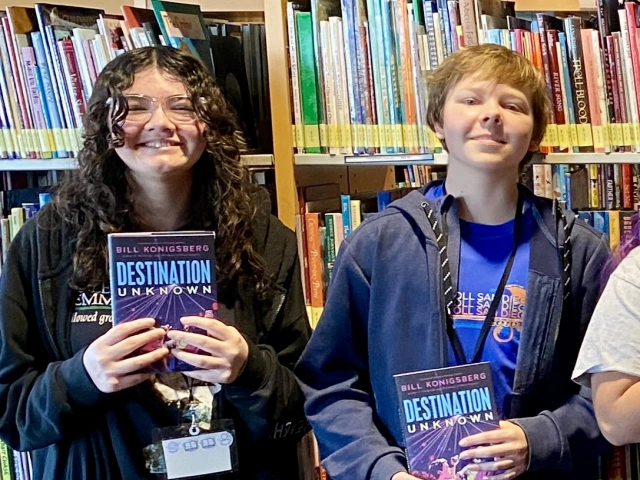
The growth of dystopian novels for all ages has exploded in the last 20 years. A genre that addresses societal fears as well as aspirations, dystopian literature is often considered an essential part of literature/reading programs from middle school through university. Dystopian books and series have been popular for over a hundred years with the publication of H.G. Well’s novel War of the Worlds serving as the first novel of alien invasion, which was published in 1898. Many of us have read a number of dystopian novels including seminal works such as 1984 by George Orwell (1949), Animal Farm by George Orwell (1950) and Fahrenheit 451 by Ray Bradbury (1953). It is an interesting phenomenon that this genre has become so popular with that popularity gaining significant growth after World War I and II. With the steady propulsion of progress across the 20th century, it is an interesting juxtaposition that dystopian thought has kept pace with such advancement. Continue reading
Author’s Corner: Jose Pimienta
By Rebecca Ballenger, University of Arizona, Tucson, AZ
Author/illustrator Jose Pimienta, or Jo to those who know them, spends a lot of time on their feet running cross country, taking long walks near home and exploring new places. On a recent visit to Tucson, the Middle School Reading Ambassadors were curious about what goes on in Jo’s mind during these solo activities. “Everything,” they reply. Continuing, “I think about how my day is going. I think about what is currently happening in my life. The most recent song I heard, the book I read a month ago but still have so much to say about, or the comics I believe deserve more recognition, etc. I have fictional conversations with people I want to talk to. I think about my current projects and how to make them better. Or I think about what I’d like to eat next. But, every once in a while, I’m just looking at my surroundings without thought.”
Jo’s busy brain is put to good use as a cartoonist, author and illustrator who has worked with Random House Graphic, Iron Circus Comics, Dark Horse Comics and the Disney Digital Network. Their books include Suncatcher (YA), Luminous Beings (YA), Twin Cities (MG), Halfway to Somewhere (MG), The Vanishing of Lake Peigneur (MG) and Let’s Rumble (picturebook). This body of work provides a range of readers multiple ways to connect. Their work is relatable for those who see their family and friends in the characters or who relate with the thoughts and concerns we have as we grow and learn about ourselves and those around us. Continue reading
The Importance of Coming Home: A Hopi Resistance Story
By Celeste Trimble, St. Martin’s University, Lacey, WA
Children’s literature with a focus on the Hopi Tribe has almost exclusively been written by non-Indigenous people both in past and contemporary publishing. The romanticization of Hopi ways of life has inspired many books about the tribe from outsiders’ perspectives, yet there are increasing examples of contemporary children’s literature by Hopi creators that can be used as a counterstory to outsider perspectives. Coming Home: A Hopi Resistance Story by Mavasta Honyouti (Hopi), published November 5, 2024 by Levine Querido, stands out as an exceptional informational text from a Hopi perspective created for young readers. Continue reading
WOW Dozen: The Visibility of Asian and Asian American Stories in Young Readers’ Nonfiction Books
By Yoo Kyung Sung, University of New Mexico, and Junko Sakoi, Tucson Unified School District
Asian American history and voices have long been rendered invisible in children’s and young adult literature, and nonfiction texts are no exception. This list brings together a range of nonfiction titles—including picturebooks, chapter books, informational texts and biographies—that offer renewed visibility for Asians and Asian Americans. These works foreground intersectional stories that challenge historical erasure and deepen collective memory. From the artistry of George Nakashima, Ruth Asawa and I. M. Pei to the athletic trailblazing of Wataru Misaka and the mountaineering achievements of Junko Tabei, these books highlight individuals whose creativity, resilience and courage reshaped their fields and expand how young readers understand the diverse contributions of Asian and Asian American communities. Continue reading
WOW Recommends: Taro Gomi’s Big Book of Words
Taro Gomi’s Big Book of Words is an interactive and engaging picture dictionary that inspires curiosity and offers rich opportunities for literacy practices. Through playful and whimsical illustrations, English words and phrases are introduced in two sections: 1) Words and Phrases That Name Things and 2) Words and Phrases to Use in Conversation. Vocabulary is organized by familiar topics such as home, school, animals, transportation and the natural world. These are presented with creative and imaginative perspectives that invite children to see and use language in various ways. The text also supports concept building by encouraging children to make meaningful connections between words and the real-life contexts in which they are used. Continue reading
Invest In Youth as Readers 2025 Final Update – We Did It!
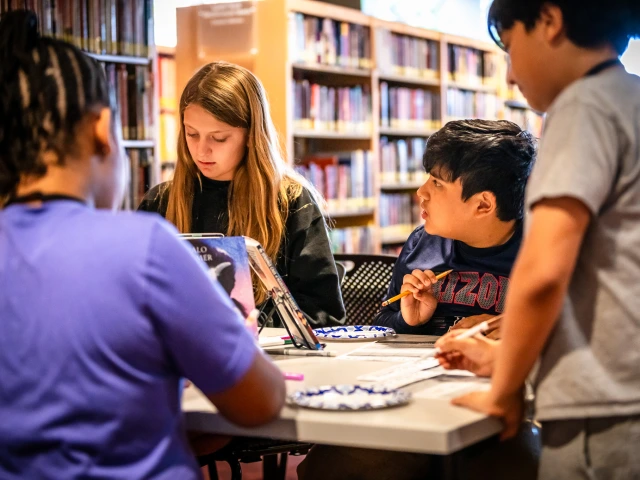
Over the summer, a group of young readers met in Worlds of Words for a focus group to better understand their needs as readers. They expressed a desire for more social connection. This connection certainly happens between peers in the program, and it also is a function of a wider community who connects in digital spaces like their Instagram or podcast feeds.

A Middle School Reading Ambassador shares her sketch with author and illustrator, Jose Pimienta, at a cartooning workshop run by the artist. Pimienta flew to Tucson for the workshop and provided special edition books to participants who bravely shared their work.