The Partition: 1947, Part 1
INTRODUCTION
Mass movements of large groups of people from one global region to another is not new, but there are certain instances that are etched into the memory of people. August of 1947 was a pivotal point in people's lives who existed in that certain region and era, i.e., India. It was an impact that touched colonial global relations. Its history needs to be explored to understand the context and content of the group of books being explored in this blog.
History: Regions of the world were taken over by colonial powers such as the Dutch, French, Spanish and above all the British Empire. Some of these regions were taken over and ruled by these powers, others were taken over and had settler societies established to rule not from afar but as a governing body within the region. The settler societies well known to us are Australia and United States of America. British colonization was impacting the world for years, but its decline became evident as the centuries passed.
Region: The regions of joint India were taken over by the British Empire and the wealth of the region was stolen and milked for years until the people rose and said enough was enough. India before the British took over had Mughal rule for centuries. They were Muslims from Persia. They contributed to the art and architecture of the region with examples such as the Taj Mahal. The British came as merchants and later took over the region through battles and politics. India has and had multiple cultures and religions but the most significant ones are and were Hinduism and Islam.
Colonial Impact of Partition: Not only did all the native people suffer under the oppression of British 'Raj' but within the subcultures, Muslims additionally suffered under the persecution by Hindus. This was the reason behind Muslim leaders asking for a separate country governed by Muslims, the dream that later became a reality in the shape of Pakistan. There was a reaction by natives within their own ranks as some believed and fought for independence against the British rule but wanted to keep India united and those that worked towards dividing India into two separate countries. Prominent leaders of the sub-continent were Jinnah, Iqbal, Gandhi, Nehru, etc.
The British, before hastily exiting India, drew boundaries that were haphazard, considering majority Hindu and majority Muslim regions. Pakistan was thus created in two parts: West Pakistan was the larger chunk and East Pakistan was the much smaller region, with 1200 miles of present-day India in the middle. Muslim majority Kashmir was left to decide their own fate at some later point. Most of the standing armies and industries were left with Hindu led India, and Pakistan was left to struggle with creating everything from government, army, industry, infrastructures, etc.
The outcome of the haphazardly drawn borders was that Hindus relocated to India and Muslims to Pakistan. This was not a simple act without drastic outcomes. Hindus and Sikhs were out to kill Muslims and vice versa. There were mob killings as caravans of people, trains and ships were attacked, and people slaughtered. Witnesses who saw those scenes and the trains, if and when, they reached their final destinations, spoke about blood pouring out of the sides of trains and the very few survivors that reached. Friends and neighbors became foe and murderers. This partition pitted good against good that turned evil. This partition became the "history’s largest and deadliest mass migration" ( Hemnani, p.401).
Present Day: India and Pakistan have waged several wars throughout their short independent existence, mostly for land grab and expansion. The only surviving portion of Pakistan is the Western portion, as in 1971 East Pakistan became Bangladesh and Muslim majority Kashmir is still a disputed territory, claimed by both countries.
The following stories draw from the above-mentioned histories and first-hand accounts from relatives and anecdotal and researched evidence. There seems be a lot of interest in this portion of history in recent years. This is again the case of the power of a 'single story' but told from perspectives of authors from both regions and religions. We will begin initially by looking at three books by the same author and then one written by a Muslim author on the same subject. The introduction and the first set of four books form Part 1 of the blog. We will then go on to explore other voices on the same topic in the second half of February 2026.
The Night Diary by Veera Hiranandani (2018)
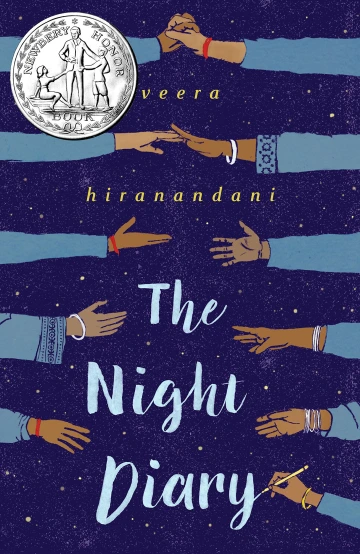
Hiranandani gave life to this story from a deeply personal perspective as she put pen to paper. This is the story of identity and divisions harbored within half-Muslim, half-Hindu Nisha, who is a twelve-year old girl. Nisha seems to project an internally wholistic personality as an introvert. She and her twin brother Amil live with their father and grandmother, both Hindus, and a Muslim cook, Kazi Syed. Her life is as stable and complete as possible, with loving adults surrounding her and her diary. The absence of her mother, a Muslim, who died when the siblings were born, is palpable. Her brother barely knows his mother, but Nisha feels her absence at every turn as she pours her heart out in the blank pages of her dairy.
This is a novel in verse that shapes this narrative through Nisha's letters to her absent mother. The story begins on the sibling's 12th birthday where the father gives Nisha her mother's gold jewelry and the Kazi gives her a diary. They live in the pre-Partition region of Punjab that later becomes part of the newly created Pakistan. Their father is a well-respected physician who is valued by people of all religions but as the atmosphere alters around them and life becomes restrained and constricted, he decides to make the long trip to go to India. As they pack up and leave their home (where they lived their entire lives with their mother, friends and family), they face many hardships. The journey and its challenges become more and more dangerous.
The journey is thoughtfully represented within the narrative. The various climaxes within the journey itself are well written. They initially board a train but quickly realize the issues of being constricted on a train, where they can become sitting targets for goons who board the trains and indiscriminately kill all who they can find. They then change their form of travel by foot. This is more demanding as hunger and thirst overcomes them and their grandmother. Amil almost dies of dehydration. They find shelter in a house and are hidden by total strangers but are also later turned in by other strangers. Being children, they trust easily which becomes a problem for them. Throughout their journey they come across Muslims who lend a helping hand and provide security and help.
The author’s choice of putting the religions of Hinduism and Islam front and center of the narrative was a bold move, and then making the protagonist a child of a Muslim woman and a Hindu man was again a gamble that paid off due to the remarkable storytelling. Cross cultural and cross religious marriages were frowned upon, especially during those times. Their family living in a mostly Muslim region of India with a marriage like that would not have been acceptable and there would have been strong repercussions even before the political issues of British India became prevalent. This union projects itself in the protagonist as she struggles with her identity and doesn't know where she belongs or who she is. Again, her choice of having a Muslim in a strong but subservient role is an issue especially as he is a 'Syed' (direct descendent of the Prophet Muhammad, may peace and blessings be upon him).
The development of Nisha's character is well documented and dynamic. Even as her country was being ripped apart, Nisha remains positive and believes in the possibility of finding her true worth and belonging in this new land and region of Bombay, India. They become reunited with their Muslim cook. This narrative is a well written one that gives significance and balance to characters of both religions that one meets throughout the trajectory of the narrative.
Veera Hiranandani's father was a refugee in India during Partition at age 9 and she draws on his experiences as she writes this story. She draws on her own identity as the daughter of parents belonging to two disparate faiths as she writes these narratives. Hiranandani, author of this Newbery Honor book, earned her MFA in creative writing at Sarah Lawrence College. She is the author of The Whole Story of Half a Girl, a Sydney Taylor Notable Book, and a South Asia Book Award finalist, and How to Find What You're Not Looking For, winner of the Sydney Taylor Book Award and the New York Historical Society Children's History Book Prize. A former editor at Simon & Schuster, she now teaches in the Writing for Children and Young Adults MFA Program at The Vermont College of Fine Arts. She earned her MFA in creative writing at Sarah Lawrence College.
Awards and Accolades: This book has received many awards and is renowned for its narrative.
John Newberry Honor, 2019, 2019 Walter Dean Myers Honor Award, 2018 Malka Penn Award for Human Rights in Children's Literature[TN1], A New York Times Editor's Choice Pick, Georgia Children’s Book Award 2019-2020 Nominee, Camellia Children's Choice Book Award Nominee ALABAMA 2021-2022, Malka Penn Book Award Winner CONNECTICUT 2018, Nutmeg Book Award CONNECTICUT Nominee 2021, Georgia Children's Book Award GEORGIA Nominee 2019-2020, Rebecca Caudill Young Readers' Book Award ILLINOIS Master List 2020, Young Hoosier Book Award INDIANA Nominee 2020-2021, William Allen White Children's Book Award KANSAS Reading List 2020-2021, Louisiana Young Readers Choice Award LOUISIANA Nominee 2020-2021, Maine Student Book Award 2019-2020 Master List, Massachusetts Children's Book Award MASSACHUSETTS Nominee 2020-2021, Great Lakes Great Books MICHIGAN Nominee 2020-2021, Mark Twain Readers Award MISSOURI Nominee 2020-2021, Great Stone Face Book Award NEW HAMPSHIRE Nominee 2019-2020, Garden State Book Award NEW JERSEY Nominee 2021, Oregon Reader's Choice Award (ORCA) OREGON Nominee 2021, Pennsylvania Young Readers' Choice Award PENNSYLVANIA Nominee 2020-2021, South Carolina Book Awards SOUTH CAROLINA Nominee 2020-2021, Volunteer State Book Award TENNESSEE Nominee 2020-2021, Lone Star Reading List TEXAS Reading List 2019, Beehive Book Award UTAH Nominee 2020, Just One More Page! WISCONSIN Reading List 2019, ILA 2019 Teachers’ Choices Reading List, 2019 Jane Addams Honor Book in the Books for Older Children Category, A Best Book of the Year by Kirkus Reviews, A Best Book of the Year by The New York Times, A Best Book of the Year by NPR, A Best Book of the Year by School Library Journal, A Best Book of the Year by The Washington Post, Junior Library Guild Selection, 2019 ALSC Notable Children's Books 2019 Capitol Choices: Noteworthy Books for Children and Teens, CCBC Choices 2019 Choice: Fiction for Children, Kirkus Reviews Best Books of the 21st Century 2025.
Amil and the After by Veera Hiranandani (2024)
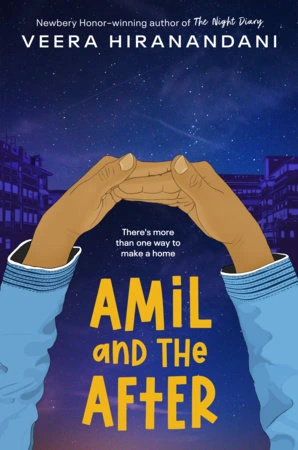
This book is the actual sequel to the popular novel The Night Diary published in 2018 that I blogged on previously. This book can be stand-alone narrative as well that is not a novel in verse. This book begins where the previous one culminated. Here the twins, Amil and Nisha, are trying to find a sense of belonging and security in their new home in Bombay, India. They are now housed in an apartment that is given to them and does not have a garden. They have time on their hands as they are left alone with their aging grandmother, who cooks for them. They do not enjoy her food as much as they did their cook's.
They miss their previous way of life in the region now belonging to Pakistan, as well as the security it had provided for them. Their father stays busy as a physician but is constantly looking for a better and more steady job to support his family. All these familiar characters have been through trauma and are going through PTSD, an issue that they are struggling and grappling with. Amil is encouraged by Nisha to use his beloved art as an avenue to come to terms with the new challenges he is facing. His art and depiction of his feelings and life make the story more accessible for the readers.
Out of the blue their trusted cook shows up at their home and life becomes steadier and more stable due to his presence. Kazi did not feel as if he could be without this family in the newly created Pakistan and made the long journey to reach and find them. This book is set in 1948 a few months to a year after the Partition. In this new regional structure, not all Muslims left to make their lives in the new country just like not all Hindus and Sikhs left the region within Pakistan. Even though the British have left, sectarian, religious and cultural issues persist and there are reactions that are ongoing. With this backdrop, their grandmother suffers a fall and must be in the hospital while Kazi disappears as well. They are perturbed that something may have happened to him as he is a Muslim. He does come back but has been through a lot. The family blossoms as they come to terms with challenges and learn to deal with them as a team.
This is a hopeful and a heartwarming narrative about finding joy after tragedy. Through Amil, readers witness the unwavering spirit of a young boy trying to make sense of a chaotic world and finding hope for himself and a newly reborn nation.
Awards
A Kirkus Best Middle Grade Book of 2024 , a School Library Journal Top 10 Audiobook of 2024, a Shelf Awareness 2024 Best Children's Books, 2025 Jane Addams Peace, Association Children’s Book Award Finalist, Children's Book Council (CBC) 2025 Favorites Awards List (Children’s favorite, 6th-8th grade), a Bank Street Best Book of 2025
Many Things at Once Veera Hiranandani & Nadia Alam (2025)
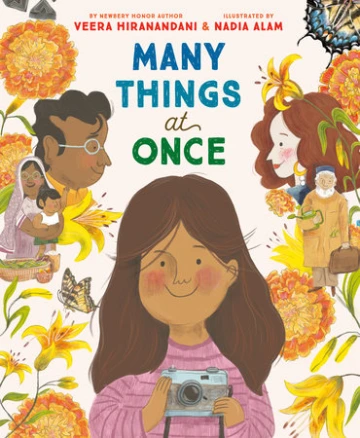
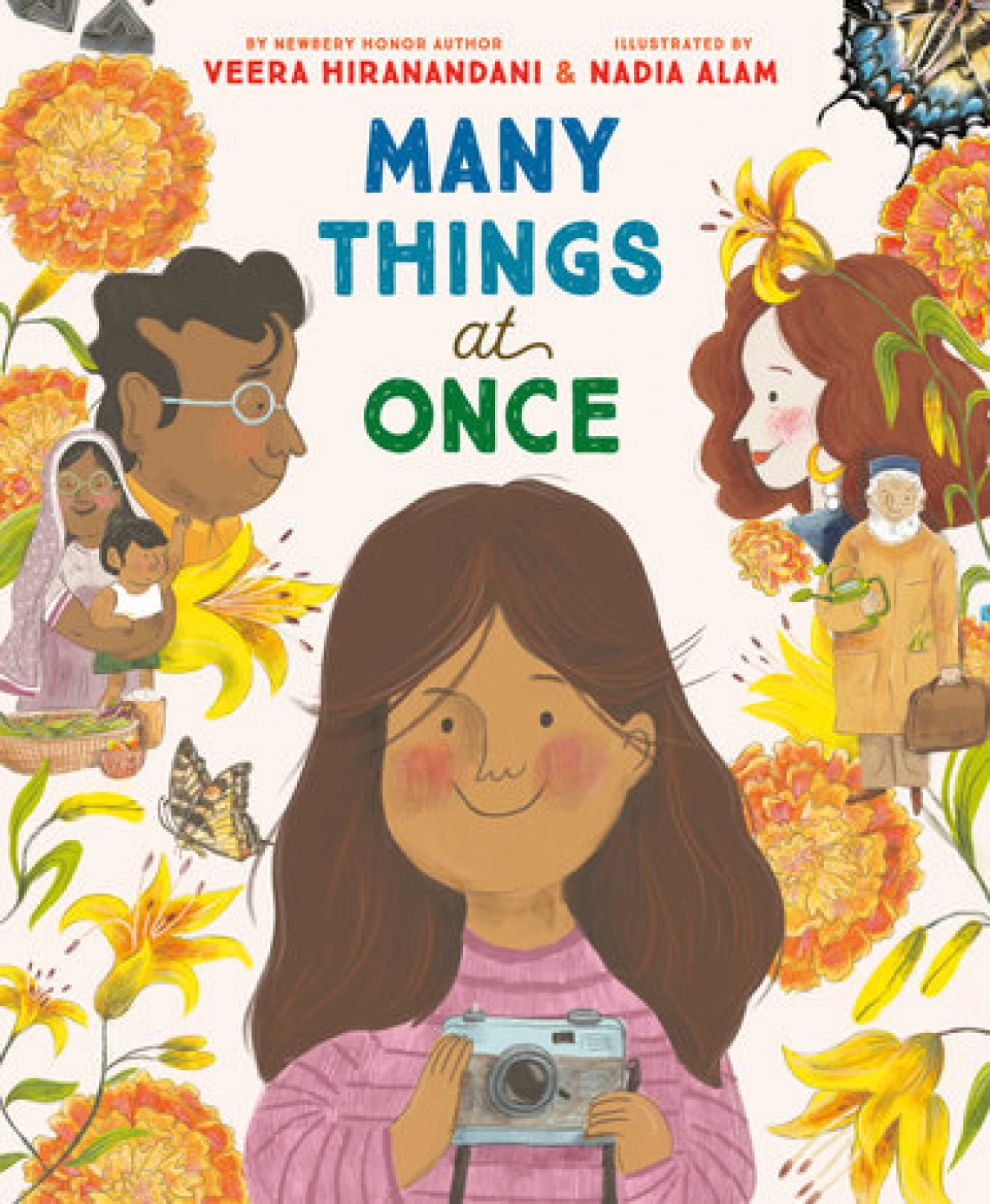
In this third book by Hiranandani she lays bare her own soul through expressing her roots within this picturebook about family and belonging. She expresses that she is the child of a Jewish mother and a South Asian father, who hears stories about her family history from each of her parents. She makes sense of who she is through the sharing of her varied heritages. She sometimes does not feel either Jewish enough nor South Asian enough but comes to realize you can feel and be many things at once.
This book is based on the author's own family history. In this moving story about a young girl from two different backgrounds, the main character's mother tells her stories about her mother, who was a seamstress in Brooklyn, New York. Her maternal Jewish grandmother lived in a small apartment and sewed wedding dresses. Her father tells anecdotes and stories of her paternal grandmother, who liked to cook spicy dal on a coal stove in Pakistan. They both tell stories about how each side came to America and eventually, her parents met in Poughkeepsie. The protagonist's identity sometimes feels as if she's the "only one like me." One day, when she spots a butterfly in her yard, she realizes it's okay to be different, there are no two butterflies alike. It's okay to feel alone sometimes, but also happy and proud. It's okay to feel and be many things at once. After reading this book one comes to understand the first two novels even more as this book lends credence to the authentic lived experiences that the author draws upon to write her two acclaimed novels. Even though this third book directly does not connect to the Partition, it still gives insight into Veera's inspirations in creating Nisha as a protagonist and powerful connections to her father and his family who did live through the Partition.
This book has been thoughtfully illustrated by Nadia Alam who is a second-generation Bangladeshi Canadian illustrator. She does justice to the culturally relevant details of both cultures depicted within the narrative. She is the illustrator of Awake, Asleep by Kyle Lukoff, which received three starred reviews, and The Wishing Machine by Jonathan Hillman, called "beautifully heartbreaking and heartening" in a starred review from Booklist. She lives in Toronto with her family.
The Moon from Dehradun: A Story of Partition by Shirin Shamsi & Tarun Lak (2022)
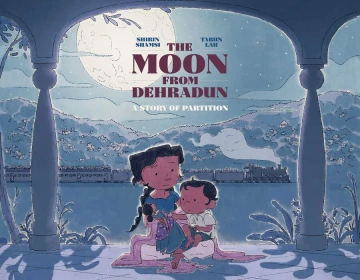
In this beautifully rendered picturebook, Shirin Shamsi creates a believable character named Azra, who exists in the pre and post Partition times in Dehradun, India. She and her beloved doll (Gurya means doll in Urdu) are inseparable as are her sibling and parents. The doll was made for her by her grandmother, and projects the love of the creator. She has grown up with it and loves it. In the doll she finds a friend and a confidant as her mother is busy with her baby brother. As things become hard for a Muslim family in India to survive and their friends and neighbors turn against them, they need to make a break at moment's notice and leave their ancestral home in the middle of a meal. With no time to spare and waste in packing, they race to a waiting vehicle that will take them to the train station.
The written text is through the voice of Azra as the narrator who is trying to make sense of the topsy turvy world she exists in. The brilliant visual imagery by Tarun Lak reinforces the written text within the book. As the country is divided and ripped apart and new flag of India is flying in Dehradun, Muslim families are being targeted and must flee whether they like it or not. Choice is taken away from them as powers beyond the common man decide where to draw the line that cannot be crossed because of the faith they are born into. Azra's family has lived in this region and this house for generations but now they cannot claim it as theirs. The plan to leave has been in the works for some time but as the shouts grow and blood thirsty mobs come to take their lives the family has to leave in a hurry. In their haste they leave behind the coveted doll. Throughout the narrative Azra misses her doll.
After going through the pushing and pulling of crowded railway platforms and trains they finally reach Pakistan and safety. The time lapse is recorded through the visual images of the moon. When they leave India, it is full but when they reach Pakistan the moon is a crescent. They are given a house to live in which is not unlike the one they had in India and as they enter it, they see that the house is in the state that they left theirs in, with a half-eaten meal and strewn objects as the family who left there was also in a frantic hurry to save their lives. It is evident that the house belonged to a Hindu family through the visual images of Hindu deities resting against a wall. Where Azra's mother picked up a rehil and Quran as they hastily leave India, the family who lived in this house, sadly, did not even have time to pick up their sacred religious deities. The Hindu family in India has also been given Azra's home. Azra's family is welcomed by neighbors and friends who come with food to share. In a bedroom Azra finds a cloth doll that some other girl forgot, under the bed. The last couple of images on a double spread have both sad and confused looking girls who find some sense of security and solace in both the coveted and loved dolls. This story, thus, culminates in positivity as it comes full circle for both families combined; half circle for each but joined by shared experiences.
This narrative is inspired by the author's family story and is an expressive and poignant picturebook which is a proof to the force, daring, and resolve of the over 10 million refugees displaced by the largest forced migration in recorded history, and shares a young girl's journey from her old home to a new one. This book was published in time for the 75th anniversary of the Partition of British India. This picture book is a stirring account of the harrowing journey faced by millions of migrants in the aftermath of the division of India and Pakistan. The back matter of the book includes a glossary, background information, an author's note, and a map that clarifies and fills multiple points that maybe confusing for the reader.
Tarun Lak is an Indian American illustrator. He was born in Miami, Florida, and raised in Chennai, India. He attended Ringling College of Art and Design to study computer animation. He has since worked as a character animator on commercials and feature films including Spider Man: Into the Spider-Verse, Soul, and Luca. Tarun currently resides in the San Francisco Bay Area and enjoys drinking coffee and making art in his spare time. The Moon from Dehradun is his first picturebook.
Awards and Accolades
A Bank Street Best Children’s Book of 2023, a Kirkus Reviews Best Picture Book of 2022, a Society of Illustrators Original Art Show Selection.
In the above mentioned, introduction and four books, we come away with thoughts on issues and concerns that schisms and partition create. Here we conclude the first half of this blog. In the next section we will explore the same topic with three additional books, before we conclude with an analysis of the texts and their varied contexts.
References
Bajaj, M. (2021), Teaching about South Asia’s Partition. Medium, www.medium.com/@mibajaj/teaching-about-south-asias-partition-673287eaad98
“Day 41 of ’75 Days of Partition’—Memories and Material Objects of Partition.”1947 Partition Archives.www.utube.com/watch/v=CO9aEStUzg8
Hemnani, R. (2024), Lion of the Sky. HarperCollins
PR From The Heart. (2025, April 14). Children’s Books Spotlight Series Ep. #238: Veera Hiranandani | Many Things At Once. YouTube. https://www.youtube.com/watch?v=T_f-p3Zu8lg