The Partition: 1947, Part 2
Here we continue this journey into the past of a creation of a nation through the lens of various authors. We will look at astounding books by two Muslim and one Hindu author focusing on the same topic but seen though two varied stances.
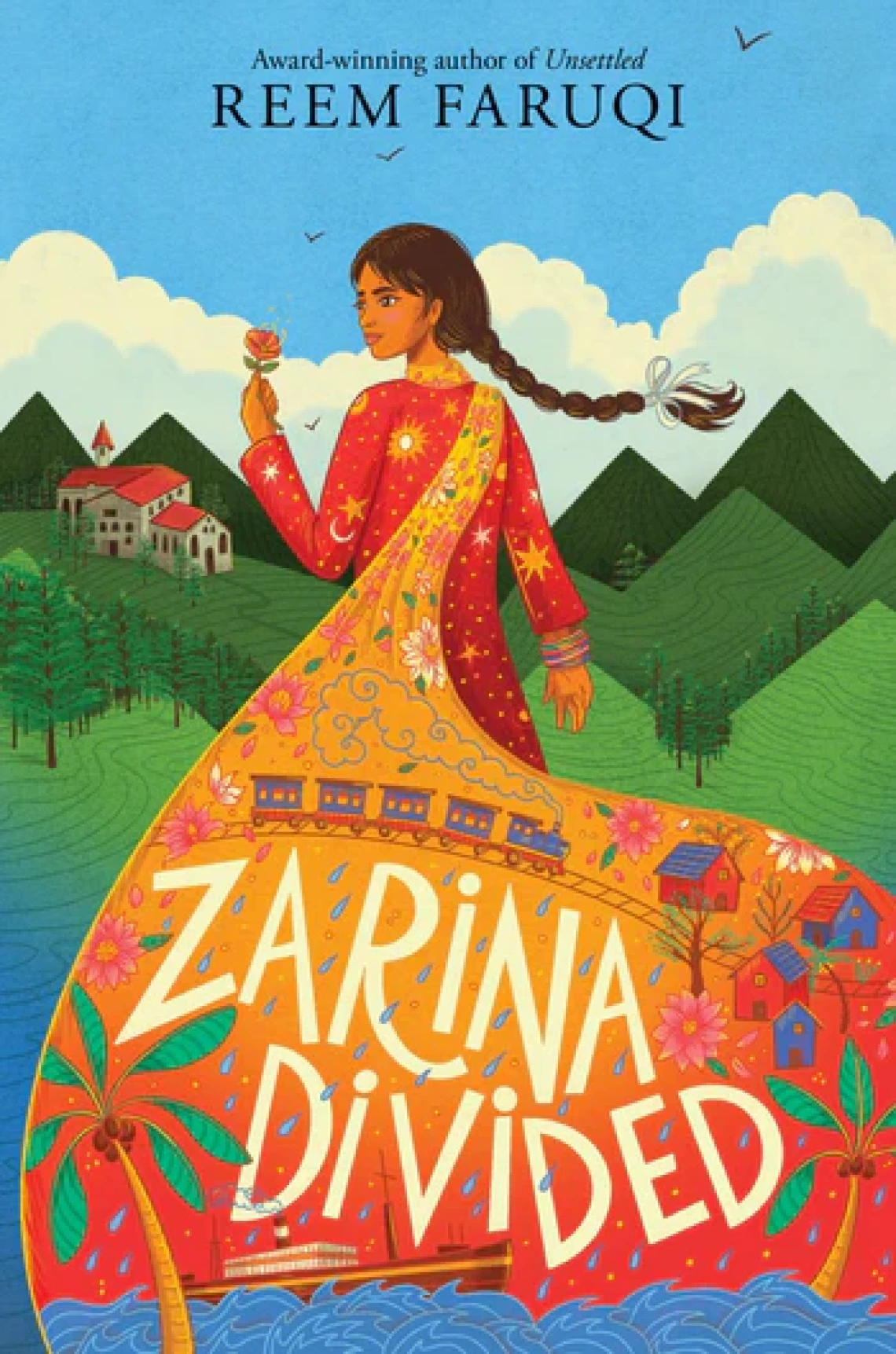
Zarina Divided by Reem Faruqi (2025)
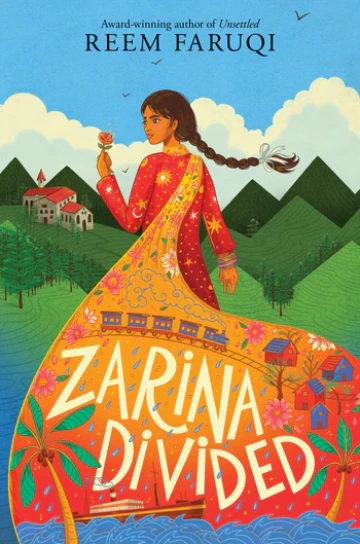
Again, the story of The Partition is revived in this poignant novel-in -verse, where the reader meets the protagonist, Zarina, a young Muslim girl who is eleven and lives in Poona, India and loves the stability of her life. She spends her days blissfully hanging out with her friends, Geeta, a Hindu, and Jahana, a Muslim. She is very attached to her 3 brothers and family and enjoys playing with her siblings. Her father, Abajan, is a politician and a leader who is wedded to the cause of a separate country while her mother, (Mummy) is a stay-at-home mom, who’s pregnant with her fifth child. The mother is struggling with her pregnancy. Zarina is shown as not too aware of the cultural and religious tensions growing around her, until her own friends become estranged, especially Geeta. Her life revolves around school and home and her friends.
The book is divided in four parts that take the reader through Poona, India to Pakistan, Karachi and then Murree and finally back to Karachi. The story is set right before the unrest hits and the peaceful existence of the neighborhood is devastated by the growing sense of unease. As friends turn to foe, Zarina and her Muslim family are given unsettling news: Muslims and Hindus are to separate by religion. Hindus are expected to stay in India, while Muslims are expected to move to a new land, Pakistan. Even though the actions and their reactions are expected and understood by the parents, the children seem to be coming to terms with it and the impact that it's going to have on their lives. Zarina is very attached to her teacher, Mrs. Nizami, and her servant Khushboo and realizes that she needs to move away from these icons that have impacted her growth for her to become almost an adult. Their decision to move to Karachi, Pakistan is because Abajan's family resides there.
Now comes the harrowing journey to Pakistan. First by train and then by ship, the torture of the crush of bodies and people being left behind and or killed is an awakening for Zarina. Her mind is grappling with loss of life as she knew it and then as she views such sharp changes she goes through a traumatic change. When they finally reach Karachi, Pakistan, a port city in the south, their welcome is short lived as they are left to find shelter for themselves. Everything that they have dreamt of in this new country seems topsy-turvy. They find a very small two room apartment with no backyard, where they struggle to adjust. This is very unlike their home in Poona. The siblings love playing blind man’s buff and while they are playing one day, Zarina bumps into her mother, who falls and almost loses her child. Zarina is guilt ridden because of this and cannot meet her mother’s eyes. Zarina is presented as childish even though she has been through the trauma of the Partition.
The siblings struggle in their respective schools in Karachi; they cannot adjust, academically or culturally. Their struggle is evident as their grades slip. So, the father decides to send the boys to Murree, a northern area boy’s boarding school, far from Karachi. When it comes to Zarina she is not permitted to go because Mummy wants her daughter to be with her while she is on bed rest after the fall. Mummy also knows that Zarina will be going through puberty soon and will need emotional and physical support at that point. Zarina, of course, is hell bent on going to an all-girls boarding school in Murree and getting away from the guilt of being the cause of her mother's dilemma. In that day and age when a lone girl child is to go far, they needed a 'petition' to be signed by all or most family members. When Zarina's report card comes everyone but her mother signs. As the majority is in favor, they bypass the signature of the mother. Thus, Zarina, gets to go and start her new life in a boarding school in Murree, where she makes friends, builds relationships, and grows as a young lady who is resilient and strong. Ironically, both the schools that the siblings go to in Murree are run by British educators.
Her journey there starts with a teacher picking her up in Karachi, along with other girls, and then she lands in a different part of Pakistan via a train to reach Murree at the foothills of the Himalayas. Here it is cold, even in summer. She meets girls like Daphne and Mavis who accept her and others like Sidra that do not. Sidra does not believe in befriending the non-Muslims, and says "you need to stick to your kind of people...my brother said 'Never trust the British'. Because of them we are in this mess" (p. 212). This is where Zarina confides in Sidra, and says, "I remember how brown people were always their good little servants, how the British didn't have to lift a finger" (p. 213). But then Zarina defends her new friends, "Daphne and others, they're are not like that" (p. 213). The introduction and dynamics of Sidra as a necessary character was good to read as it's that character that puts into perspective the issues that the people must have faced while they were struggling to get out of the colonial rule of the British, who had divided the country so haphazardly. I believe it is in this tension between class fellows of different backgrounds and mindsets that permits the reader to delve into deeper depths of the issues being faced by people after the Partition took place.
My connections to this story were strong especially as Zarina goes to a Murree boarding school just as I did but here the connections stop, and the tensions begin. While Zarina is treated well in the structured atmosphere of the school that helps her become a strong character under the guidance of the Matron and the other British teachers, there were many others that did not. Students there faced serious problems of oppression, especially for the brown Muslim girls that resided there during or later in the time line of this story. St. Denny's is a school that is still in operation in Murree, even though presently there are native teachers as well. Zarina and her Muslim friends are helped by the faculty to fast during Ramadan and pray accordingly.
Within the confines of this boarding school she finds and reconnects to her beloved schoolteacher from Poona, Mrs. Nizami, and then their house help Khushboo and her friend Jahana. Zarina comes to fight for and find her identity as she goes through her first year in this school. When finally Zarina goes back to Karachi at the end of the school year, she finds she has a little sister, her mother is fine and has forgiven her for defying her orders, and her father has found them a better house with a small backyard and a pond. The concerns of this family who were wronged by the British government are brought to the fore very well by the author in this fast moving, readable and relatable book.
Author of the award-winning novel Unsettled, Reem Faruqi presents her first historical fiction novel, inspired by her grandmother's life, that explores displacement, identity and resilience. She draws on her writing ability to weave fiction with non-fiction for bringing this historical event to life. The back matter of the book explains her family connections and background through pictures and texts. She has an author's note and a glossary of words. She has pictures that show the school that her grandmother went to and the iconic Miss White, the Principal. She is also the author of the ALANotable picturebooks Lailah's Lunchbox and Amira's Picture Day as well as the acclaimed Milloo's Mind and I Can Help. She is of Pakistani descent and immigrated to Peachtree City, Georgia, in the United States from the United Arab Emirates as a teenager. Reem is also a teacher and photographer who loves to doodle. She lives in Atlanta with her husband and four daughters. Visit her online at reemfaruqi.com.
Awards
A 2025 South Asian Kidlit Ash Rose Michael Readers' Choice Honors list pick, The Center for the Study of Multicultural Children's Literature Best Books of 2025 list pick, A Gienapp Best Anti Bias Middle Grade Books of 2025 list pick!
Lion of the Sky by Ritu Hemnani (2024)
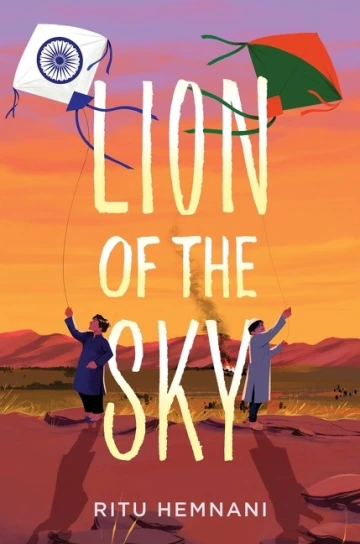
This book is an in-depth look at the pre, during and post partition times in the province of Sindh. While other provinces such as Punjab were divided between India and Pakistan during partition, Sindh was a region that was given fully to the Muslim Pakistan due to the Muslim majority living there. The story revolves around the friendship of Raj, a Hindu, and Iqbal, a Muslim, and comes to the reader through the personal perspective and narration of Raj. Both boys are 12 years old and the hobby that draws them together is kite flying (patang bazi is a craze in the regions of India and Pakistan to this day). This is a novel in verse that explores the confusion of these boys that are close even though they are not similar in the socio-economic and religious sense. The only thing that physically distinguishes them and their people are their caps (topi). Iqbal wears a white Muslim one and Raj wears the Sindhi multicolored one. This book is divided in eight sections and each section leads the reader through the spellbinding tale.
The boys cannot come to terms with or understand why and how religion is what the British powers are going to use to destroy their long-standing harmony. Raj is most satisfied and happiest flying kites and strives to be the lion of the sky on the day of independence. His father and family are among the affluent Hindus of the region who own and hold much of the land there and run a tailoring business. He lives with his parents; baba and Amma, older brother Vijay and younger sister Maya. He struggles with school, especially math. His character seems more interested in the kitchen and cooking than studies. He also wants acceptance and admiration from his father as the narration unfolds. Iqbal on the other hand belongs to a family that depends on selling their only cow's milk and lives in a small hut. He lives with his parents. His hooligan cousin, Tamir is mentioned many times in the narration. Ironically, when British powers draw the Ratcliff line across a map, splitting India in two, it is Raj and his family that are thrust into a fractured world. Their grandfather (Nana) refuses to go with them as he feels responsible for staying back and cremating the bodies of the Hindus that were dying there.
There is explicit depiction of the unrest and resulting reactions within the narrative. This lends to the reality of the events at that point in history. Vijay and his gang are gathering and ready to fight with swords and steel for keeping the religions and cultures together. As the kites are to fly on the day of independence, Raj is caught between going and meeting Iqbal to reassure him of his defense and support. Yet he is caught in the crossfire of his brother and his gang and the Tamir and the Muslims' gang who are out and ready to fight the Hindus with cricket bats. It ends with a bloody fight where Vijay's girlfriend Bhavna is hit on the head. Both sides realize that things are getting serious and they decide to have persons from their faiths out guarding the streets.
The person guarding Raj’s Street, is killed and as a result, Iqbal’s hut is burnt down and his beloved cow wounded to the point that she must be put down by Iqbal’s father. Iqbal witnesses the events and sees Raj while all this is going on and observes that Raj does not come out to defend him or his family. They also go to raise their voices in front of the British authorities in their section of Sindh but to no avail. The falling out between the two friends is resolved right before Raj's family leaves the region. Iqbal gives his cap to Raj for his security. Inevitably, devastatingly, it is Raj's family that is forced to flee and become refugees even though they thought that it would be the Muslims who would be pushed to move. With Partition declared, Hindu, Sikh and Muslim communties are torn apart, with Raj’s Hindu and Iqbal’s Muslim families are among them. Raj's family take the harrowing journey which is described in detail and end up in Bombay, India. The only responsibility given to Raj throughout the journey is to take care of his little sister but in the confused hurry Maya is lost and is, sadly, never found till the end of the book. Baba says, "why does HE need to eat...all you had to do was WATCH HER!" (p. 218). The family refuses to leave the train station thinking that Maya may come looking for them and keep going out and looking for her. They had moved to Bombay (Mumbai) due to the father's brother being there and inevitably move in with them.
Their life in Bombay is full of chaos as they struggle to adjust in the uncle's small home and his family, comprising of a wife and two daughters. Baba and Vijay go out to find work as tailors and have no luck as people do not want new clothes and seem to be financially struggling as well. Meanwhile in a role reversal, Amma begins to make and sell food and is quite successful in that. Raj helps Amma in the kitchen and goes to school. Amma's success is not acceptable for Baba as he has always been the bread winner for the family. Raj stands up to Baba and defends his mother. Even though he has success in school and home fronts, there seems nowhere to fly kites and there is nothing that is remotely like Sindh here and Maya's absence weighs heavy on him. At school Raj has to face a school bully named Nirmal, who believes that everyone who left their lands and came to India were deserters. He physically uses and abuses them. Vijay on the other hand disappears every night and comes back haggard. One night Raj follows him and finds out that he is ready to give all of Amma's hard earned cash to shady characters who tell him that they know where Maya is. As things get heated between them Raj intervenes by throwing coconuts at them which scares them off. Raj is thus taking on leadership roles in every aspect of his family's life and his decisions are respected and accepted by his father and uncle as well.
Tamir and Nirmal as characters show a different side to the story just like Sidra did in the previous book. Tamir is the necessary antagonist compared to Iqbal and is shown as a different kind of Muslim. Nirmal is a character who sees every refugee as a negative person because they are cowards who left rather than staying and fighting, and in his own way tries to make them pay until Raj stands up to him.
This book is by far the most gripping one in this whole textset, in my opinion, where each character shows deep growth and dynamism. It flows very well while taking the cultural details of each geographic region that are described within the narrative. This story is inspired by the author's family history. Lion of the Sky is a deeply moving coming-of-age tale about identity, belonging and the power of hope. Ritu Hemnani is a journalist, teacher, voice actor and motivational speaker. She identifies as ethnically Indian and a British national and calls Hong Kong her home, where she lives with her husband and three children. Lion of the Sky is Ritu's debut middle grade novel. You can find her online at rituhemnani.com. The back matter of the book has detailed notes and pictures, a glossary of terms and a detailed research direction for this time-period. It would be very surprising if this book does not receive multiple awards.
The Partition Project by Sadiaa Faruqi (2024)
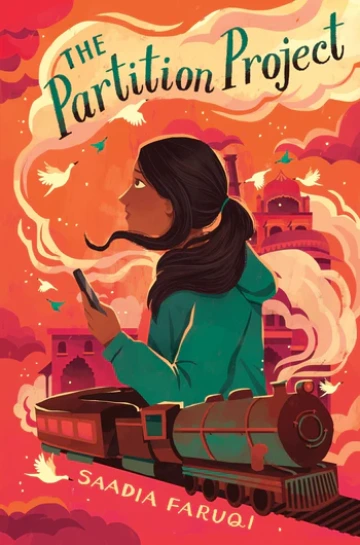
This book is different in the fact that it begins in the contemporary day and age and moves backwards as the narrative progresses. Mahnoor is a Pakistani American 12-year-old girl living in Houston, Texas. She is born and raised in USA and considers herself American. Her parents are from Pakistan; father is a physician and mom is a nutritionist in the same hospital. Her sole sibling is her older brother Talha. The Raheems are a typical family with working parents and children that go to school. The siblings have never traveled to Pakistan and have not been exposed to the country or its cultures.
The story begins with their grandma's (Raffia/Dadi) arrival in their safe cocoon of a home where they have a rhythm that is fulfilling and complete. With the arrival of the grandma everything is thrown out of whack. Mahnoor's room is now occupied by the grandmother, and she has been moved into the small attic space. It is a change that is completely unacceptable for Mahnoor but she goes along with the adjustment and accepts the changes that come with a new person in the expanded family and home. It is mentioned here that her grandma adopted their father and now that she is aging their father decides to move his mother to live with them for good. Dadi has been a long-time educator of math and is a fluent English speaker. As the days go by Dadi starts to adjust in her new life and begins to cook and talk to her grandkids. Mahnoor is really taken by her grandmother and sees herself reflected in the older lady. As Dadi begins to reflect into her experiences of the Partiton, Maha (Mahnoor) learns more about her heritage and background. Mahnoor is then designated to be her grandmother's sitter. Maha takes her to the senior center at her father's hospital, where she meets different people from India, Pakistan and Bangladesh, whose lives, she finds out later, have also been impacted by the Partition.
Mahnoor is good in studies and is active and accepted by her classmates and faculty. Her best friends are Kim and also a boy named Ahmad, who has recently moved to the USA with his family and is admitted in her class. The trio keep each other grounded as they work on and unravel their various class projects. When her elective media class is offered, she jumps at the opportunity to learn how media is projected in journalism as she wants to be journalist when she grows up. The class project this year brings together her passion in journalism and as she struggles to research what topic she needs to choose to make a documentary on, she starts to ask questions about her Dadi's past and in doing the research into her own history. The grandmother, Rafi's, conversations with Maha (Mahnoor) get deeper as they start talking about the Partition of India and Pakistan, an event that played a huge part in her grandma's life. There is a strong bond that the two form, as Maha helps Dadi tell her story and it is remarkable to see it unfold.
Dadi’s character and the reason it became so cut and dried makes sense as she talks about reaching Pakistan, living in the Walton refugee camp in Lahore where she loses both her brothers and her grandparents to cholera. After this period of loss, she also loses the sense of wonder and happiness as she and her best friend Rasheeda fall apart as friends and lose contact. Rasheeda and her family had traveled with her to Pakistan and then stayed in the refugee camp with her family. The conversation begins with Dadi's childhood in Ludhiana, northern India, and about the Partition that forced her to leave her home and relocate to the newly created Pakistan. As details of Dadi's life are revealed, Dadi's personal story feels a lot more like the breaking news that Maha loves so much, and she can see the connection between journalism, documentaries and newsworthy stories and above all how and why it matters to the present. During and after the process of documenting the details Maha ends up knowing much more about herself, her history and her connection to a culture she was not aware of before. Her passionate focus on the subject brings together the whole community and its impact is felt domestically and globally as her documentary is uploaded to YouTube and gains several views that is much greater than her course members.
The story masterfully brings together Maha's present-day family and school life, friends and above all her determination to find out about her own history through her Dadi's stories. This is not a novel in verse but flows beautifully as the family members discover each other's strengths and weaknesses. Being open to learning is a great way to move away from prejudices, biases and preexisting notions about people we do not know about. History and heritage do play a huge part in one's life, as Maha discovers.
Saadia Faruqi is a Pakistani American writer and interfaith activist. She is widely published in the arena of children and YA books. Her recent 2026 novels: Some of Us Are Brave, and Ms. Marvel: Remnants of the Past are getting rave reviews. She is the author of the Eisner-nominated graphic novel Saving Sunshine, the popular early-reader series Yasmin, and Marya Khan, and other middle grade novels such as The Strongest Heart, A Thousand Questions, Yusuf Azeem Is Not a Hero, and of course, The Partition Project and is the coauthor of the middle grade novel A Place at the Table as well as The Wonders We Seek: Thirty Incredible Muslims Who Helped Shape the World. She has done an incredible job of using her roots and her culture to lend a certain authenticity to the content she explores in her storytelling and writing. She was profiled in O magazine as a woman making a difference in her community and serves as editor in chief of Blue Minaret, a magazine for Muslim art, poetry, and prose. She resides in Houston, Texas, with her family.
CONCLUSION
As I went through the process of taking an in-depth look at this topic, I came ended with many new take aways and a myriad of insights hither-to unknown to me. The stories from both sides reinforced my knowledge of the event that has come down to me through personal stories of my own parents and extended family and friends. My family did not move to another region but stayed where they were, in that they were lucky, but they did witness many of the events and horrendous things within the content of the books I read and explored for this blog. Needless to say, it was an event that not many remember in the present day and age, even though it impacted millions of lives, many of who are still living. Storytelling is pivotal in the process of giving relevance to this and other global events. We are observing a push towards rejecting refugees and other immigrants, domestically and somewhat globally. Generally, people do not want to leave their homes and livelihoods without strong reasons as is evident in the above-mentioned books. Uprooting lives is very serious and not an easy process. It makes one wonder if that was the case in this event. How would people have moved and adjusted in their new regions and homes without acceptance and hope? This historical event is easily available to be researched on the internet with authentic resources and sources.
Why and how does this impact those of us who have no connection to the cultures being represented within these books, is the main question. This question is somewhat explored in the final book of the blog. Past does impact the present in more ways than one. History does repeat itself again and again. Schisms and partitions have happened globally and are still going on. Colonial powers such as Britain have been the oppressors and creators of these events and one can say playing God has been part of the plan of these powers. Global borders of regions have been moved around to fit into the narrative that is accepted and convenient. The manner in which it impacts life of the ordinary humans has never been a consideration. Impact of these actions has been and is far reaching where animosity is not only created but inflamed just for personal gain, deliberately neglecting the pain of the 'others.' In 1948, only a year after this event of mass migration took place, another country was created, that of Israel, again by the British colonial powers.
References
Bajaj, M. (2021), Teaching about South Asia’s Partition. Medium, www.medium.com/@mibajaj/teaching-about-south-asias-partition-673287eaad…
"Day 41 of '75 Days of Partition'—Memories and Material ObjectsofPartition."1947PartitionArchives.www.utube.com/watch/v=CO9aEStUzg8
PR From The Heart. (2025, April 14). Children’s Books Spotlight Series Ep. #238: Veera Hiranandani | Many Things At Once. YouTube. https://www.youtube.com/watch?v=T_f-p3Zu8lg