WOW Recommends: Little Shoes
The color orange has an interesting history in fashion and décor. Bright and vibrant, it has never quite claimed the status of a staple color that transcends decades. Yet its meaning changed profoundly when it became associated with the Every Child Matters movement. On September 30, the National Day of Remembrance of U.S. Indian Boarding Schools, we wear orange to honor and remember the Indigenous children who were forcibly taken from their families and sent to residential boarding schools. What was once simply a bold and vibrant color has become a powerful symbol of remembrance, resilience and the enduring importance of honoring the children who never came home.
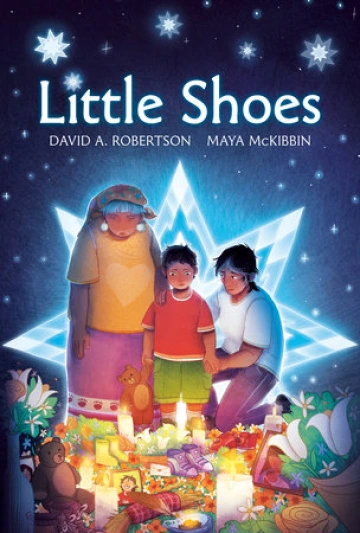
Little Shoes, written by David A. Robertson and illustrated by Maya McKibbin, introduces young readers to the trauma Indigenous people and communities have endured as a result of the residential school system. Robertson wrote the book in response to a question his child asked after visiting a memorial for children who attended residential schools: "Who cuddled the kids at night when they were at residential school?" This question serves as the emotional premise for a story about a young boy named James, who seeks comfort from his mother when he struggles to fall asleep at night.
One day, James takes a walk with his kōkum (grandmother) and finds himself surrounded by a sea of orange at an Every Child Matters march. At the end of the march, James encounters a memorial featuring shoes placed there to honor the children who "had gone to residential school but had not come home." His kōkum tells him that she once attended a residential school, as did her sister, but that her sister did not survive her time there. That night, James struggles to sleep as he thinks about the horrors the children endured. He finds comfort in his mother's arms and eventually falls asleep thinking about the children who may not have had their parents with them, but who may have had one another on the nights when they, too, needed comfort.
What I find most striking about this book is how Robertson and McKibbin have created a work of literature that speaks to the generations who came after the residential school system while continuing to honor the children and families who experienced it firsthand. James represents a generation that did not experience residential schools firsthand but continues to live with their consequences. The questions that keep James awake at night are a reminder of how beliefs, cultures and stories can be threatened or erased through cultural assimilation. Through James, Robertson illustrates how the effects of residential schools extend beyond the children who experienced them directly and continue to shape subsequent generations.
McKibbin further emphasizes this generational trauma through the use of deep blues, glowing white celestial imagery, the bright orange of the Every Child Matters march and dark blacks and purples that evoke the terror experienced by many Indigenous children. Within these illustrations are subtle representations of Native culture existing within a predominantly white American world. As James lies awake in his bedroom, readers see a modern room filled with objects that might appeal to a young boy: dinosaurs, an ATV poster, a Magic 8 Ball and a replica of the solar system. Yet throughout the book, the glowing white moon weaves in and out of the illustrations, serving as a visual reminder of the cultural knowledge and identity James is trying to understand and reclaim.
Through James's questions, his kōkum's memories and the memorial of shoes, we begin to understand that history is not simply something found in a textbook; it is something carried through families, communities, stories and traditions. The orange of the Every Child Matters march therefore becomes more than a striking color in McKibben's illustrations. It represents remembrance and a collective refusal to allow the children who never came home to be forgotten. By ending with James receiving comfort from his mother, Robertson also reminds readers of what was taken from Indigenous children when they were separated from their families. In effect, Little Shoes ultimately demonstrates how stories can help younger generations confront painful histories while creating space for remembrance, understanding and healing. Little Shoes is the perfect read for September 30th National Day of Remembrance as we honor those who were lost and those who survived Indian Boarding Schools.
David A. Robertson (Norway House Cree Nation) is an author, educator, and public speaker. He has written numerous books for young readers, including When We Were Alone (2016) and On the Trapline (2021), both of which received the Governor General's Award. Maya McKibbin (Ojibwe, Yoeme and Irish) is a Two-Spirit animator and illustrator whose works include Swift Fox All Along (2020) and The Song That Called Them Home (2023).--Recommended by Deonna Tourtellot, Red Rock Elementary School
Title: Little Shoes
Author: David A. Robertson
Illustrator: Maya McKibbin
ISBN: 9781774881729
PubDate: July 29, 2025
Publisher: Tundra Books
Each month a committee of Worlds of Words advisors recommends a book published within the last year. Our hope is to spark conversations on our website and on social media about the book that expand global understandings and perceptions. Please join us by leaving a comment. You can also share your thoughts with us by using the hashtag #WOWRecommends on social media.