Authors' Corner: Daniel Nayeri

Reading Daniel Nayeri’s books and speaking to the person require two different skill sets. A prolific and award-winning author with four books out in 2025 and another four forthcoming (plus a backlist of award-winning and often interactive books), Nayeri was just announced as a juror for the Neustadt prize. He's go, go, go. But to read one of his books is to experience language flowing into structure as a languid house cat pours into any vessel of their choice, occupying every weirdo angle. The one-time chef would likely prefer a foodie comparison.
The Authors' Corner interview begins with polite chatter around his packed promotion schedule. "Anyway, let's not start by talking about all the things I suck at. We'd be here too long," Nayeri jokes.
So, let's not.
The Profession of Teaching
“Babak is a teacher. His father gave it to him, a good mission in wartime” — The Teacher of Nomad Land (p. 162).
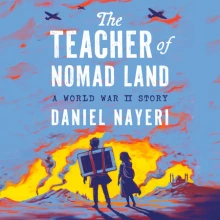
The National Book Foundation awarded Nayeri the National Book Award in young people’s literature for The Teacher of Nomad Land: A World War II Story (2025). The story follows newly-orphaned Babak and his sister as they seek a future together in Iran. Their country is occupied by British and Soviet forces while Nazi spies roam the streets and countryside. Babak hopes to prove useful to a nomadic group as a teacher.
Babak finds himself in a state of ambivalence that many young people experience and which could shut them down. The search for purpose, especially during times of hardship, is relatable. Babak often wonders what the value of teaching is to a nomadic tribe in an occupied and uncertain country.
Nayeri references The Journeyman (1990), a middle grade work of historical fiction by Elizabeth Yates. The book takes place in New Hampshire after the Revolutionary War and follows Jared, a traveling painter offering his services to struggling farmers. Like Babak, Jared has to pitch a skill set that doesn't immediately or obviously fill hungry bellies or meet other basic needs.
"Yates does such a good job of describing when the lady of the house walks into this room, and she's just about to weep [over the skilled craftwork]. We need that beauty. That's something that you should give money to. The same applies in education," says Nayeri. "It feels as if our culture is renegotiating what we value in the arts and in education. How does a teacher constantly bring value for their students -- an education, a broad education, a well-rounded education -- when it seems less important to their detractors?"
As beauty and education are necessary in times of hardship, Nayeri writes stories trying to make a case. He sees himself as the fortunate student of many teachers and coaches for whom education is a calling. In his middle-grade memoir, Everything Sad Is Untrue (2020), he uses an amalgam of teachers to create the character of Mrs. Miller.
"It was very much supposed to be a love letter to teaching. I had so many teachers who I look back on now and think, what gracious human beings these people were," he says. "You know, these people pour a lot into you."
The Gimmick
“It's rare to find a book this clever that is also emotionally powerful” -- Matt de la Peña on Drawn Onward (2024).
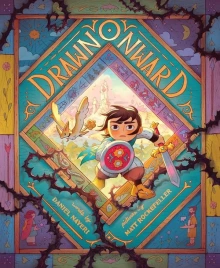
Rather than match material to the mechanism, Nayeri smooths language to fit rules of structure in service of the story. In the case of Drawn Onward, the poetic structure of a palindrome is a gimmick that serves a story of grief.
Nayeri says, "I love the word gimmick, because in the magic world, a gimmick is any device that helps the magician pull off the illusion. I'm often thinking in terms of the mechanism of the story. There is the material of the story, and then there's a mechanism by which it's delivered."
A self-described puzzle nerd, Nayeri came up studying formal poetry and wondering about the purpose of different forms. Repetition and rhythm of certain forms may help row a boat or reap a harvest. "I find this stuff fascinating," he says, "because it comes down to the utility, the usefulness of poetry. Can a poem's structure get us into a particular narrative better than if we just told it to you straight?"
Of course, many good books are written in this way, but in the case of Drawn Onward, the back and forth of a palindrome simulates how people experience grief. Like the character in the book, people face the complex stages of grief, including denial and anger. The character feels destabilized and anxious and then he gets to the bottom where he remembers his mother. He starts to work his way out and registers his emotions. "And we want a hopeful ending for a young reader," Nayeri says.
Drawn Inward (forthcoming Fall 2026), follows a boy in the midst of a panic attack and is written as a pantoum with mirrored illustrations. The boy is in his home on a rainy night and feels lost. Emotion takes over and everyday objects begin to loom ominously. The father enters at a low point, holds the boy and helps him deal with his anxiousness by exploring the five senses.
"I wish I could work with that artist forever. He's brilliant," Nayeri says of Matt Rockefeller.
Infinite Stories
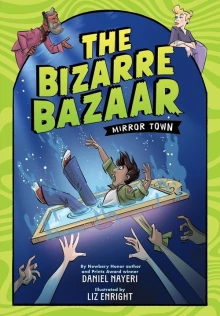
"I always wanted to know more about the Crypt Keeper” — Daniel Nayeri.
The Bizarre Bazaar (Biz Baz) graphic series sprung from Nayeri’s love of pulp and is all things young readers like. The books are fantastical and fast-paced, have meaningful relationships, not necessarily good ones but powerful ones, and some magic sprinkled in. There's also a story within a story as Babs and Bruno, the series "hosts," are recurring characters whose histories reveal themselves over the course of multiple books.
As a child, Nayeri loved anthology shows -- everything from Twilight Zone to Tales from the Crypt to Goosebumps. Although he liked that every episode in a series was completely different, he wondered why the host was not part of the story. Babs and Bruno step into each Biz Baz story.
By putting together an anthology series where, slowly, the reader gets the story of the hosts and realizes that the hosts are the bigger narrative, Nayeri gives himself creative options. "I can push forward as much story or as little as I want in each frame. The story, ostensibly, is that week's episode of some contemporary kid in some kind of supernatural peril. That's the fun of it. I don't have to always push forward the story of Babs and Bruno," who, by the way, are the two worst criminals in all the Seven Kingdoms and imprisoned in the Bizarre Bazaar. "I can dribble out, little by little, enough of their story to be satisfying but not too much to take over. And the rest of the stories are episodic, high-concept fantasies."
Conscious of his young readers, Nayeri created these hosts as characters to follow so younger readers can be more open to a story ending with twists and turns that usually are off the table in horror or thrillers. In this way, he manages the center of the reader's emotion. His contemporary characters can also feel like a reflection of the reader or less relatable.
Biz Bas has four books so far (published and forthcoming). Each is set in a different U.S. state, is illustrated by a different artist and presents a different character personality. Readers may root for some of the characters and want a difficult character arc for others. For example, in the fourth book, we meet an A+ student who thinks she's a failure. She is likable and readers feel empathy for her when negativity is directed her way. On the other hand, the third book features a character who, as the book opens, refuses to pass a soccer ball, "which is one of the more obnoxious behaviors you can do. You don't want to see him win," says Nayeri.
Readers shouldn't be caught up in the Biz Baz previews at the end of each book. They are parodies of books that will never come to be. Nayeri leaves readers with something joyful in these fake previews.
Reader Relationships
"I'm not going to have ketchup on the table, but there will be an acidic sauce for your hamburger. I promise" – Daniel Nayeri.
Nayeri, a former chef, often thinks of the arts from a food service perspective. Readers have a menu, but he sets it. Readers can select what they like from the menu, but he wants to push their palate. It's a trusting relationship. For his part, he offers a little surprise for those who stick around.
When a 6th grader asked him what kind of humor he likes best, his answer is the long, delayed joke. He describes the beauty of a novel as the length of anticipation with a punchline that can land with hilarity or melancholy. He related to her that process is akin to inside jokes, which are never funny to anyone else because they're formed through relationships.
"A great novel builds those kinds of relational connections with the reader, so that by the time you're at places like the climax, they deliver a relational kind of humor that is perfect," Nayeri says. "She totally got it, because, thank goodness, she was a 6th grader who has friends. She's done that. You come back from a sleepover, and you have 15 of those ready to go. I'm about as far as you can get from a 6th grader, but she was right there with me. As a writer, I felt like we connected."
This connection between author and reader goes two ways. Nayeri recalls sitting in a collegiate lecture hall with students prepared to ask studied literary questions. After the introduction when it was time to ask those questions, he instead heard crickets. No one raised their hand to ask the first question. Finally, he hears from the back, "so did you ever learn how to use a toilet?" -- a callback from his memoir.
A Hero's Journey
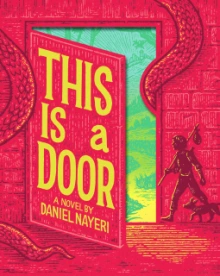
Nayeri's next book, This Is a Door (2026), presents as an illustrated novel with no pictures. Like his other books, this one has a meaningful story told through a specified structure. Influenced by concrete poetry and carmen figuratum, he began to play with text and wondered if he could create a whole novel from a sketch he made of a door using text. He determined a trim size for the codex and began creating rules for how the text could behave. His first rule seems to be to play faithfully(ish) to traditional typesetting parameters, so that text couldn’t be digitally distended.
"It needs to be words as words themselves," he says. "Smelly is so smelly that other words spread away from it." Other rules include a monochromatic palette and unchanging typeface (size can change, font cannot).
The story itself takes readers through the 12 segments of the hero's journey. It opens in the ordinary world with our hero, Nothing. Nothing wakes up on the floor. He sits up. The floor is cold. He is alone. But high up in the rafters of the stables is a little mouse who had whimpered all night. The backmatter includes an author note and a description of the hero's journey with a pictorial representation. Nayeri talks about both the product and the process in a video made for Sourcebooks.
Young readers will enjoy both the story and how the story is told in This Is a Door. They may also have fun showing off the thick tome they are reading. Teachers may appreciate the many ways to engage students in the poetic structure and story theme. Nayeri hopes to catch readers at the precipice of a journey – maybe a school transition. He says these are times when young people ask themselves, "what am I going to be like or what is my purpose?" Nayeri wants to meet them there, so he can take them on a journey where Nothing asks the same questions.
Authors' Corner is a periodic profile feature in which authors discuss their writing process and the importance of school visits. Worlds of Words frequently hosts these authors for events in the collection. To find out when we are hosting an author, check out our events page. Journey through Worlds of Words during our open reading hours: Monday-Friday, 9 a.m. to 5 p.m. and Saturday, 9 a.m. to 1 p.m.