

Living Between Two Cultures: A Digital Literature Discussion of Return to Sender by Julia Alvarez, Part 5
Stories, novels, are the truth according to character… you are not talking about the truth universally, you are talking about the particular individual embodiment of different truths. -- Julia Alvarez (2009, Radio interview KUER)
Whether multicultural literature is alien or exotic is not inherent in itself, but rather lies in the perception of the reader. From the perspective of marginalized ethnic groups this new category of literature is not alien or exotic at all. Instead, it represents their world, reflecting their images and voices. When it is incorporated into the curriculum, children from these groups find characters with whom to identify in the books they read in school. (Cai, 2002, p. 11)
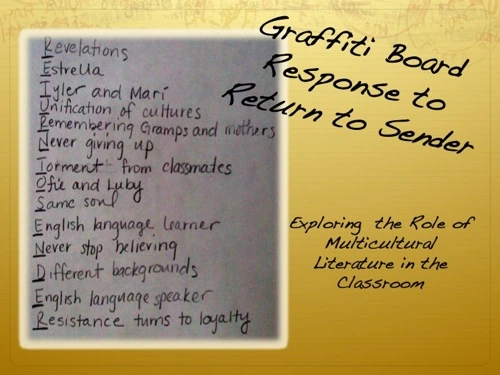
In the last decade, much has been written about the multiple and contested meanings of multicultural literature. In particular, scholars focusing on this issue caution that different definitions of what constitutes multicultural education may impact the ways in which this type of literature is used in the classroom. Making a distinction between a pedagogical and a literary definition of multicultural literature, Cai (2002) writes that, “the pedagogical definition of multicultural literature is predicated on the goal that this category of literature is supposed to achieve: Creating a multicultural curriculum and implementing multicultural education” (p. 4). In this respect, multicultural literature has the potential to help expand the curriculum and bring a pluralistic perspective, one that is inclusive and democratic versus exclusive and hegemonic. From the discussions and responses that we have seen on this month’s WOW Currents, we know that our undergraduate and graduate students from Texas and New York have engaged in a critical discussion of their reading of Return to Sender. Some of those responses, as reflected by one student’s use of an acrostic poem in her Graffiti Board response, are uniquely personal; they reveal the how critical multicultural literature, such as Return to Sender, may help craft spaces for critical conversations in the classroom.
For this final week of our digital literature discussion, we focus on the use of multicultural literature in the classroom. Particularly, we are interested in discussing how this reading experience may help inform your decisions as educators when it comes to selecting literature for your students in your classroom. How does your role as a reader of critical multicultural literature inform your role as an educator? How does your reading of Return to Sender help you understand the pedagogical possibilities of multicultural literature in your curriculum? Does critical multicultural literature such as this novel have a role in the classroom?
Reference: Cai, M. (2002). Multicultural literature for children and young adults: Reflections on critical issues. Westport, Connecticut: Greenwood Press.
Journey through Worlds of Words during our open reading hours: Monday-Friday, 9 a.m. to 5 p.m. and Saturday, 9 a.m. to 1 p.m.
In response to Yehimi Saquiche’s comment, I agree with the fact that not only Mexicans are the only ones that are being decriminalized. We as Latinos must be aware of our surroundings and what’s happening around the world. It’s our job as educators to make sure that our students understand the importance of multicultural literature. It’s our job to make them understand that it’s not only about their own world they live in but there is more out there (a bigger world). We should expand their minds to explore and investigate what’s out there. It’s important that our children learn about the different cultures in the world. I agree with Yehimi that if we start teaching our children early, we can change the way most students think about other cultures. Students will learn not be prejudice and to respect others. Of course, it would make a major difference in our society. It’s a change that will benefit many.
The importance of reading multicultural literature in a classroom is to teach about other cultures. Students gain knowledge about other cultures and become more open mind. This book, Return to Sender is such a great book. By reading this book many will understand why immigrant families come to this country. Hard working families come to this country to work and give a better life to their children, the life that they can’t offer (their children) in their native country. It’s hard to live in this country when you know that you are not legally and any minute you can be deported. Living with that fear is not life. I hope that whoever reads this book gets to think differently about immigrants . I hope it opens their mind and heart.
Comment 40 In response to Stephanie Ruiz’s comment: I believe many parents, grandparents and teachers want our children to have the opportunity to learn and appreciate other cultures. We should never deny the opportunity of learning of multicultural literature. They will miss out on so much and the more our children learn the better it will be for them. They will have a different view of the world. They will become better human beings and that’s our goal as parents, grandparents, teachers and citizens. As educators our major goal is to make a difference in a child’s life. When we accomplish this, then we know we have done a great job. Our children are the future, so let’s mold good citizens.
I remember my first year teaching. I was having a really hard time getting my mostly "latino" population to get involved in the literature that I was given to teach by. Yes... I said "given". These kids did not care about Bridge to Terabithia or Gary Paulsen's Hatchet or any of the "white kids" that were having "issues". I did a little research on Paulsen (the author whom we were required to teach) and learned that he had written a book called The Crossing. It is about an orphan boy living on the border of Mexico and the U.S. and his story of trying to find money and a way to cross the border for a better way of life. They ate it up. It was that connection to Mexico, the spanish words that were used, and things that they felt defined them (the food, customs, etc that were mentioned). I was so intrigued by their reaction that I made sure my next author study was Sandra Cisneros's The House on Mango Street. I cannot tell you how much more involved they became when they felt a personal connection to the text. It was wonderful and I am looking forward to continuing this trend.
How does your reading of Return to Sender help you understand the pedagogical possibilities of multicultural literature in your curriculum?
As a future ELL educator, perhaps even a bilingual educator, I feel that multicultural literature will not be optional in my classroom, it will be the norm. It is essential that my students learn to appreciate multiculturalism in all its facets; books, movies, points of view, food, customs. I don't know exactly when or how I can use multicultural books in my lesson plans, as I have not created a lesson plan for those fields, but I am certain that I will find a spot for them in my classroom. Of course, I will need to make sure that all of my multicultural books are representative of the students in my class, lest I created a sense of inequality in the classroom.
P.S. I meant to say that I absolutely agree with Beth above, when students(or anyone at all) feel a connection to a book, they walk away having taken a lot more from it. Not only does the reading become easier for students, who typically find reading a chore, but it will also have a tremendous impact on class participation and any assignments taken from the reading.
After reading Beth's comment above, I realized how important it is for teachers to know their students and their backgrounds. By doing this, teachers can make a valuable connection to the students and the material they are teaching. It also makes the children feel important that their culture is being recognized in the classroom, and not just ignorned.
In response to Nora Moreno's comment, I definitely agree that Alvarez's book has the ability to open your eyes to how immigrants can be treated in the United States. By using this piece of literature in the classroom, I feel that it definitely can open children's eyes to different cultures and how people from different backgrounds can work with each other no matter how different they are.
In response to Stephanie Ruiz's comment about, I agree with the fact that teachers have the responsibility of making their students aware of the various cultures around the country and world. Although this may be difficult at times, it is important for students to be accepting of individual differences among not only their peers, but people that they may encounter in their daily lives. In doing so, we are helping to create a society that is more tolerant and socially aware.
Another view point of how immigrants are treated in the United States. It used to be that it was a celebrated thing, coming to America was excting and new. Now, its problematic and heart breaking.