

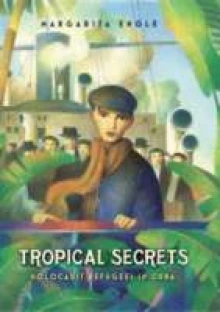
Tropical Secrets: Holocaust Refugees in Cuba
Written By Margarita Engle
Henry Holt, 2009, 208 pp.
ISBN 9780805089363
This is one of the few books about Jewish refugees who, when denied entry to the U.S. and Canada, ended up seeking asylum in Cuba. Told by four different voices, two Jewish refugees and two Cubans, this story takes place from 1939 to 1942 during WW II. Paloma is a generous Cuban girl who has inner conflicts with the way her father, El Gordo, makes money. El Gordo has a wounded heart because his wife ran away with another man; a trauma that drove him to be cold-hearted, taking advantage of the desperate refugees through demands for large amounts of money for permission to find refuge in Cuba. Paloma becomes friends with Jewish refugees. David is an old man who came to Cuba from the Ukraine where he experienced anti-Semitism while Daniel, a German Jew, was put on a ship bound for America by his parents and ends up in Cuba after he is turned away from the U.S. and Canada.
The four characters have their own stories, perspectives, politics, and cultures. Language, music, and celebrations metaphorically signal cultural adjustments and a range of acceptance among the four characters. Although this book is ostensibly about Holocaust refuges in Cuba, this is not a story of life or death decision making prevalent in the Holocaust genre but rather a story about embracing your own and other people’s cultures and language.
The author, Margarita Engle, tells this story of refugees in Cuba through her well-known free verse writing style. Engle’s historical fiction narrative style, powerfully delivered in The Poet Slave of Cuba (2006) and The Surrender Tree (2008), continues in this novel. Engle notes the major events and situations in Tropical Secrets are all factual. The story is based on German propaganda claiming, “Even a small, impoverished, racially mixed tropical island wanted nothing to do with Jews” (p.195). Joseph Goebbels, master propagandist of the Nazi regime, used these words to stir up anti-Semitism in Cuba. According to the author’s note, passengers rejected by Cuba were returned to Europe since the U.S. and Canada had already rejected them. As a result, many Jews were transported to concentration camps in Europe.
Engle doesn’t limit her story to Jewish refugees but also includes non-Jewish Germans who were accused of being Nazi spies and held at the prison in Sla de Pinos, on the southern coast of Cuba. Fear about identifying who should and should not be jailed indicates the vulnerability of political identity and situations in 1939-1942.
Engle’s unique cultural background as a Cuban-American poet and journalist contributes to her authentic descriptions of Cuba. Her Ukrainian Jewish grandparents’ history of fleeing anti-Semitic violence provides cultural richness to this nuanced story of cultures. In history, ships like the St. Louis and the Orduna actually sought refuge in Cuba in 1939 and Daniel’s story is the dominant echo in history. In addition to the truthful descriptions of the refugee event, 13-year-old Daniel’s voice longing for a reunion with his parents takes readers to universal characteristics of childhood and children’s love for their parents and family.
The alternative young voices exploring cultural identities as defined through interactions with others can be experienced in other books like When My Name Was Keoko by Linda Sue Park (2004), Morning Girl by Michael Dorris (1989), Seedfolks by Paul Fleischman (2004), and Witness by Karen Hesse (2003). The descriptions of cultural identity differ, depending on the contexts of culture, gender, ethnicity and identity in each book, but these books resemble Tropical Secrets insofar that readers can join character’s shared experiences in the search for identity and connect or disconnect with these voices.
Yoo Kyung Sung, University of New Mexico, Albuquerque NM.
WOW Review, Volume III, Issue 2 by Worlds of Words is licensed under a Creative Commons Attribution-NonCommercial-ShareAlike 4.0 International License. Based on work at https://wowlit.org/on-line-publications/review/reviewiii2.


