

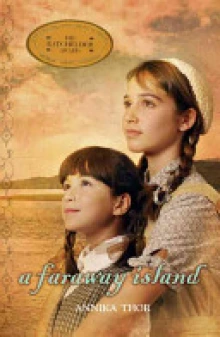
A Faraway Island
Written by Annika Thor
Translated by Linda Schenck
Delacorte Press, 2009, 256 pp.
ISBN: 10-038-573-6177
The picture is two years old. In those days, the Steiners were still an ordinary family, taking the streetcar, going to movies and concerts, enjoying vacations. But less than a year after the picture was taken, the Nazis invaded Austria . . Things the Steiner family had always taken for granted were suddenly prohibited. Forbidden to people like them, to Jews. (p. 21)
For protagonist, Stephie Steiner, the picture of her family marks normality, a time before her entire world changed. It marks a time before she was separated from her parents and her homeland of Austria. A novelized account of two sisters who are part of the Kindertransport Program just prior to World War II, A Faraway Island is set on an island off Sweden in 1939 at the beginning of the Holocaust. The novel introduces twelve-year-old Stephie Steiner and her eight-year-old sister Nellie, whose parents send them through the Kindertransport Program, which was introduced in 1938 by Great Britain and other countries across Northern Europe after the Kristallnacht incident in Nazi Germany. It was a program used to sponsor Jewish children under age 17 until the crisis was over. As more and more Jews in Vienna are targeted by the Nazis and taken away from their homes, the Steiners place their daughters on the train to Sweden, believing they will follow shortly. The girls are to await their parents’ release from Austria so they can travel together as a family to America where they will be safe. Shortly after the sisters arrive on the island, Austria is invaded by the Nazis and the sisters are caught between what they knew as Austrian Jewish children, what they are experiencing as Jewish refugees in a predominantly Christian country, and what possibilities might exist for them once—and if—they are reunited with their parents.
A quiet story with an atmosphere that reflects the cold and alienating setting of a windswept Swedish island, A Faraway Island aptly depicts outsider Stephie who is not only physically separated from her parents, but is culturally and emotionally separated from her adoptive community. She struggles to make friends and to find a place of safety between her Jewish heritage and the predominant Christian ethics of her adoptive community. She is bullied by classmates, reflecting the political climate of Europe toward Jews at the time, and is not allowed to continue in school, reflecting the cultural limitations she must accept as a young girl within her new community. The novel reveals how children from the Kindertransport had to make great changes to fit in their new countries and families, including—for many—their Jewish identity. Nellie, the eight year old who is placed with a young family, fits in easily. She readily gives up her German language and her culture as she adjusts to her new family and her new surroundings. She begins to embrace the Christian perspective of the community. Stephie, however, has more to lose, and has a difficult time living with Aunt Marta, whose sadness reflects her own. While her new Aunt does not require Stephie to accept Christian values, there is no acknowledgement of Stephie’s Jewish heritage, and she must partake in the Christian rituals of her adoptive community. Thus, Stephie is a young girl who also has the huge responsibility of keeping her parents, her Jewish heritage, and her old world alive in her own and her sister’s imagination. The outward struggles she faces on the island reflect her inward turmoil, and throughout the story she struggles with who she is, where she belongs, and what she needs to do to remain faithful to the beliefs she has always known.
The first of a series of books about Stephie and Nellie, A Faraway Island gives readers a new perspective on one of the outcomes of Hitler’s policy on Jews. Something frequently overlooked about the Holocaust is how that policy directly impacted all Jews in the areas of Europe that were occupied by the Nazis, with some experiencing what might be considered a more gentle devastation. The text focuses on Stephie’s struggle within a culture that is often quite hostile to her emotionally, socially, and religiously. This text makes a nice complement to Number the Stars (Lois Lowry, 1998) if readers wish to read a narrative about what happened to Jews once they escaped to Sweden for safety. A better pairing, however, would be Black Radishes (Meyer, 2010) as another fictionalized account of a Jewish family that flees Paris before the Nazi take over and division of France. This pairing would be especially beneficial for showing young readers the price many Jews paid as a direct result of Hitler’s policy—the giving up or hiding their identities, losing their rights and privileges as members of a society, or loss of their materials goods, including houses, businesses, and yes, for some, the lives of family members. Both texts aptly portray the angst those in safe areas felt for those who were not so fortunate, and both are based on actual family accounts.
A Faraway Island could be used with any number of Holocaust texts that would allow middle school readers a wider range of understanding about what transpired in Europe during World War II, and the resulting situations—both horrific and less so—during that time period. This story addresses themes that question what it means to survive, what it takes to be faithful, what is family, and ultimately what it means to embrace life and love as it is given. There is a great sense of loss and sadness in this novel that could be overlooked by younger readers. Older and more sensitive readers, however, will ponder the loss of both national and religious identity, and will wonder what happens to the Steiner sisters, especially Stephie. The rest of the series has not been released in English, but readers should anticipate their arrival; if they are anything like this first text, they will be worth the wait.
Author Annika Thor based her novel on interviews of Jewish survivors who, as young children, were sent to Sweden during World War II. She grew up in a Jewish family in Sweden where some of her cousins experienced the Kindertransport as young children. In her author’s note, she mentions how many young children were never reunited with their parents, and thus absorbed into Swedish families and a new culture. A Faraway Island, the 2010 Batchelder Award winner for translation, is only one of a number of novels Linda Schenck has translated from Swedish for an English-speaking audience.
Holly Johnson, University of Cincinnati, Cincinnati, Ohio
WOW Review, Volume III, Issue 2 by Worlds of Words is licensed under a Creative Commons Attribution-NonCommercial-ShareAlike 4.0 International License. Based on work at https://wowlit.org/on-line-publications/review/reviewiii2.


