

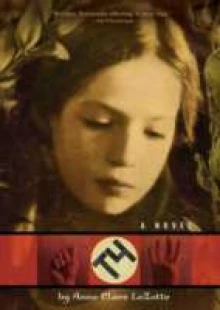
T4: A Novel in Verse
Written by Ann Clare LeZotte
Houghton-Mifflin Company, 2008, 108pp.
ISBN -13; 978-0-547-04684-6
In selecting a book related to the theme of the Holocaust, I was intrigued to encounter T4: A Novel in Verse by Ann Clare LeZotte. My interest was heightened when I discovered that the author, the main character of the story, and I share the experience of being deaf from early childhood.
The opening chapter, “Hear the Voice of the Poet,” set forth the author’s intent and purpose:
Hear the Voice of the poet!
I see the past, future and present,
I am Deaf, but I have heard
The beauty of song.
And I wish to share it with
Young readers.
A poem can be simple,
About a cat or a red
Wheelbarrow.
Or it can illuminate the lives
Of people who lived, loved,
And died. You can make
People think or feel
For other people, if you
Write poetry. In T4 the facts
About history are true, and
My characters tell the story.
T4 is named for the location of Nazi headquarters, Tiergartenstrase 4, in Berlin, where an “Action Plan” to kill mentally-ill and handicapped people was devised. The main character is Paula Blecker whose parents send her into hiding after they learn of the T4 Action Plan from a local priest. The priest takes Paula to the safety of a retired teacher’s farm. She lives there until the secret police arrive with questions about the presence of a Jewish child in the home. The teacher convinces them that a former student dropped by to visit and Paula is taken to another refuge. There she meets and befriends an older boy known as “Poor Kurt.” In 1941, after the dissolution of the T4 Action Plan, Paula and Kurt return to her home where she learns about his family and his true identity.
While I appreciate and commend the efforts of the author to create this book, I find the novel to be problematic for several reasons. As a whole, the story is essentially a melding of fiction and historical fact onto the backdrop of the Holocaust. The frequent juxtaposition of story and facts results in two distinct voices in the narrative. The first being the voice of the young character and the second being the voice of a more mature “instructor” conveying information to the reader.
In some instances, verses were robbed of their impact by the inclusion of unnecessary explications. For example:
I watched the lips
Of my relatives
When they told stories.
I could see words
Being formed on their mouths.
It’s called lipreading.
****
She made certain movements with her fingers
And took my hand to do the same thing.
She was trying to teach me
The official sign language alphabet of the
Deaf.
I learned to make the letters on one hand;
It’s called fingerspelling.
In other instances, concepts and words that are used in this day and time are incongruous within a text written for a different era. For example:
wanted perfect people
To give birth to more perfect people.
They imagined Germany as a master race
Who would rule the world.
They attacked Jews, people of color,
Homosexuals, and Gypsies, among others.
****
We drove two hours
To a church with a homeless shelter.
****
Germany’s Deaf
Community
Never completely recovered.
The terms, “people of color,” “homeless shelters,” “Deaf Community,” and others used in this book do not fit the historical context of this story. Indeed, their inclusion negates the authenticity of the story and the character’s first-person voice in this time period and setting. Without authenticity, we are left with a simplistic, coming-of-age romance that is superimposed upon the notion of the Holocaust.
Author Ann Clare LeZotte is a 1991 graduate of Sarah Lawrence College, and became deaf as a young child. She has published several poems in various journals and this is her first novel. She credits the book, Crying Hands: Eugenics and Deaf People in Nazi Germany, by Horst Biesold (Galluadet University Press) as the catalyst for this work.
Possible companion books for this novel might include: A Knock at the Door by Eric Sonderling (1997), A Picture Book of Anne Frank by David A. Adler (1993), Anne Frank by Richard Tames (1989), Rose Blanche by Roberto Innocenti (1990), and We Remember the Holocaust by David Adler (1990).
LaFon Phillips, Tucson Unified School District, Tucson, AZ
WOW Review, Volume III, Issue 2 by Worlds of Words is licensed under a Creative Commons Attribution-NonCommercial-ShareAlike 4.0 International License. Based on work at https://wowlit.org/on-line-publications/review/reviewiii2.


