

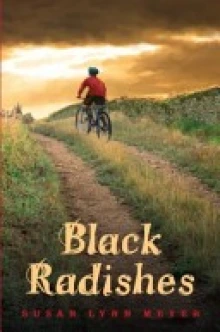
Black Radishes
Written by Susan Lynn Meyer
Delacorte Press, 2010, pp. 228
ISBN: 978-0385738811
The Eiffel Tower was ugly. That was the only word for it, Gustave thought, gazing upward. It used to soar, a vivid red-brown, up into the sky over Paris. But now, quickly coated in dirty gray camouflage paint to disguise it from Nazi bombers, it somehow looked squat and sinister. From farther away in the city, earlier on this cool March afternoon, it had been hardly visible, melting eerily into the iron gray of the sky. But that was the point, of course. (p. 1)
Black Radishes tells the story of eleven-year- old Gustave Becker, a French Jew, and his family during the time period of March 1940 to January 1942. Although the story begins with an ordinary Boy Scout meeting, the tone quickly changes when Gustave finds the words "La France Aux Francais!...Juifs Hors de France!" painted on his street. The simple life he enjoyed with his mother, father, aunt, cousin, and friend must be left behind as the family seeks safety on their way to hopeful freedom.
Gustave and his family leave Paris in the spring of 1940 to stay in the quiet countryside of Saint-Georges. The quiet is quickly disrupted a few months later when Germany invades France. Gustave's family joins the exodus to Spain; however, Nazi planes cancel their plans. After returning to Saint-Georges to continue their secret life as Jews, France is split with the Demarcation Line to separate occupied from unoccupied France. Luckily, the Beckers are just south of the line and continue their fragile existence in Saint-Georges, trying to determine who can and cannot be trusted. When Gustave starts school, he must discreetly discern between trustworthy and untrustworthy. When he meets Nicole and Philippe, they both strengthen and challenge his maturity and resolve.
Because Gustave's father has Swiss papers, he bravely makes many trips across the river into Nazi-occupied France to barter for needed food. Gustave and his stuffed monkey, one piece of his childhood from Paris, accompany Papa on these trips. He learns the value of “black radishes,” a term that refers to the bribes his father offers to German border guards.
In October, 1941, Gustave unwittingly accompanies his friend Nicole on a dangerous mission and sees the Menier castle which straddles the Demarcation Line in Chenonceau. As events unfold, Gustave and his father become a part of something larger than they could have imagined at that time. Gustave hopes for the moment when he can safely get his family and the families of his two close friends safely on their way to America. It is a journey filled with danger, joy, and sorrow that sits like a lump in the throat of Gustave and the reader.
A map of Europe in 1940 is placed at the front of the book for the reader to keep track of the movements of the Nazis during the war, although Gustave also marks the movements on his own map in the story with red watercolor paint. French and German words are scattered throughout the text but are easily negotiated with either direct translations or generous context clues. The Author's Note at the end reveals that the route taken by Gustave and his family was the route followed by the author’s father who was born into a Jewish family in France in 1929. The Author's Note and Acknowledgement detail a long list of written resources and interviews the author used to establish the factual content that is woven throughout the story. Meyer carefully details the life of fear for Gustave's family but also portrays their strength in charting their own course to freedom. She cleverly disguises plot events that are slowly revealed to be a part of the French Resistance movement, a group that saved thousands of lives during World War II.
Students in fourth through eighth grades would benefit from Black Radishes in a study of World War II and the Holocaust. Other titles can be partnered with this book as they relate to events of the war in France, Resistance movements, and the Jewish experience of the war: A Pocket Full of Seeds by Marilyn Sachs (1972), Sky: A True Story of Resistance During World War II by Hanneke Ippisch (1996), Greater Than Angels by Carol Matas (1998), Good Night, Maman by Norma Fox Mazer (1999), The Good Liar by Gregory Maguire (1999), Tamar by Mal Peet (2008, see WOW Review Vol. 2, 1), A Faraway Island by Annika Thor (2009, see WOW Review Vol. 2, 3), and Resistance: Book 1 by Carla Jablonski (2010, see WOW Review Vol. 3, 2).
Wendy Harper, The Ohio State University, Columbus, OH
WOW Review, Volume IV, Issue 1 by Worlds of Words is licensed under a Creative Commons Attribution-NonCommercial-ShareAlike 4.0 International License. Based on work at https://wowlit.org/on-line-publications/review/reviewiv1.


