Crowdfund Campaign: Main Character Energy
World Building
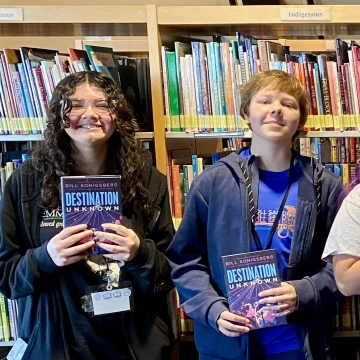
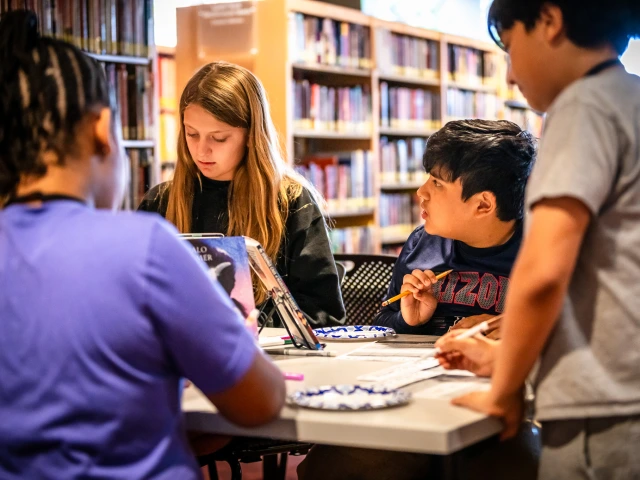
For the first time in program history, the Reading Ambassadors have senior members who came up through the Middle School Reading program. When they graduate in May 2027, Quin and Averi each will have served at least as Reading Ambassadors for 5 years, interviewed 12 authors, recorded 25 podcasts, read 20-24 books and created 6-7 ‘zines. They have met with U of A scholars from multiple departments/colleges discussing a range of topics and took field trips to several campus locations. They participated in the Tucson Festival of Books in sessions and as exhibitors. All of these accomplishments came on top of their academic, social and volunteer obligations.
Their combined insight has been critical in shaping the Reading Ambassador program as community engagement specifically for people their age -- a program that honors their intellect and curiosities and that offers autonomy around reading choices. For this week's crowdfund update, I stole a minute to chat with Averi and Quin about how they experience the current reading environment, how the Reading Ambassador program changed their perspectives and what awaits them after graduation.
Typical Dialog
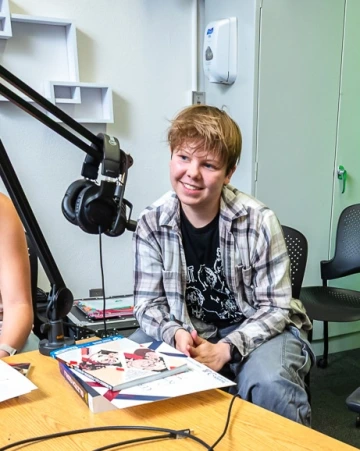
Quin’s take on the fears of the U.S. becoming a “post-literate” society is measured, “We have different technology now that makes [some types of focus] kind of more difficult,” he says. He points out that when a person is used to consuming a series of short videos, that turning to something that requires a long attention span does require adjustment. But then he continues with a take on bite-sized information that allows room for both deep focused reading and enjoyment of short-form videos. “I don't think it’s doomsday. It's just a different generation growing up with new, different media. It's more difficult to tear yourself away from this technology because it's made to be addictive, but I don't think reading is going to end.”
Averi considers the question through the lens of climate change, the theme the Teen Reading Ambassadors explored in September and October. She asks Quin to clarify. “Today we were talking about climate change, and what we know about climate change. If we are living in a soundbite world instead of a world of deep focus with people who can read, especially [with regards to] scientific things, can TikTok deliver to you what you need to know?”
“Not all of it,” Quin replies, “but maybe media evolves to require shorter attention spans so you can pick up information quickly from several sources, be around a bunch of flashing lights, and still be able to concentrate on a certain thing. Then maybe [short-form media] is necessary.”
“I feel like those two things are directly contrasting,” says Averi. “Being able to pay attention even with flashing lights and having a shorter attention span are opposites of each other. If you have a shorter attention span, you're not able to lock in and ignore all the things coming in from the side,” says Averi.
“You're able to interpret multiple pieces of information at the same time because of that shorter attention span,” Quin clarifies. He talks about a process of scrolling that is more like research – looking up multiple bits of content on one theme to get clarity or learn how something works.
This specific use of social media isn’t of issue for Averi. Her concern centers on scrolling while engaged in other activities. “I'm in AP psych right now, and one of the things we talked about was the brain basically doesn't have the ability to multitask despite what a lot of people like to claim.” She brings up the example of screenwriters who simplify storylines to accommodate people who watch shows while scrolling on their smartphone. She then returns to scrolling to compare the merits of each in discovery. “We need to be able to just sit down and take in information without jumping around for multiple sources. Sometimes you just have to read a book in order to gain information. If you never just sit down and read a non-fiction book because it's too long and it's too boring, you're going to miss out on a lot of good information that you can't get from someone summarizing that chapter of the book in a 60-second video on TikTok.”
Fiction Gets Real
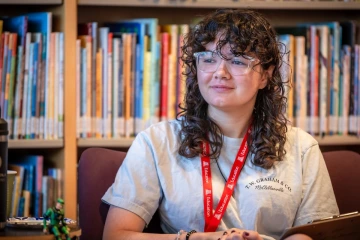
“One thing you can gain from reading fiction is actual, true information,” says Averi who uses the example of Banana Fish, a manga-to-television series which provided context around a mind-control experiment conducted by the U.S. government. “And so you're able to learn about real historical events from fiction or you can even just learn messages from fiction, again like we were talking about climate change,” she says again referring to their current thematic study.
Quin adds, “One of the amazing things about fiction is that there's so many forms of it. There's historical fiction, there's realistic fiction, there's fantasy. And so there's so many different worlds you can delve into and so many different perspectives. That is so important because sometimes just sitting down with a non-fiction book and reading about specific cities and memorizing dates is more difficult without all that context and world building.”
Moral of the Story
Both Quin and Averi came to Worlds of Words as Middle School Reading Ambassadors and are now seniors in the Teen Reading Ambassador program. Quin plans to study Astronomy/ Astrophysics as a Wildcat at the U of A while Averi plans to join the Lumberjacks at Northern Arizona University to study Biology with a minor in Astrobiology. I wanted to know how their reading habits might factor into their academic pursuits.
Averi jumps in immediately. “People underestimate the amount of writing and reading you do in science fields and especially with biology, which is like the least math containing science. You're doing a lot of writing and reading. The Reading Ambassador program taught me how to process what I'm reading and put it into words. And so that's really good for research papers.”
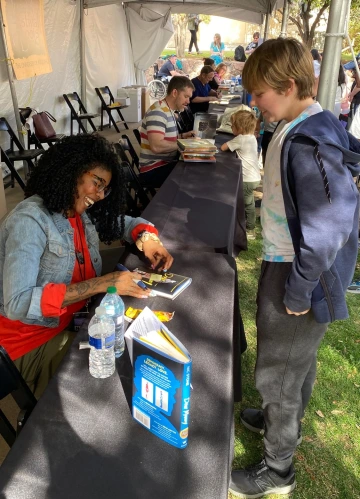
Quin shares, “I like that this program got me involved with the actual authors who wrote the books. And all these different people have different perspectives on different books. I love hearing what the others have to say about their writing process. We’ve read so many different books over the years that it's inspiring.” By way of his point Quin mentions meeting a U of A COE scholar, LaCher Pacheco, to talk about her work with Indigenous children in northern Arizona and sharing books around climate issues. “What we heard from LaCher about the environment and the insight from the kids she works with… It was like, wow, there's so much I can be doing to help. It was empowering. This program has been really empowering.”
“The program opened my eyes for opportunities in the future,” says Averi, “because when we met the DC author, I got to learn all about like how publishing for DC works. And meeting a bunch of authors, we get to learn about their activism and learn what they're doing in the world, and realize, oh, we can do that for the world too.”
Quin says, “The community really kept me coming back. I love the people here even though it changes every year. It’s nice to be surrounded by people who I know also love reading and also share a lot of the same opinions as myself and then also have these like other ideas about the books that we're reading. That’s really, really cool.”
I couldn’t agree more, Quin. It is really cool. It’s our great fortune to have Quin and Averi join us over the years. We look forward to finishing out this year as well.
If you would like to support readers like Averi and Quin – “just some kids excited about reading” – please visit our crowdfund campaign at crowdfund.arizona.edu/wow. A donation could be as little as $19 for a single book or as generous as $2000 for an author visit.
WOW Currents is a space to talk about forward-thinking trends in global children's and adolescent literature and how we use that literature with students. "Currents" is a play on words for trends and timeliness and the way we talk about social media. We encourage you to participate by leaving comments and sharing this post with your peers. To view our complete offerings of WOW Currents, please visit its archival stream.