Beyond Two Solitudes
November's WOW Currents features the Dynamic Biliteracy (DB) Maleta Project currently underway throughout New Mexico, U.S.A. The framework of DB Maleta Project advances the belief that bilingualism is an asset that can and should be leveraged in classrooms to promote rigorous academic learning for all learners. With funding from the Kellogg Foundation, the DB Maleta Project aims to support bilingual learners, educators and families with instructional resources, professional development and meaningful advocacy.
In the first blog post we, the DB Maleta team, present a vignette featuring Mary Fahrenbruck's and Susana Ibarra Johnson's interactions with children in a first grade classroom. The vignette showcases children's fluid language practices during a Read Aloud and a literacy lesson. Then we explain the Dynamic Biliteracy position that guides our work throughout the state of New Mexico. To conclude, we share our connection from dynamic biliteracy to multilingual global children’s literature.
Rethinking Biliteracy Through the Corriente
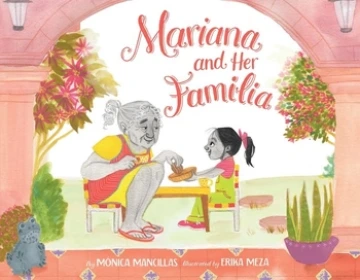
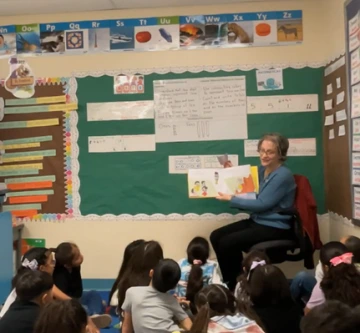
Children listen to Mary read aloud Mariana and Her Familia (Mancillas, 2022) in their 1st grade classroom. Written in English and infused with Spanish, children follow Mariana as she visits family in Mexico for the first time. The children listen as Mariana reveals that she doesn't speak or understand Spanish and she worries about communicating with her cousins, her tios and tias, and most importantly her abuela. Throughout the story the children make text-to-self connections with Mariana who learns Spanish from her family when she plays with cousins, gives gifts to her tios, and helps her tias and abuela prepare lunch. A conversation with the children ensues when the story ends.
Mary: What were you thinking about while I was reading the story?
Victoria: That she (abuela) was speaking and she (Mariana) was repeating the words.
Isela: The grandma learned English too, but Mariana didn't know Spanish so she helped her learn more Spanish.
Hugo: I wasn't thinking about nothing!
As the discussion ends, Susana transitions into the role of teacher.
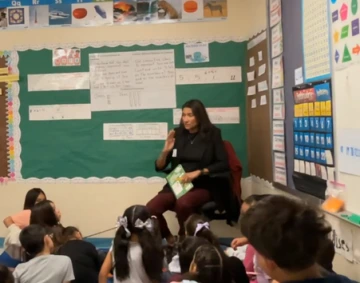
Susana: Hola, como estan? (Hello, how are you?)
All children: Bien! (Good!)
Jordan: Y tu? (And you?)
Susana: Muy bien, gracias por preguntarme. Si, ahora están listos para escribir, si o no? (Very good, thanks for asking. Yes, now you are ready to write, yes or no?)
All children: Si! (Yes!)
Susana: Bueno, lo que vamos a hacer van a escribir. ¿Quién tiene, todos tienen un libro de doble raya? (Well, what we are going to do, you are going to write. Who here, everybody has a double-line notebook?)
All children: Si. (Yes)
In this vignette, the children's fluid language practices represent sophisticated multilingual ways that bilingual speakers communicate as literate beings. Children leverage their full linguistic repertoires for dialogue, connecting and learning. Seltzer et al., 2025 refer to this approach as translanguaging. In educational settings, translanguaging provides a dynamic, rather than static, approach to literacy. Language flows through the learning space like a corriente meanders across the landscape. Like the corriente, children use languages, dialect, cultural knowledge and ways of communicating to expand the ways they think, discuss, read and write.
Exploring Dynamic Biliteracy
Within the Dynamic Biliteracy Model, doing biliteracy means actively engaging in reading, writing, speaking, listening and critical thinking by drawing on learners' full linguistic repertoires to construct and communicate meaning. Rather than treating English and Spanish literacy as two separate processes, doing biliteracy recognizes that learners can strategically and flexibly use both languages to comprehend texts, develop ideas, make cross-linguistic connections and express their understanding. For example, learners might read a text in Spanish, discuss its meaning using English and Spanish, connect vocabulary and concepts across languages, and write a response in the language of instruction or in both languages, depending on the learning purpose. At other times, learners may read, discuss and write entirely in one language to deepen their language-specific literacy development.
Doing biliteracy is therefore not simply learning to read and write in two languages; it is the dynamic process of using language, oral and written, to make meaning, develop literacy identities, construct knowledge and become critical thinkers. Central to this process is teacher agency, as educators intentionally design opportunities for flexible language use while ensuring explicit foundational literacy instruction and meaningful engagement with texts in English and Spanish.
Connecting to Global Children's Literature
Global children's and adolescent literature crosses linguistic boundaries through translation, adaptation and publication in multiple languages. These multilingual texts create opportunities for readers, both children and adults, to explore meaning through illustrations, dialects, cultural references and dialogue regardless of linguistic background. Educators can use global literature as a tool to help learners explore language representation and experiences that get highlighted and those representations and experiences that remain absent as a way to challenge language bias and inequities.
Exploring multilingual global children's and adolescent literature is one of many ways educators can bring children's language repertoires to the forefront in classrooms. In our next blog post, we will share how we use multilingual picturebooks and interactive read alouds to put dynamic biliteracy into practice.
Our Invitation to You, the WOW Audience
Identify one way you can make learners' language repertoires and resources more visible in your classroom, library or other literacy space. Share your ideas in the Comment section below.
References
Mancillas, M. (2022). Mariana and her familia. (E. Meza, Illus.). HarperCollins. ISBN 10: 0062962469
Seltzer, K., Johnson, S. I., & Garcia, O. (2025). The translanguaging classroom: Leveraging student bilingualism for learning (2nd ed.). Brookes Publishing. ISBN13:9781681257716
The Dynamic Biliteracy Maleta Project Team consists of educators - scholars residing in New Mexico, U.S.A. including (alphabetically):
Adriana Cardenas, New Mexico State University, Las Cruces, NM
Mary L. Fahrenbruck, New Mexico State University, Las Cruces, NM
Susana Ibarra Johnson, New Mexico State University, Las Cruces, NM
Minea Armijo Romero, New Mexico State University, Las Cruces, NM
Elisabeth Valenzuela, New Mexico Highlands University, Las Vegas, NM
Angelica Casillas Wortham, New Mexico State University, Las Cruces, NM
WOW Currents is a space to talk about forward-thinking trends in global children's and adolescent literature and how we use that literature with students. "Currents" is a play on words for trends and timeliness and the way we talk about social media. We encourage you to participate by leaving comments and sharing this post with your peers. To view our complete offerings of WOW Currents, please visit its archival stream.