

A Mirror and a Window: Read Aloud Multicultural Books for Adult EFL Learners
By Yang Wang with Yuebo Zheng
The first time I learned about multicultural literature was in a seminar during my doctoral program. Reflecting on my past teaching experiences, I realized that many EFL (English as a Foreign Language) learners in Mainland China did not have access to authentic literature, narrative and expository texts that are written in the original, natural language of the authors. Instead, they read textbooks and completed worksheets to learn the English language. Seldom did students have opportunities to take an aesthetic stance to what they read and share their initial responses to literature (Rosenblatt, 1978). Since my early teaching experiences in China I have come to believe readers create meaning through participating in the text (Rosenblatt, 1978, 1982). Each individual reads literary work for himself/herself, which is to say, he/she draws on past experiences and molds new experiences through transaction with the text.
Similarly, I believe that learning a language is learning a culture. This concern, coupled with my desire to incorporate authentic literature into the teaching English as a foreign language to Chinese students, led me to work with Mrs. Zheng in introducing multicultural books to a group of college EFL learners. We selected many picture books that provided information through text and visual representations (Sipe, 1998). Our work together was built on the premise that reading multicultural literature could provide readers with a mirror that reflects their culture and a window into learning about other cultures (Glazier & Seo, 2005). Our inquiry question was: How do adult EFL learners on the mainland of China respond to the read-aloud of multicultural books in the English language class? How does reading aloud multicultural literature affect their learning?
Setting and Participants
Mrs. Zheng taught at a major university in the middle region of China. During this inquiry she had 30 freshmen majoring in English Language and Culture. They met twice a week for her Comprehensive English class. Through an online survey and communications with Mrs. Zheng’s students, I learned that half had never read authentic children’s literature in English, with others having read one to three classic novels, texts that represent some high standard of quality that has stood the test of time, such as The Tempest, Midsummer Night's Dream, Wuthering Heights, Red and Black, Shakespeare sonnets, Hamlet, Tess of the d’Urbervilles, Emma, The Great Gatsby, The Call of the Wild, Greek mythology, etc.
I selected books that reflected American and Chinese culture created by American and Chinese American authors and illustrators (see Table 1). My selection criteria were largely based on students’ interests, American teachers’ recommendations, and my knowledge and experiences of reading multicultural children’s and young adult literature. For each book I created questions and activities that paralleled students’ understanding of the texts’ content. Mrs. Zheng read aloud one book each week and led the discussion. She audio-recorded the read-alouds and kept teaching journals. I interviewed her and three teacher-selected students of varied English language proficiency after we introduced the seven books.
| Title | Genre | |
|---|---|---|
| Chinese Culture | The Dragon Prince: A Chinese Beauty & the Beast Tale | Fairy tale |
| Lon Po Po: A Red-Riding Hood Story from China | Folklore | |
| Taichi Morning: Snapshots of China | Poetry | |
| American Culture | The Relatives Came | Fiction |
| My Name is Sangoel | Fiction | |
| When I was Young in the Mountains | Fiction | |
| Jazz | Poetry |
Reading in Action
The first book we introduced was The Dragon Prince (Yep, 1997), a Chinese version of the beauty and beast fairy tale. It is about a farmer’s youngest daughter, Seven, who has to marry a dragon in order to save her family. In the end, the dragon turns out to be a prince living in the palace under the ocean. Mrs. Zheng read aloud this book and asked: “How do you think this book represents Chinese culture? How authentic it is? Why is it authentic? What makes it authentic? What misconceptions does it carry?” The responses of students in their discussion were based on their knowledge and experiences of living in China all their lives, with their comments falling into two categories.
On one side, they reported this book represented Chinese culture in a variety of ways: the traditional images of dragon and characters; justice will always win over evil; the emperor and the prince are symbolized by the dragon; the dragon lives at the bottom of the ocean; women were responsible for embroidering and making shoes in ancient times; the groom paid for a bride; the newly married bride visits her parents several days after the wedding; many parents named their children One, Two, Three, … ; and the images of the architecture, furniture, clothing, and hairstyle represent Chinese culture.
On the other side, they pointed out elements that concerned them, such as the book was created by an outsider who was born in the U.S.; people respect dragons as the dragon represents power, dignity, royalty, greatness, fortune, etc., and not evil. They also noted that it was unusual that the farmer did not have any sons in his family, with the eldest child supporting the family, not the youngest. Additionally, they observed that an emperor or prince usually has more than one wife in the history, and were troubled by the images that didn’t reflect how women had small feet in Qing dynasty due to the foot-binding tradition, not big feet as illustrated in the book. The women and the prince’s outfits came from different dynasties. Women followed the “Three Obediences” in ancient China, that is to say, a woman was required to obey her father before marriage, and her husband after marriage, and her sons in widowhood, so it was rare that the farmer’s six daughters did not listen to him. One student said, there’s the misconception of the image of dragon. In China, dragon is considered a symbol of power, dignity, royalty, greatness, good luck, etc. Dragon can even bring rain to people when there is a drought. It shouldn’t be related with any bad things. And when people meet it, they will consider it to be extremely good luck, showing their utmost respect to it. If there is the chance for them to marry their daughter to it, they will die for joy. But in this story, the dragon is described as a monster who will even kill and eat people for supper, which is American understanding of dragon--- it is considered as being ugly and fierce.
After reading all the selected books about Chinese culture, students responded that they learned about their culture from outsiders’ perspectives. They read Chinese American books based on their background and experiences and commented on the cultural authenticity in those books. Looking through the mirror of cultural books, they recognized the cultural elements in those books, discussed those elements as cultural insiders and enjoyed taking the ownership of reading about their cultures in English. Maoxin, a student, said in her interview, personally, Chinese culture is complicated. Even many Chinese people are not able to understand the whole of it. Although some foreign authors have mentioned abundant kinds of opinions in the books, it didn't mean they know everything about Chinese culture.
Among the books that represented American culture, the students’ favorite was My Name is Sangoel (Williams, 2009). This book is about a refugee boy, Sangol, who teaches his teacher and classmates how to pronounce his name correctly by making a t-shirt with images associated with his name. We asked these questions after the read-aloud: “What do you think of the book? What does the book tell you? What does it tell you about American culture? How would you like others to name you? How would you like American people to name you? Why? What does your name mean for you? “
Students responded that they learned that people show respect by pronouncing names correctly; people of other countries may not understand your name because your name carries your traditional culture and heritage; Americans are open, warm-hearted, friendly, helpful, and equal. After their discussion, they wrote about their own names and designed ways to help English speakers pronounce their names correctly (see Figure 1).
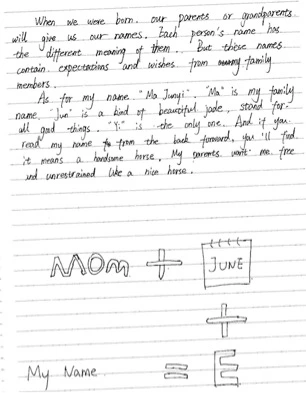
Through the window of reading picture books set in the U.S., students learned about American culture from insiders’ perspectives. However, this learning is double-sided. They confirmed the cultural elements in these picture books using knowledge they learned from their textbooks, English language class, and other second-hand sources. They were concerned that they did not have any first-hand sources to check whether the books are authentic. Some students shared, “What I know is book knowledge,” and “I’m not American.” They believed they had to experience the culture and live in the U.S. in order to better understand it.
Discussion
Through reading aloud multicultural picture books, adult EFL learners in Mrs. Zheng’s class became more engaged with texts, more motivated to learn the language, expanded their perspectives on American culture, and reflected on Chinese culture from an outsider’s point of view.
Through participation with authentic multicultural picture books, these EFL students created personal connections and critical responses. Student participants really enjoyed discussing the books, and the questions Mrs. Zheng posed guided them in understanding the books and encouraged deep discussions of the texts in light of cultural explorations. Shiying, one of the student participants, explained the experience, “We listen and we discuss together. Very active we are. The questions we discussed are interesting.” Students had an opportunity share their voices, make connections and question the texts. Mrs. Zheng reported this change in her students in the following excerpt:
The students became more critical in thinking. They even sometimes pointed out some of the mistakes in the pictures and descriptions . . . it makes me think more deeply about the effective ways of English language teaching and training of students' critical thinking. The students became more critical by not only simply reading and receiving the material but also thinking actively, evaluating what they are receiving, detecting the inconsistency or even mistakes, and even reflecting on the knowledge they've learned or the idea they already hold.
The EFL students enjoyed reading aloud multicultural books and became more motivated to learn the English language. Student participants learned the English language through reading the texts in those multicultural books and the illustrations in the books helped them with constructing meanings. Shiying said in her interview, “I like the book you choose for us. Picture, culture and the question are valuable.” Another student Tiange said, “I became more interested in learning English. Everyone is more engaged in class.” Some students asked where to purchase the books so they can keep copies and read to their younger siblings and other relatives. They were motivated not only to learn the language but also to teach younger English learners.
The students learned about American culture and reflected on their culture using multicultural books. The read-aloud books about American culture provided the EFL students a window into understanding a culture beyond simply learning English language. One student said, “Reading more foreign books can help us a lot in English learning and know more about their culture.” Moreover, students reflected on Chinese culture using the books as a mirror. One student explained, “Some (books) remind us the Chinese culture that we forget or ignore.” Another said that reading the books helped her, “know something about American culture, and what China is like in their eyes.” They reported they learned about the differences between American culture and Chinese culture and respected those differences. Mrs. Zheng commented that reading multicultural books,
Let the students know more about American culture, such as values, traditions, idiomatic ways of expression . . . ; aroused the students' interest in English learning; made the class atmosphere more active; made the students more critical in their thinking; improved my teaching ability and enriched the teaching method.
She reflected on her teaching and commented that read-aloud is an effective instructional strategy for EFL learners. In addition, she wanted to seek for more authentic teaching strategies for her students.
Final Reflections
Through our experience of reading picture books to adult EFL learners, we have come to believe EFL teachers could use multicultural picture books to engage students of varied ages learning English language. Teachers could use questions and meaningful activities to stimulate personal responses and develop critical inquiry. In addition, EFL learners could read multicultural literature for information (efferent stance) as well as for pleasure and personal explorations (aesthetic stance) (Rosenblatt, 1978). Additionally, multicultural literature can help learners reflect on their cultural experiences and build global experiences (Short, 2011).
Through student surveys and student and teacher interviews, I learned both the teacher and students wanted to collaborate with American native speakers and discuss their responses to the same books they read because, as one student noted, “we have never been to the U.S.” Reading multicultural literature books encouraged Chinese EFL learners to reach out and explore global experiences.
References
Cai, M. (2008). Transactional theory and the study of multicultural literature. Language Arts, 85(3), 212-220.
Glazier, J., & Seo, J. (2005). Multicultural literature and discussion as mirror and window? Journal of Adolescent & Adult Literacy, 48(8), 688-700.
Rosenblatt, L. (1978). The reader, the text, the poem: The transactional theory of the literary work. Carbondale, IL: Southern Illinois University Press.
Rosenblatt, L. (1982). The literacy transaction: Evocation and response. Theory into Practice, 21(4), 268-277.
Short, K. (2011). The significance of perspective in exploring international literature with educators. Worlds of Words, III(2), retrieved from http://wowlit.org/on-line-publications/stories/storiesiii2/7.
Sipe, L. (1998). How picture books work: A semiotically framed theory of text-picture relationships. Children’s Literature in Education, 29(2), 97-108.
Children’s Literature
Grimes, N., & Young, E. (2004). Taichi morning: Snapshots of China. Chicago, IL: Cricket.
Myers, D. (2006). Jazz. New York, NY: Holiday House.
Rylant, C. (1981). When I was young in the mountains. New York: Dutton.
Rylant, C. (1985). The relatives came. New York: Atheneum.
Williams, K., & Mohammed, K. (2009). My name is Sangol. Eerdmans.
Yep, L. (1997). The dragon prince: A Chinese beauty & the beast tale. New York: HarperCollins.
Young, E. (1989). Lon Po Po: A red-riding hood story from China. New York: Philomel
Yang Wang is an Assistant Professor of Language and Literacy Education in the Department of Instruction and Teacher Education at the University of South Carolina.
Yuebo Zheng is an instructor at Hebei University of Economics and Business in Shijiazhuang, Hebei China.
WOW Stories, Volume IV, Issue 9 by Worlds of Words is licensed under a Creative Commons Attribution-NonCommercial-ShareAlike 4.0 International License. Based on a work at https://wowlit.org/on-line-publications/stories/iv9.


