Stitching Stories in the Borderlands
November's WOW Currents features the Dynamic Biliteracy (DB) Maleta Project currently underway throughout New Mexico, U.S.A. The framework of DB Maleta Project advances the belief that bilingualism is an asset that can and should be leveraged in classrooms to promote rigorous academic learning for all learners.
In our third blog post we, the DB Maleta team, share the Stitching with Love event, a reader response activity focused on stories, family, identity and connection. The event, collaboratively organized by elementary educators Medra Aguilera and Julietta Ibarra, the principal Sonia Barajas and the DB Maleta team, demonstrates the ways educators can extend the classroom curriculum to focus on language use and meaning-making through creative arts.
Supporting Biliteracy with Creative Works
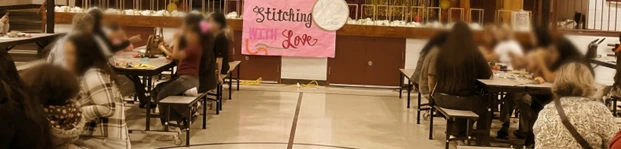
In the early afternoon in Chaparral, New Mexico, women and children gathered around a table in a school cafeteria near the Mexico–United States border. The heat had begun to allow summertime to settle in the Chihuahuan Desert, and, with Mother's Day approaching, over 100 K-2 children entered the cafeteria with anticipation. Across the table lay embroidery hoops, folded cloth, estambre de colores, and skeins of thread that kept rolling toward the youngest child.
"¿Así, mamá?" a girl asked, holding up her hoop.
Her mother leaned closer. "Sí, así. Just pull a little softer so the fabric doesn't wrinkle."
The girl returned to her stitching, slowly shaping a flower reminiscent of those that bloom in the desert.
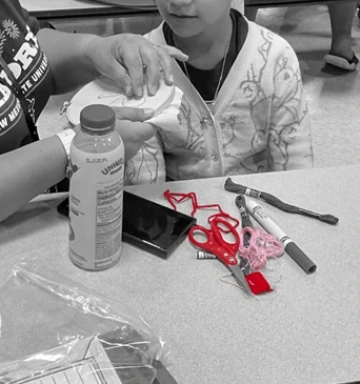
Beside them, a boy worked green thread through the outline of a leaf. He had chosen the color himself and declined two offers from an adult to change it. Around the table, children worked to make sense of the needle, the lines and the stories taking shape in their cloth. The boy's grandmother watched him struggle to thread the needle, waiting until he held it out to her for help before she showed him how to coax the wispy thread through the narrow eye of the needle. As they worked together, she shared stories, recalling puntos, patterns and colors. Her knowledge became visible in the movement of her hands and the guidance she offered. For the boy, each stitch opened another possibility for discovery.
Later, holding the microphone, he proudly shared his embroidery with the large group. He explained how his image connected to his life, his school and his abuelita. The cloth became a point of connection between what he had stitched, what he had learned and the relationships that gave his creation meaning.
Viewed through a borderlands lens, this gathering invites us to see the table as a meeting place for knowledge, languages and memories whose significance need not stop at a national boundary. The movement between Spanish and English, between generations, and between cloth and spoken story offers a way to consider how belonging can be woven across places. A transnational reading does not require assuming that every participant has crossed the border; instead, it invites attention to the family connections, cultural practices and remembered places that may link everyday life in Chaparral to communities on either side of the border and beyond.
Embroidering Dynamic Biliteracy: Stories Held in the Bordados
From the Latin trama, referring to the threads woven across a fabric, trama names both the structure of a tejido and the plot of a story (Real Academia Española, n.d.). This connection offers a meaningful metaphor for dynamic biliteracy: threads, like linguistic resources and lived experiences, gain meaning through their relationships with one another. Just as embroidery introduces new stitches into an existing tejido, bilingual learners draw on and expand their repertoires as they read, write, speak and construct meaning across languages. From a translanguaging perspective, these resources work together in meaning-making rather than functioning as wholly separate systems.
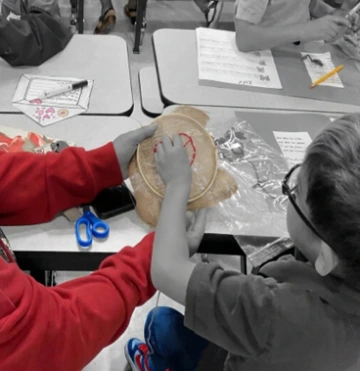
In this gathering, the relationship between embroidery and biliteracy takes shape through shared storytelling, explanations of stitches and interpretations of designs. When extended into written reflections, captions or family narratives, these exchanges can connect oral, visual and written expression (Ibarra Johnson & Garcia, 2023). The bordados become more than finished objects: they offer starting points for texts that recognize family knowledge and bilingual practices as resources for learning. Within a Mexico–United States borderlands context, these texts can also make room for layered accounts of place and belonging; stories that connect a child's school and neighborhood with family memories and relationships extending beyond them.
The DB Maleta Project: Carrying Stories Across Spaces
The DB Maleta Project extends this connection by offering a space to gather and carry the threads of dynamic biliteracy: embroidered pieces, family stories, photographs and bilingual writing. Like a portable trama, the maleta can bring these expressions into conversation, inviting children and families to revisit memories, interpret symbols, and create new texts using their full linguistic repertoires (Busch, 2017). Moving between home, community, and classroom, it can make visible how biliteracy grows through relationships, cultural knowledge, and shared meaning-making. By anchoring instruction in social and personal ways of knowing, the families, the Dynamic Biliteracy Maleta Project team, and the children co-construct a learning community grounded in collaborative meaning-making rather than a prescriptive curriculum (Fahrenbruck et al., 2006). This meaning-making conceptual framework directly parallels the dynamic biliteracy embroidery activity, where tactile, multimodal engagement allows learners and pre-service educators to stitch together their linguistic repertoires, memory work, and testimonios. Just as the "Journeys" inquiry frame used by Fahrenbruck et al. encouraged learners to interrogate broader systems of meaning and personal evolution, textile embroidery serves as a generative, physical extension of language mapping—transforming dynamic biliteracy into a deeply reflective, creative and decolonial praxis.
In a transnational borderlands context, the DB Maleta Project can also hold traces of connections across places: a photograph of a relative, a remembered expression, an embroidered design or a story associated with a community in Mexico or the United States (Armijo Romero, 2026). Its significance lies not in assuming a shared migration story, but in making room for the different ways families experience connection, distance, continuity and belonging. Together, the maleta and the bordados offer children opportunities to carry these relationships into their learning and to stitch their own interpretations into an evolving family and community trama.
Our Invitation to You, the WOW Audience
Select a favorite read aloud picturebook connected to a meaningful theme for learners and plan a creative response to pair with the text. Share the title of the picturebook and your ideas in the Comment section below.
References
Busch, B. (2017). Expanding the notion of the linguistic repertoire: On the concept of Spracherleben—The lived experience of language. Applied linguistics, 38(3), 340-358.
Fahrenbruck, M., Schall, J., Short, K. G., Smiles, T., & Storie, M. (2006). Journeying through life and literature. Journal of Children's Literature, 32(1), 27-36.
Johnson, S. I., & García, O. (2023). Siting biliteracy in New Mexican borderlands. Journal of Latinos and Education, 22(5), 1913-1928.
Real Academia Española. (n.d.). Trama. In Diccionario de la lengua española. Retrieved October 24, 2026, from https://dle.rae.es/trama
Romero, M. A. (2026). Crafting space and cycles of reciprocity for Comunera and Comunero youth in a transnational indigenous community in Michoacán, Mexico. Journal of Latinos and Education, 25(2), 726-741.
The Dynamic Biliteracy Maleta Project Team consists of educator - scholars residing in New Mexico, U.S.A. including (alphabetically)
Adriana Cardenas, New Mexico State University, Las Cruces, NM
Mary L. Fahrenbruck, New Mexico State University, Las Cruces, NM
Susana Ibarra Johnson, New Mexico State University, Las Cruces, NM
Minea Armijo Romero, New Mexico State University, Las Cruces, NM
Elisabeth Valenzuela, New Mexico Highlands University, Las Vegas, NM
Angelica Casillas Wortham, New Mexico State University, Las Cruces, NM
WOW Currents is a space to talk about forward-thinking trends in global children's and adolescent literature and how we use that literature with students. "Currents" is a play on words for trends and timeliness and the way we talk about social media. We encourage you to participate by leaving comments and sharing this post with your peers. To view our complete offerings of WOW Currents, please visit its archival stream.