Reading Across Languages
November's WOW Currents features the Dynamic Biliteracy (DB) Maleta Project currently underway throughout New Mexico, U.S.A. The framework of DB Maleta Project advances the belief that bilingualism is an asset that can and should be leveraged in classrooms to promote rigorous academic learning for all learners.
In our second blog post we, the DB Maleta team, offer suggestions for choosing picuturebooks that foster language use during read aloud sessions with children. We close with the read aloud sequence we employed during a read aloud session in a third grade bilingual classroom.
Children's Literature as a Space for Translanguaging
Readers of WOW Currents blog posts most likely know that reading aloud to children is more than simply reading the words on the page. Like Rosenblatt (1978), we believe that reading is a two-part process whereby readers transact with the ink on the paper to make meaning. In our previous blog post, we shared a vignette that describes a portion of Mary's read-aloud experience with children in a first grade classroom. Throughout the read aloud, children engaged in meaning-making by connecting the character's language experiences to experiences they have had with their home language, explaining familiar scenes in the illustrations and comparing the character's feelings of uncertainty about using language to their own uncertain feelings. These interactions throughout the read-aloud experience highlight the authentic ways children's language development involves the use of their entire linguistic repertoires. We conclude that we witnessed children engaged in multilingual meaning-making.
Selecting Picturebooks
Choosing picturebooks that support translanguaging and multilingual meaning-making requires thoughtful consideration and intentionality. Here we offer strategies to support this intentionality.
- Look for picturebooks in which languages happen naturally in text and illustrations.
- Look for accurate and authentic representations of cultural and linguistic experiences, forgoing texts that rely on stereotypes to carry the plot.
- Closely examine how translation, code-switching, dialect and culturally specific expressions affect the story.
- Look for many, varied entry points for multilingual readers to transact with the text, including illustrations, story elements (e.g. characters) and narrative structure.
These strategies foster global connections that can be applied to texts published in any country, regardless of language, translation, illustration style, plot or theme. The strategies focus on intentionality rather than complexity.
Reading Aloud to Third Grade Learners The Interpreter (Abtahi, 2025)
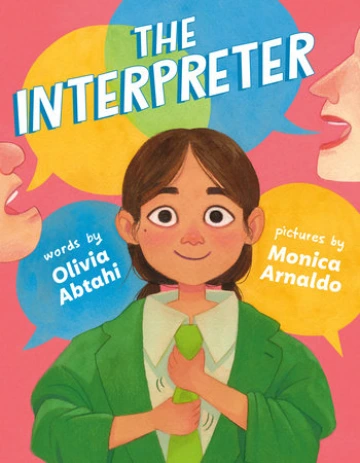
Mary used the criteria above when she selected The Interpreter (Abtahi, 2025) to include in the DB Maleta Project. As the story unfolds, listeners learn that Cecilia, the main character, has two jobs; to be a kid and to be a translator for her parents. Sometimes Cecilia enjoys the important work of translating from Spanish to English and from English to Spanish. At other times, translating can be overwhelming. When Cecilia becomes overwhelmed and asks for help, her family creates a plan that helps Cecilia balance her two jobs.
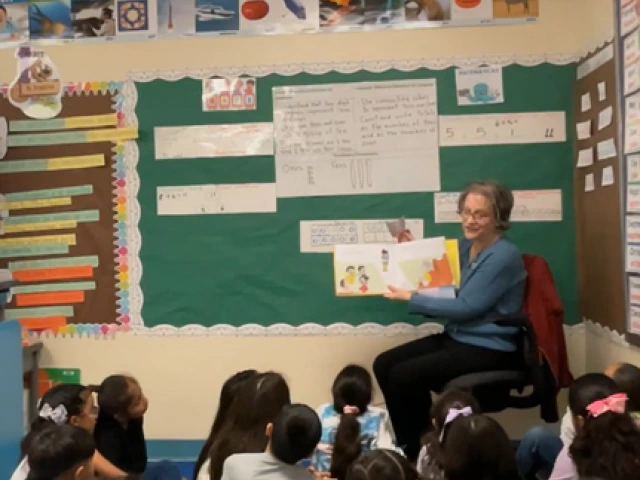
Elisabeth and Mary read aloud The Interpreter (Abtahi, 2025) to learners in a third grade bilingual classroom. Throughout the read aloud experience, they modeled how languages work together to communicate meaning. Elisabeth and Mary encouraged learners to draw on their full linguistic repertoires to communicate their understanding of and connections to the text. After the read aloud, learners were invited to share their experiences with translating from one language to another, taking into consideration the social and ideological dimensions of the context in which they were engaged.
The Team's Read Aloud Sequence for The Interpreter (Abtahi, 2025)
Here we share the read-aloud sequence we used for the read aloud session. A significant note is that learners were invited to draw from their linguistic repertoires to express themselves throughout the session.
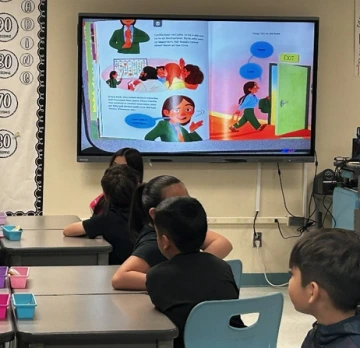
- Before reading: Show the cover of the picturebook. Read the title, author's and illustrator's names. Define interpreter for learners. Invite learners to make connections to their experiences as language interpreters.
- During reading: Pause throughout the reading to discuss words, expressions, font size and color, character relationships, etc. to facilitate comprehension and connections.
- After reading: Ask learners "What were you thinking about as we were reading?" This question invites all learners to share their thinking about how language shaped the story and their understanding of it.
Even though our session did not include it, educators can explicitly teach vocabulary, review a phonics skill, reinforce a comprehension strategy or focus on another foundational literacy skill during the read aloud. Translanguaging and explicit instruction of literacy skills and strategies need not be treated as mutually exclusive.
Moving Beyond the Picturebook
Intentionally selected picturebooks serve as tools for instruction and invitations that support learners’ multilingual discussions. Furthermore, these discussions provide opportunities for learners to make connections across languages as they respond to a story through writing, drawing or other modes of response. In our next blog post, we share how stitching with needle and thread extends learners' responses to literature, demonstrating our belief that creative expression is one form of purposeful literacy instruction when connected to language and identity.
Our Invitation to You, the WOW Audience
Select a favorite read aloud picturebook and plan ways to use the text to invite more multilingual discussions with learners. Share the title of the picturebook and your ideas in the Comment section below.
References
Abhati, O. (2025). The interpreter. Illus. by M. Arnaldo. Penguin Random House. ISBN9780593620441
Rosenblatt, L. (1978). The reader, the text and the poem: The Transaction Theory of literary work. Southern Illinois University Press. ISBN 13: 9780809308835
The Dynamic Biliteracy Maleta Project Team consists of educator - scholars residing in New Mexico, U.S.A. including (alphabetically)
Adriana Cardenas, New Mexico State University, Las Cruces, NM
Mary L. Fahrenbruck, New Mexico State University, Las Cruces, NM
Susana Ibarra Johnson, New Mexico State University, Las Cruces, NM
Minea Armijo Romero, New Mexico State University, Las Cruces, NM
Elisabeth Valenzuela, New Mexico Highlands University, Las Vegas, NM
Angelica Casillas Wortham, New Mexico State University, Las Cruces, NM
WOW Currents is a space to talk about forward-thinking trends in global children's and adolescent literature and how we use that literature with students. "Currents" is a play on words for trends and timeliness and the way we talk about social media. We encourage you to participate by leaving comments and sharing this post with your peers. To view our complete offerings of WOW Currents, please visit its archival stream.