

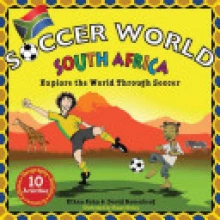
South Africa: Explore the World through Soccer
Written by Ethan Zohn and David Rosenberg
Illustrated by Shawn Braley
Nomad Press, 2010, 48 pp.
ISBN: 978-1934670538
South Africa: Explore the World through Soccer is part of a six-book “Soccer World” series written by professional soccer player, Ethan Zohn, and award-winning television and book author, David Rosenberg. Zhon, who is a main character in the book, teams up with an eight-year-old South African Xhosa girl named Tawela to tell the story of her beautiful country. In the book, we learn why South Africa is called “The Rainbow County,” how to say “hello” in its eleven official languages, what it is like to grow up in Tawela’s neighborhood, the main food dishes, tribal customs and more. To provide children with a “right there” experience of South Africa, the book offers science, social studies and art projects along with recipes and a glossary of terms.
Juxtaposed with a journey through various parts of South Africa is the story of the country’s love for the sport of soccer—a love that seems to unite its people despite their many differences. Zhon says that this game is like a common language that brings people together. He introduces young readers to his motto: “Unity In Diversity,” and while he does not directly address South Africa’s history with apartheid, he mentions that today people are learning to live together in South Africa and that it is important to focus on who people are on the inside instead of what they look like on the outside (p. 4). To demonstrate by example, in chapter two, Ethan and Tawela play soccer with a group of Tawela’s friends. The children are black South Africans who have made a soccer ball out of recycled rags, plastic bags, and string. Because they have no goalposts, Ethan offers his luggage to mark the goals. The game ends in a friendly tie. In the following chapter, we learn that the 2010 world championship of soccer is being held in South Africa and “people from all different walks of life” will come, cheer and have fun together (p. 21).
This book fits, to some extent, with recent books published in South Africa to promote democracy. There is a hint of the past history of apartheid, but the focus is on hope for a better future. Dispersed throughout the text are “Words 2 Know” like “diversity,” “cooperation” and “communication.” The major difference between what Zhon and Rosenberg have produced and the post-apartheid literature that is being published in South Africa is its intended audience. Zhon and Rosenberg, as well as their illustrator, Shawn Braley, are Americans, and the purpose of this book is to provide American children with an opportunity to experience South Africa through soccer. One thing that makes this experience more authentic is the inclusion of Tawela, a black South African child who helps introduce readers to local foods and customs. Another aspect is the accuracy of the portrayal of a segregated country. In chapter two, we visit Tawela’s neighborhood, where the authors do not attempt to portray a racially harmonious South Africa—one in which people of all races, cultures and classes live side by side. Instead, they portray Tawela’s all-black community, where they stay until it is time for the big soccer game.
Because of the various ideas and activities presented in South Africa: Explore the World through Soccer, the book lends itself well to an integrated curriculum. For children in grades 2-5, it brings up opportunities for discussions surrounding anything from tolerance and teamwork to race and class. While not explicit in the text, the illustrations of all black townships and images of poor black children with homemade soccer balls speak volumes, especially when compared with Soccer City, Johannesburg’s 90,000 seat stadium. If encouraged to think critically, children can make a connection between what South Africa is struggling to accomplish in terms of equality with issues encountered in the United States and elsewhere. To help students make the connection between segregation in the United States and South African apartheid, this book could be paired with Goin’ Someplace Special (Patricia McKissick, 2008) or The Other Side (Jacqueline Woodson, 2001). Woodson’s The Other Side might also compliment Rosenberg and Zohn’s efforts to encourage students to ponder what unifies all people, despite race, culture or class.
Desiree Washington Cueto, University of Arizona, Tucson, AZ
WOW Review, Volume III, Issue 3 by Worlds of Words is licensed under a Creative Commons Attribution-NonCommercial-ShareAlike 4.0 International License. Based on work at http://wowlit.org/on-line-publications/review/reviewiii3.


