

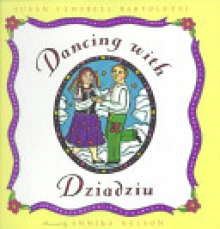
Dancing with Dziadziu
Written by Susan Campbell Bartoletti
Illustrated by Annika Nelson
Harcourt Brace, 1997, 40 pp.
ISBN: 978-0152006754
Dancing with Dziadziu begins with Gabriella performing her snowflake ballet routine for her sick grandma, Babci. Although Gabriella is dissatisfied with her performance, Babci is reminded of the music that she danced to with Gabriella’s grandfather when he was still alive and she tells Gabriella the story of her Polish parents’ cross-Atlantic voyage to the United States. When Babci falls asleep, Gabriella finds her mother in the kitchen preparing an early Easter meal because she is afraid that Babci will not live to Easter. Later, Babci tells Gabriella more stories of her life growing up in the United States, and Gabriella feels connected to her grandmother. On Sunday, the family invites the priest to their house, and they celebrate the early Easter dinner with Polish food, making Babci smile. After dinner Gabriella is able to perform her snowflake routine just right for Babci, and she realizes that dance connects her to her grandmother.
Dance is a tradition that connects people in Gabriella’s family, regardless of the generation. Gabriella knows that she will always remember and honor her grandparents through her dance performances; thus she is able to cross the generational and cultural divide with her grandmother. This theme can provoke a discussion of how traditions are passed down through generations and the ways that we are connected to others although we have different cultural experiences growing up. Other books that would lend themselves to exploring grandchild-grandparents relationships and traditions in families are The Keeping Quilt (Patricia Polacco, 2001), Thundercake (Patricia Polacco, 1997), and Tortillas and Lullabies (Lynn Reiser, 2008).
As a Polish immigrant, I found that many cultural elements included in this picture book are authentic. Gabriella compares her grandmother to a round loaf of bread, a staple of the Polish diet. Babci talks about Polish songs, including the polonaise, polka, and mazurka. The traditional polish clothing and headdress depicted in the book are authentic, including the flowered skirts and vests decorated with beads, braided women’s hair, and halos of ribbons and flowers. A reference to a prized tea set is also reflective of important values in Polish culture. The Easter meal that the family prepares, which includes ham, kielbasa, horseradish, lamb butter, and Paska bread, represents an authentic tradition for Polish Catholics.
The life that Babci describes as an immigrant reflects Polish immigrants’ 20th century experiences, including having to bathe in a washtub, raising chickens, baking bread, and heating the house and water with coal. Anne Nelson’s illustrations portray all of these details and events realistically. Furthermore, Nelson illustrated the text using printmaking, an art form that is practiced in Poland, adding to the authenticity of the text.
At first, as a Polish-speaking reader, the inclusion of the word Babci seemed problematic to me. Polish nouns have declensions based on the context of the sentence. To me, Babci is equivalent to saying Grandmother’s, not Grandma. However, through personal correspondence, the author indicated that Babci is a regional word for Grandmother. Thus, the author represented this family based on what she knew of Polish immigrants in her region (Pennsylvania).
One issue of authenticity is the Easter meal. While all of the foods included in this meal are authentic, the family eats them for dinner. Traditionally, Poles celebrate Easter with a big Sunday breakfast following the morning mass. Although it is possible that this family’s custom has changed because several generations have lived in the United States, the fact that Babci insists on a traditional Easter meal makes me question why the family did not eat it at breakfast time. Also, a staple in the Polish Easter meal is pisanki – colored eggs. While the illustrator included two illustrations of pisanki in the story, they are not mentioned in the text.
Throughout the book there is little use of Polish words to represent Polish concepts; instead only the English translations are used. This takes away from the authenticity of the text, as many Polish immigrants and their descendants think of their traditional foods and customs in the original language, not in their English translation. The colors, illustrations, and immigrant experiences portrayed in Dancing with Dziadziu represent authentic Polish immigrant experiences, but this authenticity is affected by the lack of Polish words. Perhaps if Bartoletti had researched the language of immigrant families, she would have found that words that represent traditional foods, customs, and people are retained in their original language, and would have been able to create a more authentic representation of the language used within Polish families.
Margaret Grabowski, Donna Independent School District, Donna, TX
WOW Review, Volume III, Issue 3 by Worlds of Words is licensed under a Creative Commons Attribution-NonCommercial-ShareAlike 4.0 International License. Based on work at https://wowlit.org/on-line-publications/review/reviewiii3.


