

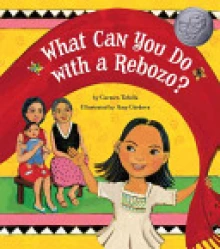
What Can You Do with a Rebozo? Que puedes hacer con un rebozo
Written by Carmen Tafolla
Illustrated by Amy Cordova
Spanish translation by Aurora Hernandez
Tricycle Press, 2008, 32 pp.
ISBN: 978-1582462714
In this English/Spanish bilingual picture book, a young girl questions “What can you do with a rebozo?” The character goes on to list the many ways that a rebozo, or Mexican shawl, is used in her family. The girl shows how rebozos may be worn in the hair, to keep warm, or to make a dress fancier. She also uses her imagination and the rebozo becomes the sash of a pirate, a tunnel, a flying cape, and a slide. However, her favorite thing to do with a rebozo is dance! The author ends the story with an explanation of a rebozo and what it is made of.
The author was raised in the west side barrio of San Antonio, Texas, which is predominately Chicano, “which is the city of my great-grandparents and of my roots” (Tafolla, 2006) Her ancestors and parents helped mold her beliefs and the traditions that she mentions in this story. In the book we cannot tell if the girl lives in Mexico or in the U.S., but it is clear that the traditions and culture that is illustrated have strong Latin American roots. The book mentions traditions that are culturally relevant like piñatas and the song, La Bamba. The illustrator of this book, Amy Cordova, has collaborated with several other authors, like Rodolfo Anaya (2001) on My Land Sings: Stories from the Rio Grande; Diana Cohn (2004) on El Tallador de suenos; and many others. She is an award-winning book illustrator, artist and educator who lives in New Mexico. Cordova likes to represent her multicultural roots: Hispanic, Native American and Anglo in her work.
As bilingual teachers, we have used this book because we connect with our Mexican heritage given to us by our parents and grandparents. The book has been well received by our students and other teachers of Mexican heritage in our campuses. Readers respond to the various uses of rebozos, which they are familiar with from family members in their homes and visits to Mexico. Children relate their personal connections on rebozos and how they are used in their households. Readers are also attracted to the bright, colorful illustrations and details that reflect Mexico, such as the one where the main character is breaking the piñata, or where she is dancing a traditional Mexican dance.
Readers who are unfamiliar with the Mexican culture depicted in the book will enjoy learning about the traditions and uses associated with rebozos. The English text in this English/Spanish bilingual book contains a few Spanish words and phrases that can be understood through the detailed illustrations. Readers who do not speak Spanish should not have difficulty following the text. This is an interesting text to introduce Mexican culture to monolingual English speakers.
This book would make a good addition to text sets on cultures and traditions. It would fit in with a number other of other books of Mexican culture, such as Lets Eat! A Comer! (Pat Mora, 2008); an English/Spanish bilingual book about a Latin American family and their culture in relation to food. Another great pairing is Carmen Tafolla’s, What Can You Do With A Paleta? (2009), which has a similar storyline focusing on paletas, a common Mexican treat. What Can You Do with a Rebozo pairs well with other books, including Abuelito Eats with His Fingers by Janice Levy (1999), which is about a young girl who overcomes her initial reluctance to spend a day with her Spanish-speaking grandfather. Gracias/Thanks by Pat Mora (2009), My Diary from Here to There/ Mi diario de aqui a alla by Amada Irma Perez (2009) or My very own room/Mi propio cuartito by Amada Irma Perez (2008). These are a few books of a long list of books that represent the Latino and Mexican cultures from authors and illustrators who are part of the community.
Clarissa Arteaga, Childrens Academy, Mission, TX
Zaida Cendejas-Omar, Valley View ISD, Valley View, TX
WOW Review, Volume III, Issue 3 by Worlds of Words is licensed under a Creative Commons Attribution-NonCommercial-ShareAlike 4.0 International License. Based on work at https://wowlit.org/on-line-publications/review/reviewiii3.


