

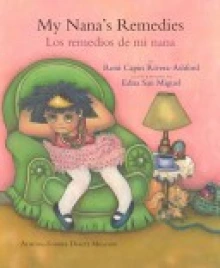
My Nana’s Remedies/ Los remedios de mi nana
Written by Roni Capin Rivera-Ashford
Illustrated by Edna San Miguel
Arizona-Sonora Desert Museum, 2002, 32pp.
ISBN: 978-1886679191.
Cuando no me siento bien, mi nana siempre está a mi lado, y me dice: - Sana, Sana, colita de rana. Si no sanas ahora, sanarás mañana (unpaged)..
This warm and caring story focuses on a loving Nana (grandmother) who prepares a variety of traditional remedies for her young nieta (granddaughter) to treat everything from an upset stomach to being frightened at night. For each ailment Nana prepares a special tea using one of the many herbs as follows: cinnamon, citrus blossom, chamomile, fresh mint, rosemary and other medicinal plants that have been used for years by Mestizos (descendents of Spaniards and Indians) and continue to be used by many Hispanic cultures. In the book Nana is always dressed in a house gown (una vatita), and an apron. Her hair is always pulled up in a nice bun and her facial features are very reminiscent of our own sweet grandmother’s gentle weathered faces. Nana wears a traditional veil to church as many Hispanic grandmothers do today.
Although the book was written about an Indigenous/Hispanic grandmother who lives in the Sonoran Desert region of Arizona which borders Sonora, Mexico, it is very reminiscent of the Hispanic culture we have been exposed to. Our own grandmothers and great grandmothers have done their best to keep with the traditions that they grew up with, in using medicinal plants as medicine, much the same way so many Native American tribes that live along the Sonoran Desert, Tucson, Arizona, the Gulf of California in Western Sonora and Phoenix, Arizona. Whenever our own children are not feeling well we always seek our grandma’s home remedies, much the same way the girl in the book seeks out her Nana. This story encompasses a very traditional way many grandchildren and grandparents foster a nurturing and loving relationship in many Southwestern and Hispanic cultures.
The text is accompanied by the vibrant and captivating art of Edna San Miguel. Nana’s kitchen resembles that of many traditional Southwestern and Hispanic kitchens, with tamales and watermelon on the table, vibrant colors on the walls and fruit designed dishes. Other texts that could also be used when discussing and learning about cultures and traditions could include, Grandma and Me at the Flea (Juan Felipe Herrera, 2002, see WOW Review Vol. 1, 3), as well as Too Many Tamales (Gary Soto, 1993). Each one of these books portrays strong Hispanic culture and tradition, one that encompasses love and nurturing relationships.
Rivera-Ashford was born to a Nogales, Arizona pioneer Jewish family and grew up in this small town on the border of Mexico where she embraced the people, their language and culture since she was an infant. She is a certified, bilingual elementary schoolteacher and a Spanish language translator/interpreter.
Lisa Castro-Salinas and Jessica Guerra-Salinas, La Joya ISD, La Joya, TX
WOW Review, Volume III, Issue 3 by Worlds of Words is licensed under a Creative Commons Attribution-NonCommercial-ShareAlike 4.0 International License. Based on work at https://wowlit.org/on-line-publications/review/reviewiii3.


