

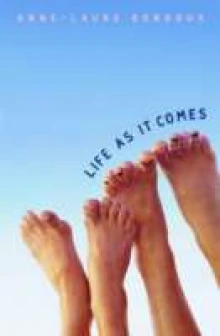
Life as It Comes
Written by Anne-Laure Bondoux
Delacorte Books, 2008, 211 pp.
ISBN: 978-0440239697
“I watch Patty as she chews her gum. Her mouth opens, closes, distorts. In the silent apartment, the spongy noise of her mastication marks the passage of time like the ticktock of a clock” (p. 1).
Thus begins the story of Life as It Comes, an adolescent novel set in France. The book tells the story of two French sisters, Mado, who is fifteen years old, and Patty, who is twenty years old, as they struggle to make their way in life. The two sisters stick together, soon finding that their lives will become intertwined forever.
Although Patty is the older sister, she is more carefree. Mado, the younger sister, is the “brainy” one. The sisters are orphans; their parents died in a car accident in the south of France the year before. Patty goes to Amsterdam to have an abortion, but she is too far along in her pregnancy. For two weeks in August, the sisters go to the family vacation home in the Ardèche, a region in southern France. While there, Patty gives birth to her baby boy. One morning, Mado wakes up to find that Patty has left for destinations unknown. When Luigi, Patty’s ex-boyfriend, arrives looking for her, he discovers he is now a father. They go in search of Patty, finally locating her in Paris. Luigi decides he wants to keep the baby, and so he and Patty share custody. Mado ends the book by realizing that despite all its toils, life is worth living: “One of the things I’ve learned lately: even through hard times, life is worth it” (p. 209).
The story in Life as It Comes revolves around each character’s inner struggles to resolve competing loyalties. Patty wants to live a carefree existence while also realizing that she must take care of her younger sister. Mado wants to be able to live her own life while also realizing that she needs to be responsible for the baby. Luigi is torn between being a father to his newborn son and rekindling his relationship with Patty. The characters in this book struggle to find their way in life while also coping with the problems life throws at them. Despite their struggles, each character finds moments of peace and happiness within the chaos that is their lives.
Life as It Comes has qualities that are specific to French culture and other qualities that are universal in nature. In the story there are specific references to French culture. Some of the names in the book are French (Mado, Judicaëlle), and the names of other characters are names used in both France and other countries (Patty, Olivia, Maude, Sabrina, Luigi). Several places in both Paris (the Butte de Monmartre, the Eiffel Tower Aubervilliers, La Chapelle, the Seine) and France (Ardèche, Lille, Nanterre, Senlis, Pas-de-Calais) are mentioned as well as several French food items (brioche, pain au chocolat). The overall plot of the story, however, is common not only in France but in many other countries as well. Bondoux does a great job of combining elements that are specific to France and French culture with other elements that are more universal.
This book can be paired with other books by the same author, including The Killer’s Tears (2007), a story of a young Chilean boy who is orphaned and taken care of by his parents’ murderer, and A Time of Miracles (2010), a story about a seven-year-old boy who flees with his caretaker during the collapse of the Soviet Union. The book can also be paired with other books on characters who struggle with family relationships, including The Pull of the Ocean (Jean-Claude Mourlevat, 2009), a modern-day version of Tom Thumb, Ask Me No Questions (Marina Tamar Budhos, 2007), the story of a fourteen-year-old Bangladeshi girl living as an undocumented person in New York, and Skinny (Ibi Kaslik, 2006), the story of a twenty-two-year-old girl who seems to have a full life but underneath experiences many problems based on her relationship with her deceased father.
Anne-Laure Bondoux was born in a suburb surrounding Paris in 1971 and lives there today with her two children. She received her degree in modern letters at the University of Paris X-Nanterre. She has created writing workshops for children in urban areas. In addition to the titles mentioned above, Bondoux is the author of other books about children--The Destiny of Linus Hoppe (2006), and The Second Life of Linus Hoppe (2007).
Brian Hibbs, University of Arizona, Tucson, AZ
WOW Review, Volume III, Issue 3 by Worlds of Words is licensed under a Creative Commons Attribution-NonCommercial-ShareAlike 4.0 International License. Based on work at https://wowlit.org/on-line-publications/review/iii-3.


