

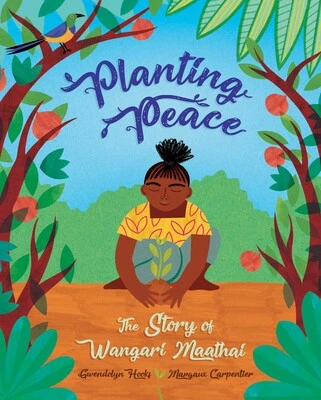
Planting Peace: The Story of Wangari Maathai
Written by Gwendolyn Hooks
Illustrated by Margaux Carpentier
Crocodile Books USA, 2021, 64 pp
ISBN: 978-1623718855
Planting Peace is a powerful biography of Wangari Maathai, the first African woman to win the Nobel Peace Prize. She was also the founder of the Green Belt Movement in Kenya, which focused on planting trees, environmental conservation, and women's rights. Her movement led to the planting of over 30 million trees. This nonfiction picturebook shows how one woman can make a big difference.
The narrative follows Maathai's life from her coffee-farming childhood in rural Kenya where she was fascinated by nature, to her later years as a scientist and activist. Hooks tells about the societal barriers Maathai faced along the way. The text highlights how deforestation affected Kenya's ecosystem where rivers dried up, wildlife disappeared, and women walked miles to find firewood. In response, Maathai encouraged women to plant trees to heal the land and to restore their communities.
Carpentier's illustrations use vibrant color palettes and bold shapes to depict Kenya's landscapes. Her images often fill the page with layered textures and repeating motifs, such as tree seedlings and outstretched hands. These design choices suggest unity and movement. The women are portrayed in traditional clothing and engaged in communal planting, reinforcing the idea of cultural and environmental restoration working hand in hand.
The book is a celebration of Maathai's life but misses some parts of the greater narrative that makes this woman's story rich and nuanced. The book portrays groups of Kenyan women working together, but the narrative centers almost exclusively on Maathai. Her collaborators are unnamed, and their voices are not heard. The book also omits details about the personal and political risks Maathai faced, including government opposition and imprisonment. Without these, readers may walk away with a story of triumph, but not a full understanding of the challenges.
Planting Peace acts as both a mirror for readers who identify with environmental activism and African heritage and as a window for those unfamiliar with Wangari Maathai's legacy. Through Hooks's storytelling and Carpentier's symbolic illustrations, young readers are invited to observe and to imagine themselves as changemakers.
Planting Peace could be paired with Wangari's Trees of Peace: A True Story from Africa (Jeanette Winter, 2008), another text about Maathai's important work. Other books about Maathai include Mama Miti (Donna Napoli & Kadir Nelson, 2010), Seeds of Change (Jen C. Johnson & Sonia Lynn Sadler, 2010), Planting the Trees of Kenya: The Story of Wangari Maathai (Claire Nivola, 2008), and Wangari Maathai: The Woman Who Planted Millions of Trees (Franck Prévot & Aurélia Fronty, 2017). Titles that introduce younger readers to other climate warriors include As the Seas Rise: Nicole Hernández Hammer and the Fight for Climate Justice (Angela Quezada Padron, 2024) and The Girl Who Heard the Music: How One Pianist and 85,000 Bottles and Cans Brought New Hope to an Island (Marni Fogelson, Mahani Teave, & Marta Alvarez-Miguéns, 2023).
Gwendolyn Hooks is an African American writer who focuses on stories that encourage children to explore the world. Before becoming a full time author, she taught middle school math. Hooks is the author of the NAACP Image Award winning picturebook biography, Tiny Stitches-The Life of Medical Pioneer Vivien Thomas (2016). You can find out more about the author and her books on her website.
Illustrator Margaux Carpentier grew up in France but is now based in London. She is known for her folkloric style, blending modern design with traditional patterns. Her art emphasizes unity, color, and natural patterns, all of which enrich Maathai's story with visual metaphor.
Casey Holland, Texas Woman's University
© 2025 by Casey Holland
Authors retain copyright over the reviews published in this journal and grant the journal right of first publication with the work simultaneously licensed under the following Creative Commons License:
WOW Review, Volume XVII, Issue 4 by Worlds of Words is licensed under a Creative Commons Attribution-NonCommercial-ShareAlike 4.0 International License. Based on work by Casey Holland at https://wowlit.org/on-line-publications/review/xvii-4/11.
WOW review: reading across cultures
ISSN 2577-0527


