

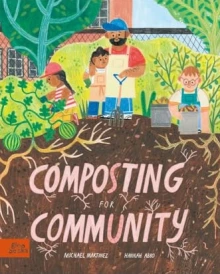
Composting for Community
Written by Michael Martinez
Illustrated by Hannah Abbo
Gloo Books, 2023, 40 pp (unpaged)
ISBN: 978-1737240488
Mateo and his classmates are presenting the various professions their family members engage in such as running a taco truck, making TV shows, or painting city murals. Mateo's father is a city composter, and when Mateo's presentation does not capture his classmates' interest, he tries to understand more about his father's profession. Starting with his Abuelo's and Tio's history of turning discarded items into things of beauty, Mateo learns more about the similar process of turning food scraps into rich soil. His father explains the various stages of composting and the science behind turning food waste into food for the soil. As his father shows him the compost bins in the community garden, Mateo also notices the community that is built as people work together in the garden. As he begins to understand, his enthusiasm grows. Mateo asks his father if he can start composting at his school, so family members and friends pitch in to build bins that his classmates begin to fill with food waste from the cafeteria. Mateo's changed understanding is summarized by his father's statement: "You saw something beautiful where others saw nothing" (p. 33).
The book is based on Michael Martinez's work as the founder, Executive Director, and composter for LA Compost, a nonprofit organization that is a community network of over fifty community composting locations in the city of Los Angeles. The narrative is a compelling combination of Mateo's growing understanding of repurposing, a high value held by his extended family, and the science behind turning plant waste into rich food for the soil. The end of the book includes practical suggestions on reducing waste and growing community through composting. The story is told in a way that makes composting a compelling necessity in city plans that address climate change.
Hannah Abbo's primitive style of art helps convey Mateo's enthusiasm for composting. The vivid and joyful colors of the page spreads are full of details that make reading the book a sensory experience. Dark somber tones portray the waste in a landfill, decomposing and creating dangerous methane gas. In contrast, three spreads depict the trio of composting bins and stages by incorporating insets that describe the science of decomposition, digestion, and curing of the compost. Complete with images of heat vapors, macro and microorganisms, and thermometers to track the stages, composting becomes a process that helps the planet, replenishes soil, and returns food to the soil for the next cycle of life.
The foundation of the story is the value of collecting waste to create beauty, whether that is turning a discarded table into a beautiful centerpiece in a living room, building a clubhouse from project leftovers, or making salsa from vegetable scraps. Several titles pair well because of similar philosophies. Using fabric scraps to create new items of clothing or art is presented in titles like the classic Something from Nothing (Phoebe Gilman, 1993), The Clever Tailor (Srividhya Venkat & Nayantara Surendranath, 2019), Malaika's Costume (Nadia Holn & Irene Luxbacher, 2016), Patchwork Prince (Baptiste Paul & Kitt Thomas, 2023), and Stitchin' and Pullin': A Gee's Bend Quilt (Patricia McKissack & Cozbi Cabrera, 2008). Recycling is at the heart of turning waste into something new and useful, though recyclers often are not involved in the creation of something new. Several titles that show participants the whole process of collecting and recreating are Flipflopi: How a Boat Made from Flip-Flops Is Helping to Save the Ocean (Linda Lodding, Dipesh Pabari, & Michael Mwangi, 2023), Scrap Metal Swan: A River Clean-Up Story (Joanne Linden & Estrellita Caracol, 2022), and Ada's Violin: The Story of the Recycled Orchestra of Paraguay (Susan Hood & Sally Comport, 2016).
Michael Martinez first learned about composting in his grandfather's garden where he noticed that plants thrived in environments that were teaming with life. As a fifth-grade teacher, he started an after-school garden club to help his students create connections around food, soil, and community. LA Compost (his nonprofit) began as an effort to collect food scraps from juice bars, coffee shops and taco shops, composting the waste in friends' and family members' backyards. However, it soon morphed into multiple community composting locations spread across Los Angeles County. A wealth of print and video information about composting can be found on the LA Compost website and blog where readers can hear Michael Martinez and his team explain aspects of composting in English or Spanish.
Hannah Abbo is a self-taught illustrator from the UK, but currently lives and works in Lisbon, Portugal. She used to be an illustration agent at Advocate Art, so in order to avoid a conflict of interest, created illustrations under the pseudonym Jean Claude. When she is not drawing, she loves making ceramics in a local studio, visiting the botanical gardens, rollerblading, and baking bread. Her concern for nature is evident in titles she has illustrated: How Not to Kill Your Plant (Magda Gargulakova & Lenka Chytilova, 2023), and Little Tree and the Wood Wide Web (Lucy Brownbridge, 2023).
Susan Corapi, Trinity International University
© 2025 by Susan Corapi
Authors retain copyright over the reviews published in this journal and grant the journal right of first publication with the work simultaneously licensed under the following Creative Commons License:
WOW Review, Volume XVII, Issue 4 by Worlds of Words is licensed under a Creative Commons Attribution-NonCommercial-ShareAlike 4.0 International License. Based on work by Susan Corapi at https://wowlit.org/on-line-publications/review/xvii-4/5.
WOW review: reading across cultures
ISSN 2577-0527


