

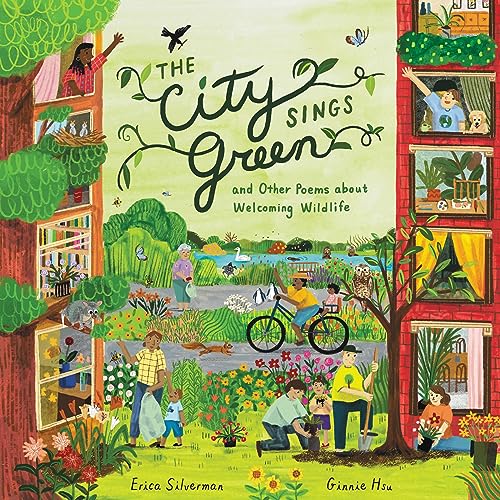
The City Sings Green & Other Poems about Welcoming Wildlife
Written by Erica Silverman
Illustrated by Ginnie Hsu
Clarion Books, 2024, 40 pp
ISBN: 978-0358434566
This multigenre nonfiction picturebook, which blends poetry with informational text, portrays the environmental impact of human activity and highlights ways to rewild cities with examples from across the globe. The book opens with this powerful and evocative poem.
The City Sings Green:
Green me, sings the city.
Dig my dirt and seed me.
Plant my streets, my yards, my lots
with native shrubs and trees. (p. 4)
Clean me, sings the city.
Take out the trash.
Remove the fumes.
Purge all poisons from my soil. (p. 5)
This poem gives voice to the city, creating a strong emotional appeal and setting the tone for environmental awareness and action. As the city continues its song over the next two pages, richly detailed illustrations depict scenes of interdependence between humans and nature. The city's voice urges, "Rewild me, sings the city, and I will rewild you" (p. 7), echoing the message of restoring ecological balance and reconnecting people with the natural world. This theme is further supported by informational text that highlights global efforts to prevent extinction and revitalize urban ecosystems.
Subsequent pages explore the transformation and revitalization of animal and plant habitats –shaped over time by human actions–through poems paired with brief informational text. In one poem about the Bronx River in New York City, readers learn of its degradation. Once a thriving habitat for beaver families, the Bronx River had become severely polluted. This problem was exacerbated by European colonists who hunted beavers nearly to extinction for their pelts. A grassroots cleanup effort initiated by local residents in the 1980s eventually restored the river's ecosystem. In 2007, a beaver returned for the first time in nearly three hundred years.
In Busselton, Australia, a poem gives voice to possums reacting to a rope bridge constructed above a busy road:
"But wait! What's this? How mysterious!
A bridge? For us? We're curious.
It stretches above the road below." (p. 22)
The possums are excited to realize they can now "leap and scurry everywhere" from the canopy above instead of trying to cross the road. The personification of possums encourages readers to view the world from the animals' perspective, fostering empathy and connection. The accompanying informational text explains how highway construction and tree removal have endangered possums in Australian cities. Innovative interventions by scientists prompt deeper reflection on habitat preservation and sustainable urban planning.
The final location featured in this book is Versova Beach in Mumbai, India. A poem from the perspective of Afroz Shah, an environmental activist and lawyer, reflects his childhood memories of the clean beach and days of swimming and diving–now littered with plastic bottles, rags, and bags. Paired with an illustration of the beach covered in trash, the poem poignantly captures the emotional loss caused by pollution. Shah began cleaning the beach with a small group of volunteers, a movement that grew over time and led to the full restoration of the shoreline. Remarkably, sea turtles, once absent, returned to nest on the beach. The United Nations recognized Shah's efforts as "the world's biggest beach cleanup."
The backmatter is rich with resources, offering website links and recommended books for young readers, families, and educators to further explore animal habitats and urban rewilding initiatives featured in this book. It also provides practical actions children can take in their daily lives, individually or as a community, such as observing local wildlife or placing decals on windows to prevent bird collisions.
Suggested children's books to read with this title include The Curious Garden (Peter Brown, 2009), Crossings: Extraordinary Structures for Extraordinary Animals (Katy Duffield & Mike Orodán, 2020), Wildlife Crossings of Hope (Teddi Lynn Chichester & Jamie Green, 2025), and Nature's Best Hope: How You Can Save the World in Your Own Yard (Sarah Thomson & Douglas Tallamy, 2023). These texts pair beautifully with The City Sings Green to explore urban wildlife and environmental stewardship, encouraging children to think critically and act responsibly toward the environment.
Erica Silverman resides in California and has a deep love for both urban life and wildlife. Her works include Jack (Not Jackie) (2018), illustrated by Holly Hatam, which follows a big sister learning to embrace her younger sibling's gender identity, and Wake Up, City! (2016), illustrated by Laure Fournier, the story of a young girl and her father's morning walk to school as the city slowly wakes up around them. More about her work can be found on her website.
Ginnie Hsu, the illustrator, lives in upstate New York. Her childhood in Taiwan, and her upbringing with her grandparents, strongly influence her artistic identity. Her recent works include The Chinese New Year Helper (Ying Chang Compestine, 2024) and The World That Feeds Us: Discover How Our Food is Produced in a Sustainable Way (Nancy Castaldo, 2023). She also illustrated Lady Bird Johnson, That's Who!: The Story of a Cleaner and Greener America (Tracy Nelson Maurer, 2021). Hsu's illustrations frequently center on the relationship between nature and human life. Her portfolio is available on her website.
Junko Sakoi, Tucson Unified School District
© 2025 by Junko Sakoi
Authors retain copyright over the reviews published in this journal and grant the journal right of first publication with the work simultaneously licensed under the following Creative Commons License:
WOW Review, Volume XVII, Issue 4 by Worlds of Words is licensed under a Creative Commons Attribution-NonCommercial-ShareAlike 4.0 International License. Based on work by Junko Sakoi at https://wowlit.org/on-line-publications/review/xvii-4/3.
WOW review: reading across cultures
ISSN 2577-0527


