
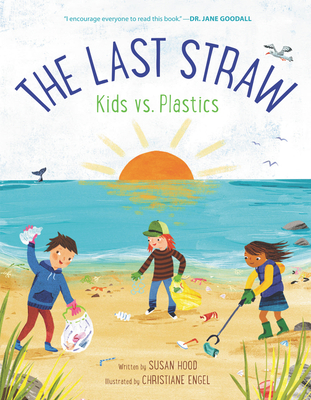
The Last Straw: Kids vs. Plastics
Written by Susan Hood
Illustrated by Christiane Engel
HarperCollins, 2021, 48 pp
ISBN: 978-0062981394
From the introduction to the “News You Can Use” at the end of the back matter, The Last Straw: Kids vs. Plastics is a child-centered book. After the introduction, written by a young person who has had an international impact on preserving the environment, author Susan Hood offers seventeen rhyming poems. She presents informational pullouts and quotes from young climate activists or researchers on each double-page spread. Christiane Engel’s charming child-friendly illustrations complete the hopeful message that everyone–no matter how old they are or where they live–can make a difference.
When he was nine years old, Milo Cress, who wrote the intro, realized that using a straw with every drink he ordered was a waste of resources and terrible for the planet. He learned that a kid could be a voice for change when he founded BeStrawFree.org, which is now hosted on EcoCycle. Milo worked to minimize the use of plastic straws, bags, and bottles. He encouraged adults to follow his lead and other children to find projects about which they are passionate in order to change the world for the better.
Susan Hood's seventeen rhyming poems include "Fantastic Plastic," "The Great Pacific Garbage Patch," "For the Love of Frogs," and "Stand Up, Speak Up." The rhyme schemes vary but the end-of-the-line rhymes can draw listening readers into the poem when they provide the rhyming word. Hood's poems use known forms such as a cumulative poem in "Plastic for Dinner," (like "This Is the House that Jack Built") as well as the limerick in "Mr. Trash Wheel."
The informational paragraph that accompanies each poem provides facts that may surprise, shock, or delight readers. For example, there actually is a "Mr. Trash Wheel." Installed in 2014, it gobbles up trash floating down a river before it gets to the Baltimore harbor. "Ode to the Jellyfish" tells how researchers discovered that jellyfish mucus can capture microplastics to reduce the amount in the ocean. The quotes from researchers and young climate activists offer inspiration and motivation to become knowledgeable and involved. The back matter includes an author's note, timeline, source and poetry notes, and more.
In a straightforward manner, Christiane Engel's acrylic, watercolor, and Adobe Photoshop artwork accurately illustrates the information found on each page. Her spot illustrations, which are included in the back matter, make that section of the book an attractive destination to further readers' interest. This design results in an overall child-friendly presentation.
Although this book is catalogued and shelved with nonfiction, it has been criticized for not having sufficient "information" to be considered nonfiction. I disagree with that assessment. Books like this one pique young readers' curiosity and can motivate them to learn more. In addition, today's children will likely use digital resources rather than informational books alone to satisfy their further information needs.
The Last Straw: Kids vs. Plastics can be paired with any number of books in this issue of WOW Review. Another possible pairing is Black Beach: A Community, Oil Spill, and the Origin of Earth Day (2023). This fiction picturebook could help children connect further with their own agency in responding to environmental issues. Written by Shaunna and John Stith and illustrated by Maribel Lechuga, Black Beach tells the story of the 1969 Union Oil spill off the coast of Santa Barbara, California. The protagonist in the story is Sam, a primary school-aged child, who is, at first, horrified by the destruction of her favorite place–the beach at Santa Barbara. When her parents and community become actively involved in saving the oil-coated seabirds, Sam is inspired to take action. Sam and her friends bottle up the oil from the beach and mail it to politicians, who finally realize the breadth of the environmental destruction. As a result of their activism, Senator Gaylord Nelson of Wisconsin proposed a national teach-in on environmental issues, which led to the first annual celebration of Earth Day on April 22, 1970. Black Beach ends with children in Sam's school participating in an Earth Day assembly, during which they recycle and learn about many other ways to preserve the environment. Along with 20 million other people who participated in that first Earth Day, Sam and her classmates joined an international movement to celebrate and protect the planet. Books like The Last Straw and Black Beach can help children understand they can make a difference.
Author Susan Hood writes early readers, picturebooks, and middle grade novels. Her books have earned numerous awards, including a 2022 NCTE Notable Poetry book award for The Last Straw. Hood lives in coastal Connecticut. Visit her online.
Christiane Engel is both a children's illustrator and author. She states her goal is to inspire readers to be curious and compassionate about the world. Engel lives in Kent, England.
Judi Moreillon, Tucson, Arizona
© 2025 by Judi Moreillon
Authors retain copyright over the reviews published in this journal and grant the journal right of first publication with the work simultaneously licensed under the following Creative Commons License:
WOW Review, Volume XVII, Issue 4 by Worlds of Words is licensed under a Creative Commons Attribution-NonCommercial-ShareAlike 4.0 International License. Based on work by Judi Moreillon at https://wowlit.org/on-line-publications/review/xvii-4/9.
WOW review: reading across cultures
ISSN 2577-0527


