

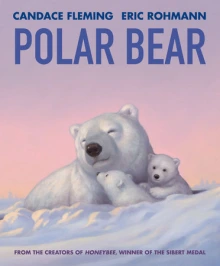
Polar Bear
Written by Candace Fleming
Illustrated by Eric Rohmann
Neal Porter Books, 2022, 40 pp (unpaged)
ISBN: 978-0823449163
This story of a mother and her two cubs starts in April in the Arctic. The reader's attention is caught with a description of the mother polar bear "crawling from her icy den, seeing her world for the first time in five months...For all that time, she has been in the den she dug beneath the snow. Not eating. Never leaving. Surviving on her stored fat." There she gives birth to two cubs that she nurses, keeping them safe and warm for four months. As the babies grow bigger, the mother grows thinner.
Now she is ready to go home to the ice where she will hunt and regain weight. But before she can take the cubs on this journey, the mother must get her cubs used to the outdoors and the cold. Once the cubs are ready, their journey begins to their new ice home. While grown bears can walk fifty miles a day, the babies' tiny legs tire quickly. The mother has to stop and nurse them, giving them time to nap before they are ready to walk again.
The cubs with this careful guidance and protection of their mother, travel forty miles to reach their new home in the Hudson Bay. There the mother hunts seals and regains her weight. Then a disaster occurs: the ice that the family is on breaks off, and they are carried far out to open water. While adult bears can swim sixty miles nonstop, young cubs cannot swim that long, but they have no choice. The mother must take the cubs into the Arctic water to swim back to land. It is an arduous, rugged journey of many hours and they barely make it. A dramatic fold-out of four pages opens up to show their lengthy journey to safety.
The lack of stretches of solid ice make it hard for the mother to survive in the summer. When there is no sea ice the bears cannot catch seals, their main source of nutrition. During the summer the mother again "lives mostly on her fat store. The babies live mostly on her milk...They are waiting for the return of the ice." Their wait continues, but it is taking too long. The mother's hunger grows and the layer of fat needed to sustain her cubs is disappearing. She desperately needs to eat. Finally, in December the ice returns and with that the opportunity to hunt seals again. The cubs will stay with their mother through this second frigid winter and the next spring and summer seasons. However, when the cubs' third winter comes, each member of the family travels on, alone.
There is an aspect in this account that is somewhat unusual for a nonfiction book. It is the portrayal of unwavering support, care and sacrifice given by the mother to her cubs. In every threatening incident in their journey back and forth to the ice, she puts her own wellbeing last and the cubs' first, a powerful reminder of what being a mother means. This part of the book may promote a lively discussion of how mothers care for their offspring.
Eric Rohmann's luminous oil illustrations enhance the narrative of the icy snow and changing hues of the light blue skies in the long Arctic summer days. The white snow is an effective backdrop for the lively cubs and their wise, caring mother. Some of the pictures are close ups that allow us to see the curiosity on the bears' faces and the actions of their bodies. Other pictures stretch out to show the incredible space of ice and water. Rohmann uses tones of blue and white effectively to showcase the bears and their surroundings. Scenes, like when wolves attack the family, are set off by a bright, blue background. Other vistas show the Northern Lights and the dark nights of winter.
The back matter is particularly effective in giving more information about the bears. A diagram of an adult bear describes how the physical adaptations of the bears enable them to survive the bitter Arctic cold. The informative section, "It's All About the Ice," discusses how global warming is impacting the lives of the bears. As the Arctic ocean warms, the sea ice in Hudson Bay melts, effectively cutting short the time the bears have to hunt and build up stores of body fat.
Fleming explains that the warming is due to human-caused climate change and describes how global warming is impacting the Arctic. Then she offers hope with a list of actions to save the sea ice and help polar bears survive. The actions are simple but they can make a difference, offering hope to young people. The back matter also includes "A Few Cool Facts" about polar bears. There are two lists of online resources about polar bears and a bibliography of books that will encourage readers to learn more. There is more information included in the back matter with "Polar Bears Online," and a selected bibliography of other books about polar bears and their environment. Using this information, children may be inspired to take action and be involved in projects to make a difference for the bears.
Books that pair well with Polar Bear are the two nonfiction titles that are collaborations between Candace Fleming and Eric Rohman, Honeybee: The Busy Life of Apis Mellifera (2020) and Giant Squid (2015). Another title, Emperor of the Ice: How a Changing Environment Affects a Penguin Colony (Nicola Davies & Catherine Rayner, 2023), pairs well because it describes the impact of melting ice on the breeding grounds for the penguins.
Candace Fleming has written over fifty books for children. She has won the Orbis Pictus Award, the Sibert Award, the Los Angeles Times Book Prize and is the two-time winner of the Boston Globe/Horn Book Award. Readers can find out more about her on her website.
Eric Rohman won the Caldecott Medal for illustrations in My Friend Rabbit (2002) and a Caldecott Honor for Time Flies (1994). He works in two distinct styles, oil paintings and cartoon-like relief prints. More information about his illustrations and process can be found on his website.
Marilyn Carpenter, Eastern Washington University
© 2025 by Marilyn Carpenter
Authors retain copyright over the reviews published in this journal and grant the journal right of first publication with the work simultaneously licensed under the following Creative Commons License:
WOW Review, Volume XVII, Issue 4 by Worlds of Words is licensed under a Creative Commons Attribution-NonCommercial-ShareAlike 4.0 International License. Based on work by Marilyn Carpenter at https://wowlit.org/on-line-publications/review/xvii-4/12.
WOW review: reading across cultures
ISSN 2577-0527


