

Flooded
Written and illustrated by Mariajo Ilustrajo
Frances Lincoln Children's Books, 2022, 34 pp (unpaged)
ISBN: 978-0711276765
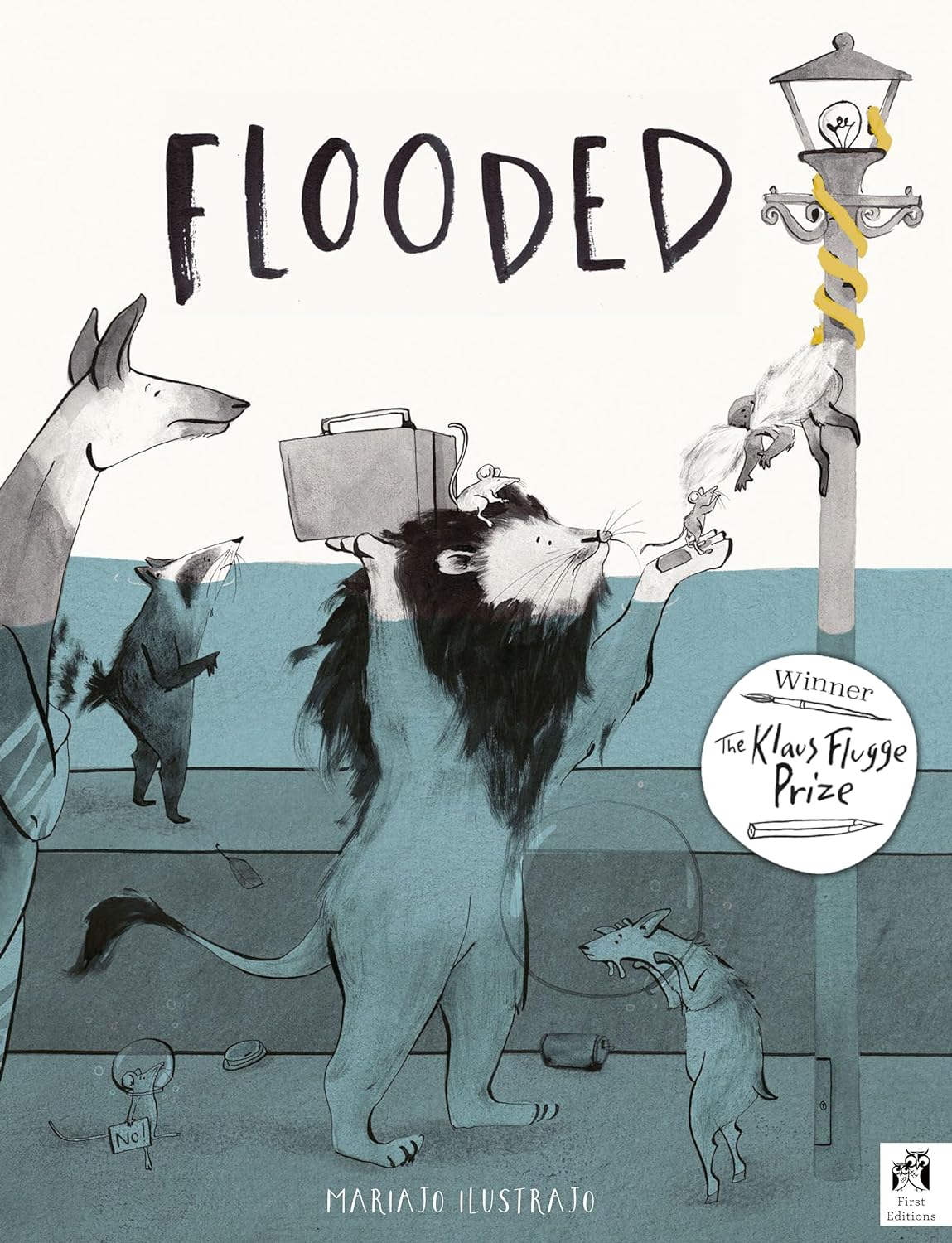
A town populated by wild and domestic animals is experiencing problems with water. The emperor tamarin is the first to notice the pervasive damp conditions on the streets. After putting on his rubber boots, he tries to draw the animals' attention to the accumulating water, but everyone is enjoying the chance to wear wellies. Everyday life carries on with adult animals talking about the water at work, while young animals enjoy playing in the water accumulating in their classrooms. But as the water keeps rising, surprising events occur. In a classy restaurant, dinners are interrupted as a rowing crew of mice practices between tables. Tall animals visiting an art museum comment on the wet paintings and voice their assumption that the rising water will eventually go away. Short animals can only walk around with diving bells, snorkels and scuba gear. Soon only the tall animals can continue to function normally, and they begin to wonder where the water is coming from. A protest is organized, complete with signage, demanding a solution. Finally, the animals listen to the tamarin who has been trying to get their attention for a long time. He has a solution, but it is going to take the whole community working together to solve the problem. Large and small, strong and not-so-strong, they all line up, tug on the drain plug, and soon the water drains away. All is now well--but the experience has changed the community. There are new problems (litter from the flood, small animals stuck on top of poles with no way to get down), but the animals now recognize the only way to fix a problem is working together.
The illustrations are simple but full of humor as the animals take on characteristics of humans and contemporary society (e.g. eating in an upscale restaurant, sitting in a classroom, visiting a museum complete with paintings of mice in the medieval wedding portrait by Jan van Eyck, and gazelles portraying The Kiss by Gustav Klimt). The narrative text is minimal with speech bubbles displaying the emotions, thoughts, and conversations of the animals. The black-and-white pen and ink illustrations have only two touches of color, the blue water and the golden tail of the tamarin. The blue increasingly fills the pages as the water rises, and the golden tail makes the communication efforts of the tamarin pop off the spreads, highlighting his questions and pleas for help.
This book functions as both a commentary on our society and a call to communities for collective action. The illustrations mimic daily commutes in cities with animals focused on getting to work, paying more attention to their cellphones, headphones, and specialty drinks, than to the voice of the tamarin who frantically tries to get their attention. At work they discuss the moisture issue, blaming it on a hippo leaving the tap on or the politicians. It is only when coping strategies become more difficult for everyone that the tamarin could finally get everyone's attention and share his plan for collective action.
Books that pair well with Flooded are ones that emphasize collective action. In Amara and the Bats (Emma Reynolds, 2021), Ganesha Goes Green (Lakshmi Thamizhmani & Debasmita Dasgupta, 2023), and Join the No-Plastic Challenge (Scott Ritchie, 2019), young children galvanize their peers and adults around them to build habitats for bats, use non-polluting clay for statues, and have a no-plastic birthday party. Indigenous titles like Stand as Tall as the Trees (Patricia Gualinga, Laura Resau, & Vanessa Jaramillo, 2023) and Autumn Peltier, Water Warrior (Carole Lindstrom & Bridget George, 2023) demonstrate the time it takes to build a collective movement and create change. Finally, in Listen to the Earth (Carme Lemniscates, 2022), it is clear that in order to move Earth Overshoot Day (the date each year that human demand exceeds what the earth can produce and absorb) it will take everyone making efforts in many ways to find the balance that protects our planet.
Mariajo Ilustrajo is an illustrator from Spain currently living in the UK where she earned a master's degree in children's book illustration from Anglia Ruskin University. She is enthusiastic about creating art and has worked in a wide variety of art-related jobs including illustrating websites, painting murals, and designing wedding invitations and other greeting cards. She also served as an artist in residence in India, printing with metal and wood in traditional lithography and xylography. In an interview on YouTube, Mariajo explains her artistic process in creating Flooded. In an interview with a member jury of the Klaus Flugge Prize (which was awarded to Flooded), Mariajo explains her process in more detail. More information about Mariajo can be found on her website.
Susan Corapi, Trinity International University
© 2025 by Susan Corapi
Authors retain copyright over the reviews published in this journal and grant the journal right of first publication with the work simultaneously licensed under the following Creative Commons License:
WOW Review, Volume XVII, Issue 4 by Worlds of Words is licensed under a Creative Commons Attribution-NonCommercial-ShareAlike 4.0 International License. Based on work by Susan Corapi at https://wowlit.org/on-line-publications/review/xvii-4/6.
WOW review: reading across cultures
ISSN 2577-0527


