

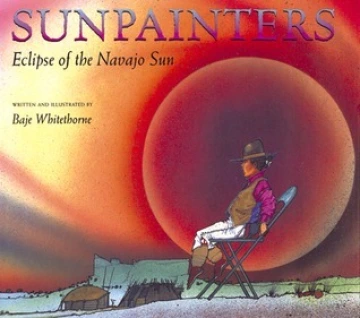
Sunpainters: Eclipse of the Navajo Sun
Written and illustrated by Baje Whitethorne
Salina Bookshelf, 2002, 32pp (unpaged)
ISBN: 978-1893354333
This luminous picture book blends Navajo cosmology, intergenerational wisdom, and the awe of natural phenomena into a story that is both educational and deeply spiritual. The book follows a young Navajo boy named Kii Leonard as he experiences his first solar eclipse under the guidance of his grandfather, Pipa. Through vivid storytelling and rich illustrations, Whitethorne offers a culturally authentic and thematically resonant narrative that celebrates Navajo traditions and the power of storytelling.
The story begins with Kii Leonard sitting in his favorite juniper tree, listening to the radio. Suddenly, his grandfather announces that the sun has died. Confused and frightened, Kii notices the world around him has started to darken into deep purples and reds. This moment of fear is transformed into wonder as Pipa explains the Navajo understanding of a solar eclipse. According to Navajo tradition, the Na’ach’aahii—Little Painters—are summoned from the four sacred directions (North, South, East, West) to repaint the world during an eclipse. These spiritual beings restore balance and beauty to the universe, using the colors of the rainbow to renew life.
Whitethorne’s text is poetic and accessible, capturing the voice of a child while honoring the depth of Navajo theology of the universe. The dialogue between Kii and Pipa is gentle and reverent, emphasizing the importance of oral tradition and familial bonds in transmitting cultural knowledge. The narrative structure is simple yet profound, allowing young readers to grasp both the scientific and spiritual dimensions of an eclipse. The illustrations are a standout feature of the book. As a celebrated Navajo artist, Whitethorne brings his heritage to life through bold, expressive artwork that completely captures the painted desert of Arizona. The palette shifts dramatically to reflect the eclipse, with deep purples, reds, and blacks enveloping the landscape. The Na’ach’aahii are depicted as ethereal, childlike figures with paintbrushes, adding a magical realism that complements the story’s spiritual tone. The visual storytelling enhances the emotional arc of the narrative, moving from fear to awe to renewal.
Culturally, Sunpainters is a rich tapestry of Navajo beliefs, language, and worldview. The book introduces readers to Navajo traditions in a respectful and authentic manner, avoiding stereotypes or simplifications. The use of Navajo terms like “Na’ach’aahii” and the emphasis on the four sacred directions reflect a deep engagement with the culture. The story also highlights the role of elders in Indigenous communities as keepers of knowledge and tradition. Pipa’s calm, wise presence contrasts with Kii’s youthful curiosity, illustrating the intergenerational transmission of cultural identity. Kii’s determination to follow Pipa’s directions of denying himself both food and water during the eclipse blossoms beyond respect for one’s elders to a reverent connection to heritage and the unique experience of witnessing an eclipse.
From a broader cultural perspective, the book touches on themes of geography, spirituality, and historical continuity. Set in the American Southwest, the landscape is integral to the story, grounding the narrative in a specific place that is sacred to the Navajo people. The eclipse becomes a metaphor for transformation and renewal, resonating with universal themes while remaining rooted in a specific cultural context. In terms of genre, Sunpainters fits well within the tradition of culturally grounded picturebooks. It serves both as a narrative and an educational tool, bridging science and spirituality in a way that respects both. The book’s thematic relevance is particularly strong in today’s multicultural classrooms, where diverse perspectives on natural phenomena can enrich scientific understanding and cultural empathy.
The book also subtly addresses socio-economic and historical issues. By centering a Navajo family and their worldview, Whitethorne challenges the dominance of Western narratives in children’s literature. The story affirms the value of Indigenous knowledge systems and offers a counter-narrative to the marginalization of Native voices in mainstream education. It also provides representation for Navajo children, who rarely see their culture reflected in books.
Other books that would complement this Indigenous masterpiece are: The Girl Who Loved Wild Horses (Paul Goble, 1978) which includes mystic storytelling and vivid illustrations of the indigenous plains culture and a reverence for nature and spiritual transformation; Jingle Dancer (Cynthia Leitich Smith, Cornelius Van Wright and Ying-Hwa Hu, 2000) which parallels the intergenerational wisdom in Sunpainters, highlighting the importance of family, tradition, and cultural continuity; and Fry Bread: A Native American Family Story (Kevin Noble Maillard & Juana Martinz-Neal, 2019) which is a contemporary complement to the more spiritual and mythic tone of Sunpainters as it explores Native identity through the lens of food and family.
Sunpainters: Eclipse of the Navajo Sun is a beautifully crafted work that excels in both text and illustration. It offers a culturally authentic, thematically rich, and visually stunning experience that honors Navajo traditions while inviting all readers to see the world through a different lens. Baje Whitethorne has created more than a children’s book—he has painted a bridge between generations, cultures, and ways of knowing.
Baje Whitethorne Sr., a beloved Navajo artist and storyteller, grew up near Shonto, Arizona, where the vast landscapes and rich traditions of his homeland shaped his creative spirit. As a child Baje and his brothers would invent stories on their way to their grandmother’s house. Known for his vibrant depictions of Navajo life, Baje’s work often features a small blue folding chair—a nostalgic nod to his childhood and a signature element that invites viewers into his world. Baje illustrated eight children’s books, authored two, and earned numerous accolades, including the Western Heritage Wrangler Award. Though he passed away in 2023, his legacy lives on in the stories he told through brushstrokes and ink. He lived and created in Flagstaff, Arizona, where his art continues to inspire. More about his life and work can be found on his official website https://bajewhitethorne.com
Abby Tree, Texas Woman's University
© 2025 by Abby Tree
Authors retain copyright over the reviews published in this journal and grant the journal right of first publication with the work simultaneously licensed under the following Creative Commons License:

WOW Review, Volume XVIII, Issue 1 by Worlds of Words is licensed under a Creative Commons Attribution-NonCommercial-ShareAlike 4.0 International License. Based on work at https://wowlit.org/on-line-publications/review/xviii-1/11.


