

The Truth About Dragons
Written by Julie Leung
Illustrated by Hanna Cha
Henry Holt and Company, 2023, 40 pp (unpaged)
ISBN: 978-1250820587
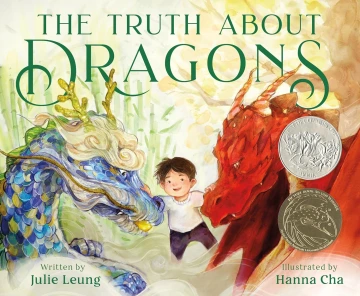
This Caldecott Honor book opens with a mother and son at bedtime. The mother begins to tell her son, whom she calls bao bei, a story about the magic that lives inside of him. The mother’s story introduces a quest to find the truth about dragons. The boy enters the story wearing a cape. The frame includes a golden European, fairy tale-like, forest. Throughout the beginning of the story there are very Western elements of folk tales, such as hobgoblins, will-o’-the-wisps, and a cottage in the heart of the forest. The boy is fed Western foods (such as apple cider and sugar cookies) by the wise woman who lives there who tells him about the Western ideas of dragons.
The boy leaves the cottage dressed in a wrapped shirt, loose pants, and slippers. The forest changes into a forest full of bamboo as the boy’s mother tells her son that he may also journey into another forest. In this new setting the boy encounters traditional Eastern folktale characters like the nine-tailed fox, white rabbit, and moon goddess. The boy then sees a palace with Chinese architecture among the clouds. There he meets another wise woman, drinks chrysanthemum tea and listens to another story of dragons. While these dragons still have claws, they are illustrated in an ethereal style with long and curving bodies. The boy learns that dragons are majestic and that one would be lucky to see them.
Then the boy learns that he may have to choose which truth to believe. The boy is illustrated being embraced by both dragons as he is told that both forests exist in his heart and that both worlds are his to discover. The scene changes: the mother covers up her son in his bed and tells him that his two grandmothers will each tell him their own truths about dragons.
The social issues raised in this book are how to balance two distinct cultures within one family unit and the dichotomy between two different truths and experiences. The author, Julie Leung, wrote this book for her son because she didn’t want him to feel like he was half Chinese and half American; she wanted him to feel that his heritage provided him more opportunities than what others have and to see his heritage as an advantage. One of the main themes of the book is that it is possible to hold two competing truths in your heart.
This book offers an introduction to both Western and Eastern folk tales. Both truths about dragons are presented in a broad way and do not give a specific region in the West or East. The illustration style changes as the story’s setting changes, and this helps set the scene for both types of dragons. In the first part of the book, Cha uses warm colors and draws fierce and threatening dragons with sharp teeth and claws. In the second part of the book, the illustrations change, the palette is cool tones, and while these dragons still have claws, they are drawn in an ethereal style with long and curving bodies.
This book would be a great introduction to folktales and fairy tales from diverse cultures. The Truth About Dragons could be in a text set of other Asian folktales like Goldy Luck and the Three Pandas (Natasha Yim and Grace Zong, 2014) and Yeh-Shen: A Cinderella Story from China (Ai-Ling Louie and Ed Young, 1982). It could work with texts that combine Eastern and Western cultures such as Take Me Out to the Yakyu (Aaron Meshon, 2013).
Julie Leung is the author of eight children’s books. She grew up in the Atlanta suburbs with her parents who moved to Georgia from China in the early 1990’s. Leung was one of only three Asian students in her school. She authors books, specifically about Chinese Americans, because she wished she had these books available to her as a child. Besides a Caldecott Honor, The Truth About Dragons won the Asian Pacific American Award for Literature. Read more about her on her website .
Hanna Cha grew up splitting her time between Korea and America. She has illustrated several books for other Asian authors and has written and illustrated her own book as well. She incorporates Asian culture into her art by using sumi ink and calligraphy brushes used in Korean folk art for her illustrations. She won a Caldecott Honor Award for The Truth About Dragons Explore her illustrations at Hanna Cha.
Heather Barton, Texas Woman’s University
© 2025 by Heather Barton
Authors retain copyright over the reviews published in this journal and grant the journal right of first publication with the work simultaneously licensed under the following Creative Commons License:

WOW Review, Volume XVIII, Issue 1 by Worlds of Words is licensed under a Creative Commons Attribution-NonCommercial-ShareAlike 4.0 International License. Based on work at https://wowlit.org/on-line-publications/review/xviii-1/12.


