

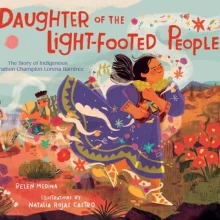
Daughter of the Light-Footed People: The Story of Indigenous Marathon Champion Lorena Ramírez
Written by Belen Medina
Illustrated by Natalia Rojas Castro
Atheneum Books for Young Readers, 2024, 36 pp
ISBN: 978-1665931427
Belen Medina and Natalia Rojas Castro work together to tell the story of marathon champion runner Lorena Ramírez, showing the rich culture and endurance of her people, the Rarámuri or Tarahumara of the Chihuahua region of Northwest Mexico. Lorena Ramírez is an ultramarathon runner who often competes in races to help support her family. The book starts with her running through the Copper Canyons and follows her throughout an entire 60 mile race, ending when she crosses the finish line. The story is based on her real life and even talks about a cultural drink called pinole that she carries and drinks throughout the race.
The narrative focuses on Lorena and cultural artifacts that connect to her people; however, it doesn't go deeply into the broader Rarámuri community. At the end of the book there is an extended informational section that gives more background on Lorena’s life, including how she and others in her community often enter races to help support their families. This story brings attention to a group that is rarely represented in children’s literature. It gives voice to not only Indigenous people, but to women too. Many Rarámuri families face economic challenges and run in races to support their families and way of life. This story challenges what we usually think success or professionalism looks like, especially when we compare it to what is valued in American culture.
Both Belen Medina and Natalia Rojas Castro draw on their own cultural heritage to tell Lorena's story. Castro's illustrations weave in traditional culture and design throughout the book. At the beginning of the book Castro includes a zigzag geometric pattern that represents traditional Rarámuri textiles that are passed down through generations and often used on baskets and clothing. She even includes a similar design on the traditional handmade Rarámuri dress that Lorena wears throughout the story. Castro also uses the illustrations to show the Rarámuri people’s connections to nature through her vivid use of colors on flowers, leaves, and plants.
Medina draws on her own bicultural background to include the Spanish onomatopoeia tapa tapa to show a stronger connection to language and culture. The birds she mentions can be interpreted as symbolic of freedom or spiritual connection. She also writes about the shoes Lorena Ramírez wears that are handmade sandals. The handmade items worn by Lorena are powerful symbols of identity, tradition, and resilience.
The Rarámuri people have a strong cultural heritage, which is depicted in many ways throughout the story, including traditional dress, vibrant designs, rich colors, and a deep connection to nature as well as the running. The book also highlights the perseverance of their people through Lorena’s endurance and inner strength. Even when her knees ache and she feels tired, she pushes through and finishes first. While these elements are important and powerful, the story doesn’t explore how material success or public attention has affected the Rarámuri community as a whole, an issue many Indigenous cultures face as they are impacted by Western values. At the end of the book, a section explains more about Lorena’s life. It shares how she has been given expensive gear but chooses to race in traditional clothing and handmade sandals because that’s what she’s used to. It also mentions that she has stayed humble and true to herself, but it doesn’t explore whether the rest of her community has been affected by the fame and attention.
This book could be paired with We Are Water Protectors by Carole Lindstrom and Michaela Goade (2020) in that both stories celebrate the strength and cultural identity of Indigenous people. These books show a strong connection to tradition, use rich symbolism and center on Indigenous female voices. This story reflects the lives of an underrepresented group while also offering a window into their rich culture and traditions for those who may not know them. Additional titles that pair well would be biographies of Indigenous people who worked hard like Lorena to serve their communities. Autumn Peltier, Water Warrior (Carole Lindstrom and Bridget George, 2023) describes the advocacy of Peltier to ensure communities have safe water supplies. Freddie the Flyer (Fred Carmichael, Danielle Metcalfe-Chenail, and Audrea Loreen-Wulf, 2023) describes a year in the life of pilot Freddie Carmichael from the Northwest Territories in the Canadian Arctic. His legendary career included everything from mercy flights to transporting teams of reindeer herders and dog sledders. As Style and Arizpe (2014) state, “We must intentionally select and use texts that function as both windows and mirrors in order to move toward a more socially just and equitable world (p.5).” For this reason stories like these play an important role in classrooms to help students appreciate cultures beyond their own.
Belen Medina grew up in California with summers at her grandparents' house in Mexico. As the daughter of immigrant parents, she has been navigating two cultures all her life. She lives in the Pacific Northwest where she switched careers from law to writing books. She won the Lee & Low New Voices Award for a manuscript about two children living on either side of the Mexico/USA border. Daughter of the Light-Footed People won the 2025 Américas Award, a commendation from the Orbis Pictus Award, and was listed as a Notable Social Studies Trade Book and a HornBook Fanfare title. More information about Belen's writing and art can be found on her website.
Natalia Rojas Castro is from Colombia. The flamboyant cheerful colors of her home are reflected in her artwork. She is also the illustrator of Old Clothes for Dinner? (Nathalie Alonso, 2024), a humorous story about a cultural misunderstanding between a Cuban grandmother and her American granddaughter.
Reference
Style, E., & Arizpe, E. (2014). Building on windows and mirrors: Encouraging the disruption of ‘single stories’ through children’s literature. Journal of Children's Literature, 40(2), 5–11.
Misty Jacobson, Texas Woman’s University
© 2025 by Misty Jacobson
Authors retain copyright over the reviews published in this journal and grant the journal right of first publication with the work simultaneously licensed under the following Creative Commons License:

WOW Review, Volume XVIII, Issue 1 by Worlds of Words is licensed under a Creative Commons Attribution-NonCommercial-ShareAlike 4.0 International License. Based on work at https://wowlit.org/on-line-publications/review/xviii-1/4.


