

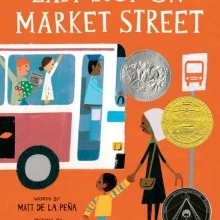
Last Stop on Market Street
Written by Matt de la Peña
Illustrated by Christian Robinson
G. P. Putnam’s Sons, 2015, 32 pp (unpaged)
ISBN: 978-0399257742
Last Stop on Market Street is a critically acclaimed picturebook inviting young readers into a diverse urban environment in the U.S. The story is told through the eyes and voice of a young Black boy named CJ and his grandmother, Nana. The text looks at socioeconomic class, race, family relationships, and community involvement. The book has received numerous awards, including the 2016 Newbery Medal, a Caldecott Honor, and the Coretta Scott King Illustrator Honor.
The story begins as CJ and Nana are leaving church on a rainy day, heading to their weekly volunteer shift at a local soup kitchen. CJ sees a friend riding in a car and wonders why he and Nana must wait in “the wet” for a bus. As they travel across the city, CJ asks Nana questions, expressing his desire for what others have and he does not, such as a car, an iPod, and a neighborhood with less visible poverty. Nana's responses are quiet, confident, and wisdom-filled, encouraging CJ to see the beauty in the people and places where they live. “Sometimes when you're surrounded by dirt, CJ, you're a better witness to what’s beautiful.”
Robinson’s illustrations amplify these themes using vibrant, textured drawings of an economically diverse city, filled with people of all races, ages, and abilities. The illustrations use collage-like textures, bold shapes, and minimal detail, allowing emotion and movement to take center stage.
This story illustrates urban life experiences in a way that is respectful, authentic, and affirming without falling into stereotypes. The characters are not defined by circumstances but by their actions, relationships, and values. For example, CJ’s family does not have a car, and the story avoids framing this as a negative. Instead, it becomes an opportunity for CJ and Nana to explore and connect with their community while riding public transportation. The cultural values of gratitude, respect for elders, and communal responsibility are woven throughout the story through interactions between characters.
Although the story does not directly discuss race or class, these social issues are subtly embedded throughout the setting, characters, and dialogue, leaving space for readers to draw deeper inferences. Nana’s view of the world reflects dignity and resilience, qualities often found in communities facing structural barriers yet maintaining strong communal ties. CJ’s outlook on his life situation captures the internal thoughts and questions children may have when comparing their lives to others. This dynamic is key, offering an ongoing conversation about how values are passed on within families and communities.
When considering cultural authenticity, Last Stop on Market Street succeeds in several areas. Christian Robinson, a Black illustrator who has lived in urban environments like the book’s setting, brings his firsthand experiences and cultural insights into the visual world he creates. In interviews, Robinson discusses the importance of reflecting diversity in children’s books, not as a lesson, but as a lived reality. Similarly, Matt de la Peña, a Mexican American author, often writes stories grounded in marginalized voices and has spoken publicly about the importance of telling stories about everyday people with nuance and heart. Both author and illustrator approach the story with care, collaborating in ways that elevate shared values and lived experiences across communities of color.
From a critical standpoint, however, the story leaves some questions open. The narrative uplifts resilience and optimism but rarely engages with the systemic reasons behind the inequities young CJ observes. For example, CJ’s dissatisfaction with their neighborhood or desire for material items is gently redirected but not fully validated. There is a risk of suggesting discomfort with injustice can be resolved solely from a personal perspective, rather than through social awareness or change. Additionally, the background characters, such as the tattooed guitarist and man in a wheelchair, are shown with empathy but not given voices of their own. They represent inclusion, but their lack of dialogue may reinforce their role as scenery rather than individuals with agency.
Educators find this book useful as a springboard for discussions about equity, diversity, gratitude, and community involvement. It is well suited for children in early elementary grades but can be extended to older students with critical discussion and cross-text comparison. Related picturebooks that could extend thinking include Those Shoes (Maribeth Boelts and Noah Z. Jones, 2008), which focuses on poverty and generosity; Saturday (Oge Mora, 2019), a story about a Black mother and daughter navigating disappointment; and The Old Truck ( Jerome and Jarrett Pumphrey, 2020), which highlights intergenerational labor and resilience in a Black farming family.
Last Stop on Market Street is a thoughtful and detailed picturebook representing a culturally specific experience with global relevance. The book values community, humility, and empathy in ways that resonate across social and cultural boundaries, making it a standout story for inclusive and critical classrooms.
Matt de la Peña has written 7 young adult novels including Ball Don’t Lie (2007), and Mexican White Boy (2008). He has also authored 6 picturebooks, such as Miguel and the Grand Harmony (Illustrated by Ana Ramírez, 2017) and Love (Illustrated by Loren Long, 2018). You can read more about this author on his website.
Christian Robinson was born in Los Angeles and now lives in Oakland, California where he works as a designer, animator, author, and illustrator. He paired up with Matt de la Peña for the bestselling picturebooks Milo Imagines the World (2021) and Carmela Full of Wishes (2018). Visit his website to learn more about this artist.
Kristine Cochran, Texas Woman’s University
© 2025 by Kristine Cochran
Authors retain copyright over the reviews published in this journal and grant the journal right of first publication with the work simultaneously licensed under the following Creative Commons License:

WOW Review, Volume XVIII, Issue 1 by Worlds of Words is licensed under a Creative Commons Attribution-NonCommercial-ShareAlike 4.0 International License. Based on work at https://wowlit.org/on-line-publications/review/xviii-1/5.


