

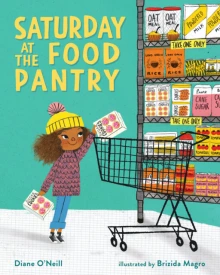
Saturday at The Food Pantry
Written by Diane O'Neill
Illustrated by Brizida Magro
Albert Whitman & Company, 2021, 32 pp (unpaged)
ISBN: 978-0807572368
Saturday at the Food Pantry is a sensitive and heartwarming portrayal of food insecurity through the lens of a child’s experience. This picturebook presents a powerful narrative that addresses social stigma, poverty, and compassion. Through its accessible language and warm illustrations, the book opens a window into a common but often invisible struggle with hunger that many children and families face.
The story follows Molly, a young Black girl who accompanies her mother to a local food pantry on a Saturday morning. When they first arrive, Molly feels confused and uneasy, especially after overhearing negative comments about people who need help. Her mother’s reluctance mirrors Molly's discomfort, as she too grapples with feelings of shame. At the pantry, Molly meets Caitlyn, a classmate who is there with her grandmother. The two girls bond over the experience and gradually come to understand that needing help is not something to be ashamed of. The book ends on a hopeful note as Molly, Caitlyn, and their caregivers share smiles, food, and a sense of community.
The social issue at the heart of this story is food insecurity, which is deeply connected to broader cultural themes of socio-economic disparity, dignity, and societal judgment. By centering the narrative around a child’s viewpoint, O’Neill provides an age-appropriate entry point into conversations about poverty, social services, and empathy. Food insecurity disproportionately affects marginalized communities, especially families from low-income backgrounds, single-parent households, and communities of color (Feeding America, 2025). This book addresses not just the logistical aspects of hunger but also the emotional toll, highlighting how shame and silence can compound hardship.
The book reflects a range of experiences. While race and ethnicity are not the overt focus, the diversity in the illustrations—including varied skin tones and family structures—subtly reflects the demographic reality of many communities in the U.S. One important aspect in this book is it does not sensationalize poverty or reduce its characters to their circumstances. Instead, O’Neill humanizes them, portraying them as resilient, proud, and caring individuals.
Saturday at the Food Pantry excels in both text and illustration. O’Neill’s writing is straightforward yet emotionally nuanced, using dialogue and internal monologue to articulate the complex feelings that children and adults might experience in similar situations. The illustrations by Brizida Magro contribute significantly to the emotional tone of the book. Soft color palettes, expressive faces, and warm lighting enhance the feeling of community and hope, while also showing the apprehension and discomfort that characters initially feel. Together, the text and images achieve a strong partnership, offering a multidimensional portrayal of the issue.
The text is missing an explicit discussion of systemic factors that contribute to poverty and hunger, such as housing insecurity, underemployment, or lack of access to public benefits. While this omission may be deliberate, given the intended age group, it’s worth noting for educators seeking to extend the conversation to older readers or through cross-curricular connections. The story also does not go into racial inequities within food insecurity, which could be explored further in classroom discussions or companion readings.
Thematic relevance is strong, especially in classrooms or libraries where educators wish to foster empathy and normalize seeking help. The author’s note at the end adds meaningful context, drawing from O’Neill’s personal experiences with food insecurity as a child. This note enriches the authenticity of the narrative and offers educators insight into the intent behind the story.
Saturday at the Food Pantry would be most compelling for elementary students, particularly in SEL (social-emotional learning) curricula or community-building circles. It offers educators a gentle yet impactful way to introduce conversations about fairness, dignity, and support systems. The book’s message, that asking for help is a sign of strength, not weakness, resonates beyond age or circumstance.
Texts that would pair well with this book include Maddi’s Fridge by Lois Brandt and Vin Vogel (2014), which also addresses hunger in a child-friendly way, and Last Stop on Market Street by Matt de la Peña and Christian Robinson (2015), which highlights economic disparity through a lens of joy and appreciation. Educators might also consider A Chair for My Mother by Vera B. Williams (1982) to deepen conversations about family resilience and financial hardship.
Diane O'Neill is a poet from Chicago who has competed in three 24-hour Poetry Marathons and had her poems included in two of the anthologies. She grew up with a mother who was not always able to work so experienced living with food stamps (which she described in an op-ed for the Chicago Sun Times). Besides being a poet and published author, she has worked most of her professional life supporting the rights and services of people with disabilities. More information can be found on her website.
Brizida Magro grew up in a Portuguese fishing village where she lived with her grandmother and sister. Together they would often make things by hand which influenced her artistic style that blends vintage children's art with fold art. Now living in Boulder, Colorado, she loves outdoor adventures and experimenting with different kinds of media to bring stories to life. More information can be found on her website.
Reference
Feeding America. (2025, July 19). Hunger in America. https://www.feedingamerica.org/hunger-in-america
Shelby Phelps, Texas Woman's University
© 2025 by Shelby Phelps
Authors retain copyright over the reviews published in this journal and grant the journal right of first publication with the work simultaneously licensed under the following Creative Commons License:

WOW Review, Volume XVIII, Issue 1 by Worlds of Words is licensed under a Creative Commons Attribution-NonCommercial-ShareAlike 4.0 International License. Based on work at https://wowlit.org/on-line-publications/review/xviii-1/8.


