
Spanish is the Language of My Family
Written by Michael Genhart
Illustrated by John Parra
Neal Porter Books, 2023, 36 pp (unpaged)
ISBN: 978-0823450046
Imagine walking into your first day of school but instead of being excited to learn and make new friends, you are walking into a place where the only language you speak is illegal and you are repeatedly told that it makes you “dirty.” When you are caught speaking that language you are beaten with a paddle or locked in a closet as punishment. That is the history behind Michael Genhart’s Spanish Is the Language of My Family (published simultaneously in Spanish as El español es la langua de mi familia). It is the story of a young Mexican American boy and his pride in the cultural heritage of his family’s language, Spanish. As he is preparing for his school's Spanish spelling bee, for which he can already spell many words, his abuela helps him study his word list. “Familia is family. F-a-m-i-l-i-a. . . Fuerte is strong. F-u-e-r-t-e” (pp. 5-6). As they work together she tells him about her school experiences when speaking Spanish was not allowed. While the boy finds this hard to imagine, it inspires him to work even harder, with his parents and abuela coming alongside to encourage him when he gets frustrated and tired. The day of the spelling bee comes and ends with cheers and the young boy full of pride.
The author's note adds valuable historical background to the story. The inspiration for this story came to the author from personal stories he heard from his mother as a child. Genhart explains the shaming his mother and other family members received when caught speaking Spanish. In contrast Genhart also includes the history of the National Spanish Spelling Bee which began in New Mexico in 2011. He includes extensive notes for a picturebook about the prohibition of speaking Spanish in public schools and the evolution of the National Spanish Spelling Bee. His selected references include significant sources reflecting the history and importance of language for Spanish speaking families. Of particular interest, one of the scholarly references about bilingualism is the documentary by Brian Birdwell, When I Dream Dreams (https://archive.org/details/WhenIDreamDreams). The film is a series of interviews of Spanish speakers who experienced the shaming of being caught speaking Spanish. Many of the interviewees went on to gain higher education so that they could transform the educational system. The Bilingual Education Act of 1968 changed the landscape and made a Spanish spelling bee possible.
In watching Birdwell’s When I Dream Dreams it is easy to see how the education system tried to strip generations of students of their cultural heritage and the work that educators and parents have had to do to reclaim that heritage for their children and future generations. It is fitting that Spanish is the Language of My Family, a narrative of a family who has reclaimed that cultural pride, has been the recipient of many awards, including the 2024 Tomás Rivera Mexican American Children's Book Award, an Américas Award Honor Book, and the Gold Medal for the Alma Flor Ada Best Latino Focused Children’s Picture Book Award.
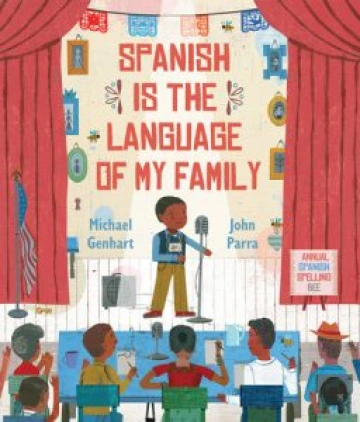
Parra, whose illustrations have won many awards including three Pure Belpré Honors, created the artwork for this book using acrylic paint and digital media. The illustrations serve to enhance Genhart’s message of cultural pride. Seen throughout the pages are depictions of papel picado (bright intricately cut paper flags seen at Mexican celebrations) and the Sacred Heart (one of the most common motifs in Mexican religious folk art). The bright colors of the acrylic paint boost the sense of pride heard in the text, only dimming when Abuela is telling the story of her school experience.
Duncan Tonatiuh's (2014) Separate is Never Equal: Sylvia Mendez and Her Family’s Fight for Desegregation is an excellent book to pair with Spanish Is the Language of My Family because it gives further historical background to Michal Genhart's story. Other books that pair well include titles that discuss linguistic pride in a heritage language. Ho'onani: Hula Warrior (Heather Gale and Mika Song, 2019) is the story of a young girl leading a group of boys in a traditional Hawaiian chant and dance. Code Talker: A Novel About the Navajo Marines of World War Two (Joseph Bruchac, 2005) is a fictionalized account of the Navajo young men who would communicate valuable war-time information by using their Navajo language as a secret code. Other book pairs introduce readers to Indigenous languages by teaching vocabulary in a story context. Two stellar examples are We Are Grateful - Otsaliheliga (Traci Sorell and Frane Lessac, 2018) and Stand Like a Cedar (Nicola Campbell and Carrielynn Victor, 2021).
Michael Genhart holds a PhD in clinical and community psychology and has his own private practice in San Francisco. He is the award-winning author of eleven picture books including May Your Life Be Deliciosa (Loris Lora, 2021) which received a Pure Belpré Honor, Love is Love (Ken Min, 2018), and I See You (Joanne Lew-Vriethoff, 2017). His books have been published in several different languages. More information can be found on his website.
John Parra is a children’s book illustrator whose work is deeply influenced by his Latino heritage. His books have won many prestigious awards including a Pura Belpré Honor and NY Times Best Illustrated Book for Frida Kahlo and Her Animalitos, (Monica Brown, 2017), and the Américas and Christopher Awards for Growing an Artist: The Story of a Landscaper and His Son (2022) More information can be found at his website.
Reference
Birdwell, Brian E., Andi McDaniel, Kennan Sloan, and Jennifer Smith. “When I Dream Dreams.” Filmed 2001 at Trinity University. Video. https://archive.org/details/WhenIDreamDreams.
Katie Campbell, Texas Woman’s University
© 2025 by Katie Campbell
Authors retain copyright over the reviews published in this journal and grant the journal right of first publication with the work simultaneously licensed under the following Creative Commons License:

WOW Review, Volume XVIII, Issue 1 by Worlds of Words is licensed under a Creative Commons Attribution-NonCommercial-ShareAlike 4.0 International License. Based on work at https://wowlit.org/on-line-publications/review/xviii-1/9.


