

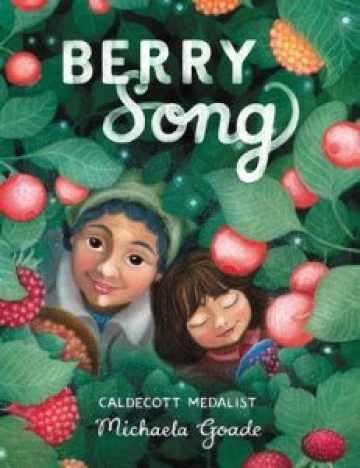
Berry Song
Written and illustrated by Michaela Goade
Little Brown and Company, 2022, 36pp [unpaged]
ISBN: 978-0316494175
This culturally rich and evocative picturebook invites readers to cultivate an awareness and respect for nature. Through the cultural tradition of berry picking, a cross-generational community practice cherished by the Indigenous peoples of the Tlingit and Haida tribes of Southeast Alaska, we experience the deep and profound reverence these communities have for their land and its natural resources.
Mirroring the author’s childhood memories, we accompany the child narrator on a journey that begins with her grandmother showing how nature provides for their needs as they gather herring eggs and salmon from the sea. The text and illustrations interact with one another to create movement as if on the open sea. The next page brings us to the edge of the forest. The circular illustration creates the illusion that we are entering the edge of the forest with the narrator carrying her berry-picking basket, almost as if we are joining her with our own basket to gather the bounty found within (p.5). The forest is filled with berries, and the young girl and her grandmother pick all kinds of berries, singing and naming them as they joyfully fill their baskets. With each turn of the page, the girl and her grandmother reflect on the bountiful land and the reciprocal relationship between the land and its people–the land takes care of them and they, in turn, take care of it. The land and sea are personified through song. They are alive and give life, and the girl and her grandmother, like their ancestors, continually give thanks, or Gunalchéesh.
Goade’s illustrations are beautiful renditions of nature and portals to the past and future. She uses white to form the foamy crests of the waves on the sea and the sparkling drops of dew in the forest to create a dreamy and magical sense of awe when surrounded by nature. The berries are bright and colorful against the serene green background of the forest. In one double-page spread, we see the narrator walking forward into a bright future holding a bowl of berries (pp. 19-20). The locks of her long hair are made of beautiful green vines, flowers, and tree branches. As she looks behind her, she acknowledges the greatness of her ancestors who came before her and how they were one with the land and sea. Goade wondrously clothes the narrator in a flowing dress whose train is like the waves of the sea, filled with marine life and the spirits of her ancestors rowing boats on the open waters.
Berry Song emphasizes the strong bond between a grandmother and granddaughter and the passing down of ancestral traditions. At the end of the story, we see the connection between generations once more when the narrator takes her little sister by the hand and begins singing to her about the berries as they enter the forest. The story mostly focuses on the feminine voice and relationships, leaving the male voice unheard. With the absence of male voices, we are left to consider how men influence the cultural heritage of Tlingit and Haida tribes of Southeast Alaska.
According to Rudine Sims Bishop (1990), literature can serve as both a window and a mirror, allowing us to explore and experience other worlds beyond our own, while reflecting our own lived experiences. As a window, Berry Song invites us to share in the stewardship of the earth for generations to come. Indigenous readers and others may experience Berry Song as a mirror, reflecting the shared cultural value of reverence for nature and the passing down of traditions from generation to generation.
Texts that complement Berry Song include We are Water Protectors (Carole Lindstrom and Michaela Goade, 2020) and The First Blade of Sweetgrass ( Suzanne Greenlaw, Gabriel Frey, and Nancy Baker, 2021). Both texts celebrate the importance of cultural heritage, community, ancestral knowledge, and protecting our natural resources.
Michaela Goade is an award-winning Indigenous author and illustrator from Southeast Alaska. As a member of the Tlingit and Haida Indian Tribes of Alaska, her children’s picturebooks predominantly center Indigenous voices and honor her rich cultural heritage. She has received multiple awards and honors for her work, including the 2021 Caldecott Medal for We Are Water Protectors, and the 2023 Caldecott Honor for Berry Song. For additional biographical information, awards, and book titles, visit her website (https://www.michaelagoade.com/).
Reference
Bishop, R. S. (1990). Mirrors, windows, and sliding glass doors. Perspectives: A Review Journal of the Cooperative Services for Children's Literature, 6(3), ix–xi
Jill Moss, Texas Woman’s University
© 2025 by Jill Moss
Authors retain copyright over the reviews published in this journal and grant the journal right of first publication with the work simultaneously licensed under the following Creative Commons License:

WOW Review, Volume XVIII, Issue 2 by Worlds of Words is licensed under a Creative Commons Attribution-NonCommercial-ShareAlike 4.0 International License. Based on work at https://wowlit.org/on-line-publications/review/xviii-2/3.


