
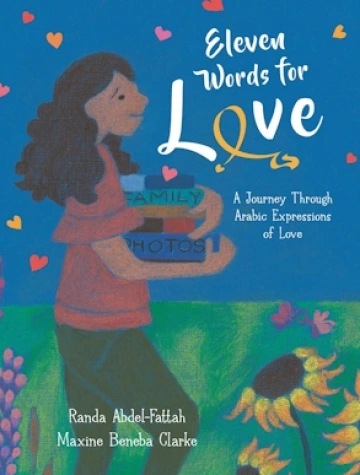
Eleven Words for Love: A Journey Through Arabic Expressions of Love
Written by Randa Abdel-Fattah
Illustrated by Maxine Beneba Clarke
Candlewick Press, 2022, 36pp [unpaged]
ISBN: 978-1536230215
Palestinian-Egyptian author Randa Abdel-Fattah, published her hilarious young adult debut novel Does My Head Look Big In This? in 2005 and followed it with a girl’s quest during the Israeli-Palestinian conflict in Where the Streets had a Name (2008). Her latest book is Eleven Words for Love: A Journey Through Arabic Expressions of Love. This book tenderly and beautifully shares the memories of one Palestinian family and the warmth of their love. It celebrates the universality of family love while centering the Arabic language through the author’s careful selection of 11 expressions of love.
Maxine Beneba Clarke, an Australian poet, writer and illustrator of Afro-Caribbean descent, further emphasizes the joy and love through her bright and playful illustrations rendered in watercolor pencil and collage on textured cardstock. The book is told through photos and scenes of a Palestinian family's experiences, bonds, and memories of home. Each double-page spread introduces readers to a specific Arabic expression of love and the way it is manifested through one family's experience of migration—from yearning for homeland, to the bond between friends, sisters, neighbors, and finally to love for those who have passed.
What makes Eleven Words for Love unique is that while it is a story of immigration and exile, it strays far from the stereotypical images in children’s books about the Middle East of wars, refugees, or desert landscapes. Instead, it is first and foremost a story of a family celebrating their love for their home country and love for the new place in which they live. As noted in the endpapers, the family members "both show and receive kindness and love in their new home" thereby humanizing immigrants and refugees and presenting counter representations to stereotypical depictions of refugees. On almost every page, the illustrations show characters extending their hands to each other in acts of generosity, love, and giving.
The Arabic language is central to this book despite it being primarily written in English. On the cover, the Arabic word for love (hubb حب) forms the letter ‘o’ at the center of the English word ‘love.’ In the book, the Arabic words are placed on the left pages with the English transliteration below the Arabic, allowing English speakers to follow along and try out the Arabic expressions; on the right pages, lyrical verses bring to life the ways in which these expressions of love are experienced in family memories and experiences.
In an interview on ABC Radio National (Nobel, 2022), Abdel-Fattah speaks about this intentionality in the placement of the text and the choice not to translate the Arabic expressions, linking this decision to a history in Australia, as well as other Western countries, of immigrants being denied the opportunity to speak a second language. Instead, she points to the need to protect indigenous languages and the desire to reclaim immigrants' home languages and to remind both immigrant and non-immigrant readers that diverse languages are enriching rather than threatening.
Eleven Words for Love was an Honorable Mention for the 2024 Middle East Book Award. It is a heartwarming read that readers of all ages interested in the Arabic language and Arab cultures will enjoy, as well as those looking for books on themes of family, home, and immigration. This book could be paired with How We Say I Love You by Nicole Chen and illustrated by Lenny Wen (2022) to explore the theme of family love and The Rock in My Throat by Kao Kalia Yang and illustrated by Jiemei Lin (2024), which is another authentic portrayal of a refugee experience centering language and including translanguaging in its pages.
Readers interested in picturebooks with Arabic words and translanguaging between speakers of both English and Arabic might also enjoy Insha'Allah, No, Maybe So written by Rhonda Roumani and Nadia Roumani and illustrated by Olivia Aserr (2024) and readers with a stronger command of Arabic can also read Bil’Arabi Ya Habibi (In Arabic, My Love) written by Dalia al-Manhal Mirza and illustrated by Maya Majdalani (2023), which tells the story of a boy growing up in a bilingual home, who is lovingly reminded to speak in Arabic when visiting his grandfather.
Randa Abdel-Fattah is an award-winning author. She worked as a lawyer and human rights advocate. She holds a PhD in Sociology and is a researcher on Islamophobia, racism, and everyday multiculturalism in Australia. She lives in Sydney, Australia with her family. More information can be found on her website.
Maxine Beneba Clarke is an Australian award-winning author and illustrator of over 15 books. She writes nonfiction, poetry, memoirs, and picture books. She is also a former lawyer (O’Halloran, 2025). Maxine is the inaugural Peter Steele Poet in Residence at the University of Melbourne.
References
Nobel, Emma. (10 October, 2022). Randa Abdel-Fattah on the Language for Love. ABC Radio National. https://www.abc.net.au/listen/programs/lifematters/randa-abdel-fattah-on-the-language-for-love/101518732
O’Halloran, Clare. (30 November, 2025). Program: New book of poetry takes a wrecking-ball to fairytales and nursery rhymes. ABC Radio National. https://www.abc.net.au/listen/programs/the-radio-national-hour/maxine-beneba-clarke-beautiful-changelings-/106088482
Dima Masri, University of Arizona
© 2025 by Dima Masri
Authors retain copyright over the reviews published in this journal and grant the journal right of first publication with the work simultaneously licensed under the following Creative Commons License:

WOW Review, Volume XVIII, Issue 2 by Worlds of Words is licensed under a Creative Commons Attribution-NonCommercial-ShareAlike 4.0 International License. Based on work at https://wowlit.org/on-line-publications/review/xviii-2/4.


