

Freedom Braids
Written by Monique Duncan
Illustrated by Oboh Moses
Lantana, 2024, 28pp [unpaged]
ISBN: 978-1915244802
This picturebook narrates the life of Nemy, an Afro-Colombian girl. It is a fictional story inspired by a historical event in San Basilio de Palenque in Colombia, set during a period of enslavement. The main character, Nemy, grows up enslaved within her community. The story depicts her daily activities, such as sowing and collecting seeds, and her encounters with Big Mother, an elder who spends nights sharing stories. Nemy observes a group of women gathering at midnight to braid each other’s hair as part of a ritual and ancestral practice. When she joins them, the experience reminds her of her Nana, and her scent of natural herbs. The practice of braiding became a form of communication through codes, patterns, and shapes that created maps guiding enslaved people to freedom; braids also served to carry seeds for settlement in their new location. Eventually, a group of women decide to escape from their captors, crossing the harsh tropical forest in search of liberty in Palenque.
San Basilio de Palenque is in the Caribbean Region in Bolivar State, close to Cartagena de Indias, a place known for the arrival of conquerors and the African Slave Trade. This town is the first place in the Americas considered free; it was liberated by people who escaped slavery, and it became a symbol of resistance. In 1540, the Spanish king was informed that enslaved people had fled through the hills of the Montes de María, risking everything for their lives and freedom. There, they built rudimentary homes hidden in the dense vegetation. They met their basic needs, such as food and shelter, using items that were easy to carry or destroy if they needed to leave the place. By 1570, the Spanish Crown officially recognized the existence of Palenqueros communities formed by runaway enslaved peoples.
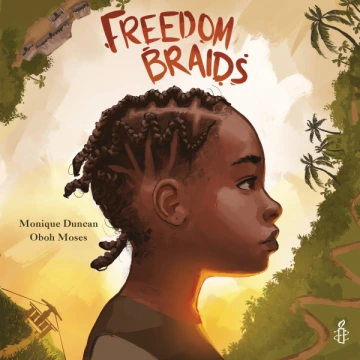
The illustrations consist of double-page spreads. The front cover features a Black girl with braided hair and a landscape in the background, while the back cover shows three women, and Nemy pointing toward a destination, symbolizing female empowerment and the vital role of women in their communities. Throughout the book, eighteen illustrated heads with different braid styles are portrayed, each labeled with a representative name, most of them in the Spanish language. This text conveys a powerful message of resistance and resilience.
The illustrations vividly portray Black women gathered outdoors around the fire as the only light source in the warm Caribbean nights. Although the exact setting is not specified, the imagery suggests a location near the Caribbean or Pacific coasts, where many Afro-Colombian communities historically lived. The book also depicts straw houses surrounded by sugarcane fields and yucca roots, reflecting the environment shaped by colonial exploitation. Spanish colonizers introduced both sugarcane and enslaved Africans to the Americas, forcing them to cultivate and harvest vast plantations to produce sugar for trading and exportation.
In the last section of the book, Duncan dedicates two pages to historical notes, emphasizing the experiences of Afro-descendant communities and the role of Palenque as a place of resistance and liberation. She highlights the importance of women while acknowledging the contributions of men who sought freedom. Braiding is presented as a way of communication that colonizers could not decrypt. Each braid style is described with accuracy, guiding readers’ curiosity to learn more about the topic.
Suggested children's books to read with this theme include Bintou’s Braids (Sylviane Diouf and Shane Evans, 2001), I Love My Hair! (Natasha Anastasia Tarpley and E. B. Lewis, 2001), and My Hair Is a Book (Maisha Oso and London Ladd, 2024). These texts highlight the meaningful practice of styling hair with intention in Black communities, emphasizing connections to ancestors and fostering an understanding of historical and cultural background.
As a Colombian researcher, I suggest creating a Spanish version of this book with the Palenqueros community to honor and commemorate their traditions. An accurate translation could contribute to connecting Afro-Colombian children to their cultural roots, enriching classroom discussions, and strengthening cultural identity.
Monique James-Duncan conducted fieldwork research in San Basilio de Palenque, Bolívar, Colombia. She explored the oral traditions of the region and interviewed residents to ensure the authenticity of her narrative. In an interview with Lantana Publishing (2024), Duncan explained that her inspiration began from childhood memories of her mother braiding her hair with styling patterns to resemble her Jamaican heritage. This practice deeply rooted in the African diaspora reflects the transmission of cultural identity and resilience across generations.
Monique James-Duncan lives in Brooklyn, New York, with her family. Her first picturebook, Mommy Time (illustrated by Ebony Glenn, 2023), received a starred review from School Library Journal, and her earlier work When Mama Braids My Hair (2020) was nominated for the Ezra Jack Keats Award. Her effort to explore African and Caribbean heritage through children’s literature demonstrates her commitment to cultural preservation, female empowerment as resistance, and permanent exploration of Black heritage. More information can be found on her website.
The illustrator, Oboh Moses, is originally from Lagos, Nigeria. His work enriches the African diaspora narrative through artwork that celebrates representation, identity, hope, and the strength of African stories and perspectives. The book features digital illustrations that use multiple colors, gradients, and strong light contrasts to highlight moments of hope. Throughout the story, the faces of the characters convey connection and intimacy, especially in the braiding scenes, where closed eyes and gentle body positions evoke a sense of calm. Additionally, the illustrations portray women escaping and hiding among the crops, allowing the audience to feel the tension of the situation. In particular, the final pages depict freedom through bright colors.
References
Lantana Publishing. (2024, February 26). Black History Month | Interview with Monique Duncan, author of Freedom Braids [Video]. YouTube. https://www.youtube.com/watch?v=KqNxw0SD0eo
Marquez, G. (2021, June). San Basilio de Palenque, Colombia – A history. Bradley Center Curriculum. https://csunbradleycentercurriculum.org/wp-content/uploads/2021/06/History-of-SBPCOL-by-G-Marquez.pdf
Moses, O. (s. f.). Oboh Moses [Perfil de ilustrador]. Anna Goodson Illustration Agency. Recuperado de https://www.agoodson.com/portfolios/oboh-moses/
Valencia Segura, K. S. (2018). Trenzando el territorio: cuerpos, mapas y resistencias en San Basilio de Palenque [Trabajo de grado, Universidad del Valle]. Repositorio de la Universidad del Valle. https://d1wqtxts1xzle7.cloudfront.net/105847648/Trenzando_el_territorio_cuerpos_mapas_y_resistencias_en_San_Basilio_de_Palenque-libre.pdf
Vega Cantor, R. (2018, 14 de julio). Capitalismo, azúcar y trabajo. Revista Herramienta. https://herramienta.com.ar/capitalismo-azucar-y-trabajo
Gina Natalia Soler Trujillo, University of Arizona
© 2025 by Gina Natalia Soler Trujillo
Authors retain copyright over the reviews published in this journal and grant the journal right of first publication with the work simultaneously licensed under the following Creative Commons License:

WOW Review, Volume XVIII, Issue 2 by Worlds of Words is licensed under a Creative Commons Attribution-NonCommercial-ShareAlike 4.0 International License. Based on work at https://wowlit.org/on-line-publications/review/xviii-2/5.


