
The Great Banned-Books Bake Sale
Written by Aya Khalil
Illustrated by Anait Semirdzhyan
Tilbury House Publishers, 2023, 32pp [unpaged]
ISBN: 978-0884489672
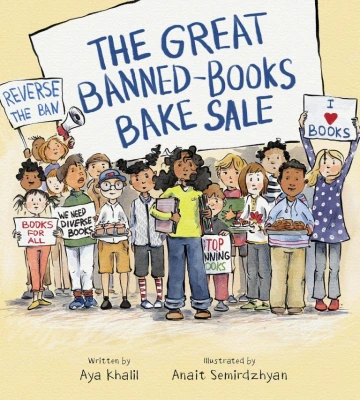
This picturebook portrays the importance of student voice and activism, and the power of diverse books. In this follow-up to The Arabic Quilt (2020), readers again meet Kanzi, an Egyptian American girl who takes pride in her heritage, who leads her classmates on a visit to the library. Today’s library visit is different though; students find out that many of their favorite diverse books that show their cultures, languages, and lives have been banned by the school board and removed from the shelves. When asked why, the librarian explains "Some words are so powerful that they intimidate people." Later, in a classroom discussion, the students wonder if books that represent their voices and lived experiences are important.
They decide to have a banned books bake sale and a protest. The proceeds from the sale will be used to purchase books that will be added to Little Free Libraries, a nonprofit that places book-sharing boxes in communities. Later, while baking baklava for the bake sale, Kenzi is inspired by her grandmother's story about protesting injustice in Egypt. On Friday the bake sale is a success and the protest that started with children expands to include many others from their community, coming together in support of students’ right to read books where they are represented. Following the protest, the school board reverses their decision and children, once again, can read library books that represent their voices and lived experiences.
Khalil’s writing is clear, compassionate, and deeply relevant. She doesn’t shy away from tough topics but presents them in a way that young readers can understand and connect. Khalil effectively conveys the characters’ emotions, especially the confusion and hurt that comes from being erased and the confidence they display when they are protesting. This story shows that children don’t have to wait until they're older to make a difference. Their unified voices can spark change now.
Anait Semirdzhyan’s illustrations bring beauty and emotional depth to the story. Her soft pencil and watercolor style gently show everything from the heartbreak of the empty library shelves to the joy and energy of the protest and bake sale. The students are from different backgrounds, and are drawn with distinct features like skin tones, clothing, and cultural details that feel authentic and respectful.
This book is useful for encouraging conversations around student voice, banned books, activism, and what it means to see yourself (or not see yourself) represented in books. The Great Banned Books Bake Sale feels timely, hopeful and relatable in today’s climate. However, while it addresses the problem of censorship, it simplifies the actions of children and adults. Based on real instances of censorship, the probability of a single protest reversing a school board's decision on censorship of diverse books is unlikely.
Educators might pair this book with Ban This Book (Alan Gratz, 2017), a novel about a fourth-grade girl and her classmates who resist the banning of Mixed-Up Files of Mrs. Basil E. Frankweiler (E. L. Konigsburg, 1967). They take action by using a locker to create a secret library of banned titles and also make up reasons to ban every book in the library in order to make a point. Young activism around identity is supported in That’s Not My Name! (Anoosha Syed, 2022), a story in which Minha teaches her fellow students how to pronounce her name rather than change it to something more Western. Finally, We Are Water Protectors (Carole Lindstrom and Michaela Goade, 2020) profiles a community banding together to protect the water and land rights of Indigenous peoples threatened by a pipeline traversing their land.
Aya Khalil is an Egyptian American author and former ESL teacher who brings lived experiences to her storytelling. In her author’s note, she explains how real-world book bans inspired the story and why children like Kanzi need books that reflect their worlds. Her earlier book, The Arabic Quilt (also illustrated by Anait Semirdzhyan, 2020), also explores identity, language, and cultural pride. The title won the Arab American Book Award and was included in the 2021 list of Notable Books for a Global Society. Khalil has served as a mentor for We Need Diverse Books. Read more about Khalil at her website.
Anait Semirdzhyan was born in Russia, grew up in Armenia, and now lives in the U.S. She loves creating whimsical worlds and often illustrates stories that focus on identity and belonging. Readers can find out more about Semirdzhyan at her website.
Alicia Leslie, Texas Woman's University
© 2025 by Alicia Leslie
Authors retain copyright over the reviews published in this journal and grant the journal right of first publication with the work simultaneously licensed under the following Creative Commons License:

WOW Review, Volume XVIII, Issue 2 by Worlds of Words is licensed under a Creative Commons Attribution-NonCommercial-ShareAlike 4.0 International License. Based on work at https://wowlit.org/on-line-publications/review/xviii-2/7.


