

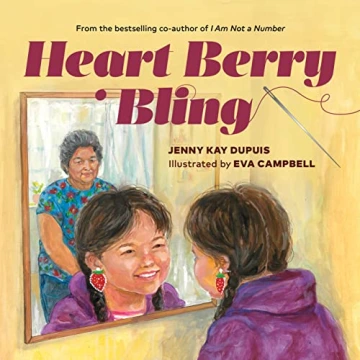
Heart Berry Bling
Written by Jenny Kay Dupuis
Illustrated by Eva Campbell
Highwater Press, 2023, 44pp [unpaged]
ISBN: 978-1774920558
“The heart-shaped fruit shows us that caring is more than feeling. We can look to the plant- its fruits, flowers, leaves, stems, runners, and roots- to understand how in nature everything is connected…The strawberry is an amazing gift.” (p.20)
In this Canadian picturebook, Maggie, a young Anishinaabe girl, spends the day visiting her grandmother in the city. After enjoying a lunch of fry bread and chili, Maggie is especially excited to open her grandmother’s bead jar and begin creating a design. While looking through patterns, she finds an old photograph and asks her grandmother about it. Her grandmother explains that the picture shows her as a young girl living on the reservation. She goes on to share that she lost her First Nations status after marrying a non-Indigenous man, a consequence of the Indian Act. This forced her to leave behind her home and everything familiar.
Despite this loss, preserving her cultural heritage remained important to her and teaching Maggie how to bead is one meaningful way she continues to pass on those traditions. When Maggie chooses to bead a heart berry, or strawberry, an image full of cultural meaning in Anishinaabe traditions, her grandmother explains its symbolism and the significance of strawberry teachings. As they bead together, Maggie not only learns the art of beading but also deepens her understanding of her family’s history and her Anishinaabe identity.
The story incorporates several meaningful social themes as Maggie spends the day with her grandmother. One central idea is cultural preservation. Maggie learns that beading isn’t just a craft, but a way to carry on the knowledge, stories, and values of her Anishinaabe heritage. The book presents Indigenous heritage with honesty and care, avoiding the stereotypes too often found in stories about Native communities. The bond between Maggie and her grandmother demonstrates the importance of intergenerational relationships and the role older people play in shaping identity and passing on traditional knowledge.
The book also addresses historical injustice when Maggie’s grandmother explains how she lost her First Nations status after marrying a non-Indigenous man because of the Indian Act. This law unfairly hurt Indigenous women because it meant that if they married outside their community, they would lose their status. Indigenous men did not face the same repercussions. This policy wasn’t just unfair to Indigenous communities, it also showed clear gender bias. Even more damaging, it denied future generations their rightful status and connection to their cultural identity.
Jenny Kay Dupuis brings Maggie’s story to life through heartfelt dialogue and vivid details that make you feel like you’re right there with her. The heart berry symbolizes love, connection, and cultural tradition, helping the story feel even more personal and powerful. The tone throughout is soft and reflective, perfectly capturing the quiet, special moments shared between a granddaughter and grandmother. The slow, steady pacing feels intentional and allows the memories and emotions to unfold naturally. Maggie grows more connected to her identity as the story progresses. At first, she’s excited about creating something beautiful, but as she listens to her grandmother’s story, she gains a deeper understanding of her family’s history and cultural roots.
The illustrations by Eva Campbell are soft and expressive, using gentle colors and warm tones that reflect the relationship between Maggie and her grandmother. The pictures complement the text by showing cultural items like the beading jar, the lunch of fry bread and chili, and the shared workspace. These images help ground the story in specific cultural details while also conveying love, learning, and legacy.
Readers of Heart Berry Bling will come away with an appreciation for tradition, respect for elders, and pride of connecting with your identity. The story encourages children to ask about their own culture and heritage, think about fairness and injustice, and learn about traditions passed down from one generation to the next.
Books like Jingle Dancer (Cynthia Leitich Smith, Cornelius Van Wright and Ying-Hwa Hu, 2000) and Fry Bread: A Native American Family Story (Kevin Noble Maillard & Juana Martinez-Neal, 2019) would pair beautifully with Heart Berry Bling. All three books highlight intergenerational bonds and the important role elders play in passing down traditional knowledge.
Jenny Kay Dupuis, a member of the Nipissing First Nation, is an educator, author, artist, and speaker who focuses on raising awareness about Indigenous communities. With her expertise, she has supported organizations, businesses, and schools in addressing Indigenous policies and promoting equity. Dupuis holds a Bachelor of Arts in History and Visual Arts, a Master’s degree in special education, and a PhD in Educational Leadership. She lives in Toronto, Canada. You can find out more about this author at her website.
Eva Campbell, the illustrator, holds a Master’s degree in African art history, and a Master’s degree of fine arts. She currently teaches art at Lester B. Pearson College of the Pacific in Victoria, British Columbia. Her artwork has been exhibited across Canada and the United States. You can see more of Campbell’s work on her website.
Laurianne Frayser, Texas Woman’s University
© 2025 by Laurianne Frayser
Authors retain copyright over the reviews published in this journal and grant the journal right of first publication with the work simultaneously licensed under the following Creative Commons License:

WOW Review, Volume XVIII, Issue 2 by Worlds of Words is licensed under a Creative Commons Attribution-NonCommercial-ShareAlike 4.0 International License. Based on work at https://wowlit.org/on-line-publications/review/xviii-2/8.


