

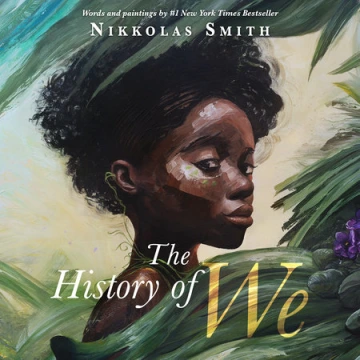
The History of We
Written and illustrated by Nikkolas Smith
Kokila, 2025, 40pp [unpaged]
ISBN: 978-0593619681
In this informational picturebook, the reader is immediately drawn into a collective history by making eye contact with a young ancestor on the book cover. The narrative begins on the end pages with a visual reference to the creation account of darkness changing to light. That is followed by a representation of Michelangelo's masterpiece, The Creation of Man, as dry and fertile land flows out of the creator's hand. Readers are then treated to a poetic and visual feast, introducing them to the African cradle and the beginnings of human activity on earth. Each subsequent page profiles early ancestors learning about healing plants, exploring seas and lands beyond the horizon, engaging in engineering tasks that involve designing and building shelters, refining agricultural practices to feed families, and creating clothing and tools that protect and aid in sustaining life. The poem is a love song to human ingenuity, curiosity, and creativity.
The word pictures in the poem are masterful and lyrical. They demonstrate Smith's ability as a poet to help us understand that our ancestors were vibrant, smart, and creative people. He sets the premise of the book in the first pages, using line breaks and formatting to lead readers into the story of our shared roots:
In this fertile African cradle,
the birthplace of civilization is found.
Here, we dreamed and we spoke. We shared and we healed.
We sang, and danced, and built, and explored.
We lived.
Let us travel back to the start, so far back
that all of our roots begin to tell the same story.
The origin story of humankind.
The history of WE. (p. 6)
Smith then takes each active verb and expands the action on subsequent spreads, using artistic vocabulary that helps readers marvel at what our ancestors accomplished. They "sculpted words that made stories." Early artists "with boundless vision, . . . painted wonder." Musicians, with "drums and heartbeats in sync, . . . played alongside the chorus of nature's radiant choir."
The hand-painted acrylic images are stunning, shifting the perspective of the reader to highlight the vastness of landscapes at the mouth of a cave, the exuberance of dance, and the wide-eyed wonder of an explorer swimming in ocean waters. In the final spreads, Smith leads readers to the notion that curiosity about the world led ancestors to build boats and explore beyond their known horizons. He visually maps the spread of humans from the African cradle to other continents. The words and image in the final spread emphasize the common roots humans share coupled with the diversity that evolved as humans dispersed across the globe.
Nikkolas Smith calls himself an artivist, an artist who uses the visual medium to give a voice to the voiceless. While that often implies the voices of marginalized people, this book involves a marginalized story. In the Author's Note and a YouTube introduction to the book (https://www.youtube.com/watch?v=69XohI7l_Rg) Nikkolas describes how he learned the human origin story that began in Africa from his parents. Thousands of years of ingenuity were skipped over and ignored in his school history books. Through the work of paleoanthropologist Mary Leakey, human activity has been verified as early as 233,000 years ago in Ethiopia (book content was verified by the Leakey family). Smith explains these humans "spoke sentences, laughed, danced, and cried as we do. They were as intelligent as us. They were us." So Smith wondered what it was like for that first artist to paint on cave walls, the first medical inventor to use plants to heal, the first astronomers to map the stars, or the first explorers to wonder what was over the next stretch of water. The images and words allow the reader to see the ancestors' wide-eyed wonder, surprise, and joy in discovery.
The book title implies commonality, a common history, a community of humans, alike in many ways, stemming from a single root. As people migrated they changed, but at the core they are the same. The message of universality works as a counternarrative to the messages internalized with immigration raids, book banning, removal of historical artifacts, and other forms of censorship. It draws readers back to the idea that we are all human beings and all deserve to be treated with dignity, humanity and kindness. But it also communicates a respect and admiration for the ingenuity and curiosity of early ancestors who are frequently portrayed in history books as only hunters and gatherers. We are one family.
There are several ways that books could pair with The History of We. Peter Spier's classic People (1980) addresses Smith's theme of the commonality and creativity of people across the globe by highlighting how diverse we have become. Smith's masterful poetic language and storytelling can be paired with other lyrical texts like Gill Lewis and Jo Weaver's (2018) A Story Like the Wind, a tale of a group of immigrants floating in a boat and encouraged through a musical story. Finally, Smith's theme of ingenuity and marginalized history can be paired with other marginalized histories of Indigenous people in Wab Kinew and Joe Morse's (2018) title Go Show the World: A Celebration of Indigenous Heroes.
Nikkolas Smith lives with his family in Los Angeles. He is diverse in his artistic reach. He earned a degree in architecture that he used in designing theme parks for Disney. He has also created concept art for films, designed movie posters, and an apparel line featuring Black superheroes. He is the author/illustrator of several books including The Artivist (2023) which describes the journey of a young artist in developing a visual voice with murals and paintings to address social inequities. He also illustrated the award-winning title The 1619 Project: Born on the Water (Nikole Hannah-Jones and Renée Watson, 2021). More information can be found on his website.
Reference
Smith, N. (2025, May 20). The History of We" by Nikkolas Smith: From idea to creative process. YouTube. https://www.youtube.com/watch?v=69XohI7l_Rg
Susan Corapi, Trinity International University
© 2025 by Susan Corapi
Authors retain copyright over the reviews published in this journal and grant the journal right of first publication with the work simultaneously licensed under the following Creative Commons License:

WOW Review, Volume XVIII, Issue 2 by Worlds of Words is licensed under a Creative Commons Attribution-NonCommercial-ShareAlike 4.0 International License. Based on work at https://wowlit.org/on-line-publications/review/xviii-2/9.


