By Holly Johnson, University of Cincinnati, Cincinnati, OH
It is place, permanent position in both the social and topographical sense that gives us our identity.
~ J.B. Jackson
Addressing geography and international literature, I want to explore issues of identity with readers. In last week’s blog, I pondered teaching geography through international literature. This week, I am interested in how young readers reflect upon their own geographical identity and resultant affinities for particular places or locations.
Certainly, geography plays a role in our identities and colors our perceptions as readers and writers when the books come from our home culture, but how does that work when the literature is produced outside our geographical selves? How we might read a text from a geographical/cultural location that is outside the book’s cultural backdrop? I am not thinking about outsider/insider perspectives here, but rather, a geographical sensibility that is part cultural but also part physical location or physical affinity.
Continue reading
 Because I like to travel, as I mentioned in my last post, geography has become of real interest to me. How can we engage international literature without thinking about geography?
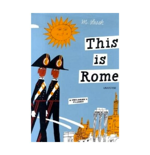 First, I like reading about where I have been. The reading is enriched when I can picture it. I pull the images from my memory to help envision the world to which the author has led me. Secondly, the reading enriches my experience of the places I have traveled. It’s also great to find books to read about a place—whether fiction or informational—when planning to travel in it. Some fun texts for cities across the globe are the Miroslav Sasek series such as This is London and This is Rome. These books were written in the 1960s and 1970s, but have “this is today” excerpts that help students see how cities change over time.
 If you ask me what I came to do in the world, I, an artist, will answer you: I came here to live out loud. — Emile Zola
 I am on a hunt. I am searching for the variety of ways international literature might be conceptualized by teacher educators, teachers, and teacher candidates. I am also interested in the ways in which they might address and differentiate between international and multicultural literature as well as how they perceive various other terms that might be used for literature that, well, transcends its native borders. I became interested in such a venture because it seemed as though as much as I discussed what I suggested was the difference between, say, “international” and “multicultural” literature, the terms and their nuances seldom transferred to my students. Was I not trying hard enough? Was I being too esoteric? Needless to say, I found the phenomenon intriguing, and so thought I would broach the topic via WOW Currents.
 This is the fourth of a planned four-part interview with Nick Glass, member of the 2009 Newbery Committee, conducted electronically by Judi Moreillon.
 This is the third of a planned four-part interview with Nick Glass, member of the 2009 Newbery Committee, conducted electronically by Judi Moreillon. Readers may refer to