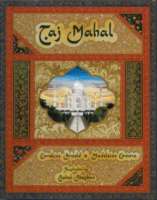
This book recounts the love story behind the building of the Taj Mahal in India. It discusses how it was constructed and provides information on Indian culture.

Materials from India
This book recounts the love story behind the building of the Taj Mahal in India. It discusses how it was constructed and provides information on Indian culture.

After trapping a tiger in a tree, a group of men must decide what to do with it.
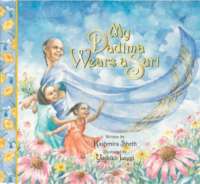
This warm, multigenerational story offers a glimpse into the distinctive culture and customs of India, while reinforcing universal themes of love and the importance of family. Every day, Rupa’s grandmother wears a beautiful sari. She shares with her young granddaughter all the wonderful things that saris can do-from becoming an umbrella in a rainstorm to providing a deep pouch to carry seashells collected from the beach. Soon Rupa’s own imagination is sparked with new uses for the saris. A note from the author and instructions for wrapping a sari are included.
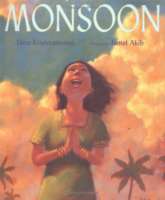
In the bustle of street and marketplace, everyone is watching, waiting for those magical clouds to bring their gift of rain to the land. A child describes waiting for the monsoon rains to arrive and the worry that they will not come.
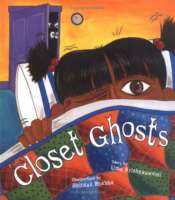
With help from Hanuman, the Hindu monkey god, Anu finds a way to cope with going to a new school, living in a new home, and even dealing with the mischievous ghosts in her closet.
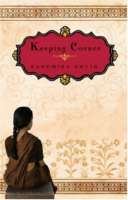
Twelve-year-old Leela had been spoiled all her life. She doesn’t care for school and barely marks the growing unrest between the British colonists and her own countrymen. Her future has been planned since her engagement at two and marriage at nine. Leela’s whole life changes, though, when her husband dies. She’s now expected to behave like a proper widow: shaving her head and trading her jewel-toned saris for rough, earth-colored ones. Leela is considered unlucky and will have to stay confined to her house for a year in the keeping corner. Her teacher offers Leela lessons at home, and she learns about a new leader of the people, a man named Gandhi, who starts a political movement and practices non-violent protest against the colonists as well as the caste system, leading Leela to wonder how she can liberate herself.

A remarkable debut novel set in India that shows one girl’s struggle for independence. During World War II and the last days of British occupation in India, fifteen-year-old Vidya dreams of attending college. But when her forward-thinking father is beaten senseless by the British police, she is forced to live with her grandfather’s large traditional family, where the women live apart from the men and are meant to be married off as soon as possible. Vidya’s only refuge becomes her grandfather’s upstairs library, which is forbidden to women. There she meets Raman, a young man also living in the house who relishes her intellectual curiosity. But when Vidya’s brother decides to fight with the hated British against the Nazis, and when Raman proposes marriage too soon, Vidya must question all she has believed in. Padma Venkatraman’s debut novel shows a girl struggling to find her place in a mixed-up world. Climbing the Stairs is a powerful story about love and loss set against a fascinating historical backdrop.
Take a closer look at Climbing the Stairs as examined in WOW Review.

The baya bird of India weaves its nest of grasses and flowers. In this dramatic yet lulling lullaby of a book, such a bird also saves a baby girl’s life.

Madeline Travis, Booktrust In To Market, To Market, a little girl sets off to the market with some money in her pocket-and no idea what to buy . . . Featuring vibrant paintings by award-winning Italian artist Emanuele Scanziani, this exuberant pictorial tribute to the wonders of the Indian market by well-known children’s poet Anushka Ravishankar suggests that the real fun may not be in the buying, after all. Longtime collaborator Rathna Ramanathan’s innovative typography creates a unique cohesion between the verse and artwork of each scene-every ele-ment on the page adds to the world of the story.

The river of jubilant people alarmed Sabine as they bobbed along Allidina Visram Street in Kampala….The dark faces drew closer. Women in bright gomesi and headscarves danced, and bare-chested men punched their fists into the air, chanting, “Muhindi, nenda nyumbani! Indian go home.”Sabine felt she was drowning in their cries.In August 1972, President Idi Amin declares that a message from God has come to him in a dream: all foreign Indians must be “weeded out” of Uganda in the next ninety days. Fifteen-year-old Sabine and her father, a successful businessman, are confident that their family will not be affected, since they are Ugandan citizens, but Sabine’s fearful mother is certain that they will have to leave.As the ninety days tick by, the President’s message – the “countdown monster,” as Sabine calls it – is broadcast every day on the radio, and life becomes more difficult for her family and other Indians in Uganda. Sabine tries to hold on to her optimism, counting on her best friend, Zena, and her grandfather, Bapa, to keep her spirits up, but after her beloved uncle Zulfiqar disappears and Zena turns against her, Sabine begins to share her mother’s fears. When a new law is declared on the radio – all Indians must leave – Sabine and her family have a hard decision to make. Should they stay and defend their rights, or should they go? And how will they begin a new life in a different land?
See the review at WOW Review, Volume 4, Issue 2