Decorative WOW News Header

The Whole World on One Page: International Wimmelbooks

By Rebecca Ballenger, Associate Director, Worlds of Words Center

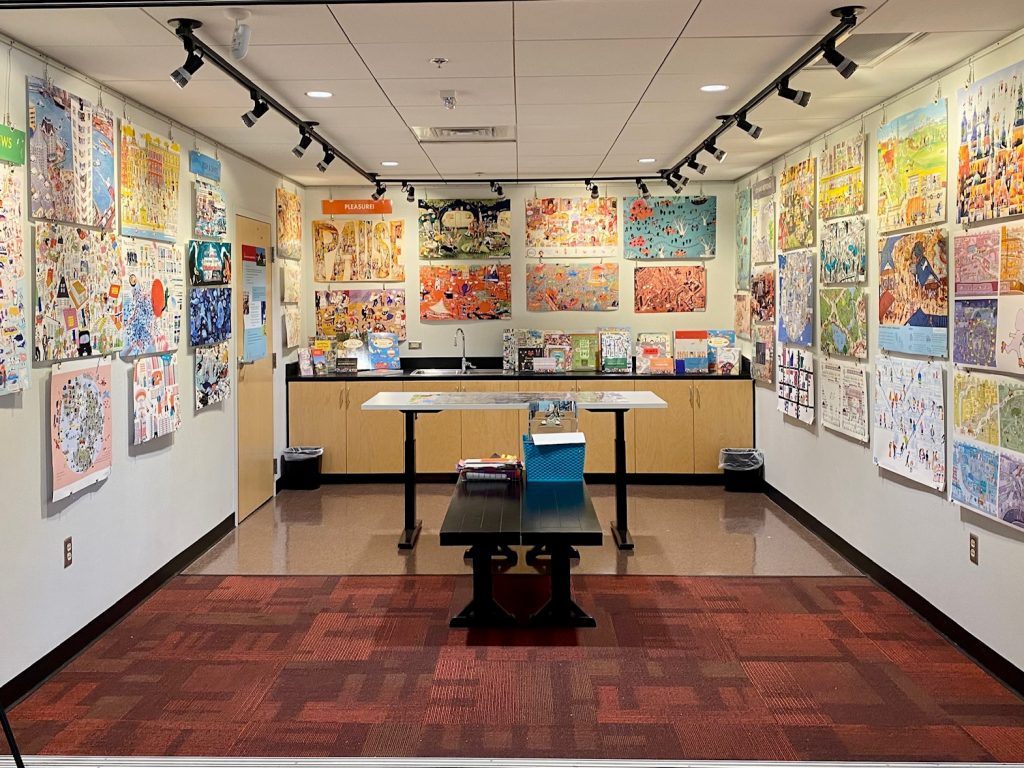
A thousand stories await discovery on every page of a wimmelbook: Where is the girl with the balloon going? And the dog with the bone? Why are those two boys wrestling? In 1968, Ali Mitgutsch created his first wimmelbook in Germany, Rundherum in meiner Stadt (All Around My Town), and since then these picturebooks have become a regular presence in many children’s libraries. For a limited time, Arizonans can take in The Whole World on One Page: International Wimmelbooks at the Worlds of Words Center of Global Literacies and Literatures (WOW) in the UArizona College of Education.

44 vibrant illustrations on the walls of a studio with books and activities set out in the center. Continue reading

Decorative WOW Currents Banner

Reclaiming Social Emotional Learning with Children’s Literature, Part II

By Angelica Serrano, 4th Grade Teacher with Jennifer Carey, School Counselor, Van Buskirk School, Tucson, Arizona

Cover of Outside In depicting a young girl in a red coat walking down a road with a cat. Trees and plants line either side of the road.

James Comer, a leading child psychiatrist once said, “No significant learning occurs without a significant relationship.”Kyle Schwartz

As a class, we discovered a certain connectedness, a bridge between each of us by exploring the activity “I wish My Teacher Knew…” The activity opened the door for our fourth-grade class to continue to have these conversations as our circles expanded and we realized just how much we each experience outside of the classroom. Now I wondered: how do we internalize this conversation and move forward? This is where we launched our second exploration with another children’s book. Continue reading

WOW Dozen: Cousin Love

by Mary L. Fahrenbruck, New Mexico State University, Las Cruces, NM and Violet Henderson, New Mexico State University, Las Cruces, NM

At the 2022 Latinx Kitlit Book Festival, one of the featured authors mentioned the power and sanctity of “cousin love.” The audience’s overwhelmingly positive reaction caught our attention and caused us to think about picturebooks and young adult novels that featured the special bond between cousins.

Drawing from personal memories about the unique connections we share with our own cousins, we selected picturebooks and young adult novels that highlight the complex family relationships that develop across time and place. These texts highlight the creative ways that cousins sustain their bonds through various forms of communication from letter writing to social media, and gap the distances through visits by car and air travel. Continue reading

Decorative WOW Currents Banner

Reclaiming Social Emotional Learning with Children’s Literature, Part I

By Angelica Serrano, 4th Grade Teacher, Van Buskirk School, Tucson, Arizona

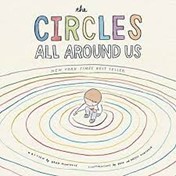
A young child sits in the center of multiple circles like tree rings.

“Tú eres mi otro yo, si te hago daño a ti me hago daño a mí mismo; pero si te amo y respeto, me amo y me respeto yo”

“You are my other me, if I hurt you then I hurt myself too, but if I love you and respect you, then I love and respect myself too”

Award-winning playwright Luis Valdez’s poem captures a foundational teaching goal of mine, focused on reclaiming time for social emotional learning during my school day. Clearly the 2020 pandemic continues to impact children’s learning, including how children regulate their emotions and social interactions with others in the classroom. Over the past two years, teachers across the nation have expressed challenges they face through social media and other outlets. Many still see ripples of the pandemic as both students and teachers struggle to create spaces for learning, communication, cooperation, and community building. Continue reading

WOW Recommends: Book of the Month

WOW Recommends: Berry Song

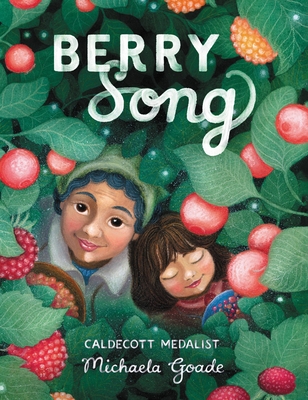
A grandmother and her granddaughter look up to the viewer from underneath green leaves and pink berries.Berry Song by Michaela Goade is a celebration of the land, the indigenous people and animals that live on the “island at the edge of a wide, wild sea.” Goade grew up and lives in the Tongass National Forest which is the home of her Tlingit ancestors. The story takes place in that Forest. A young girl tells of how her Tlingit grandmother taught her to harvest what they needed from the salty ocean gathering herring eggs, seaweed and netting silvery salmon. “And in the forest… we pick berries. …The berries sing to us, glowing like little jewels. We sing too, so berry–and bear–know we are here.” As they sing they say the names of the multiple kinds of berries that they harvest. Their songs encompass the variety of ways the forest “sings to us, through misting rain and whoosh of wing, the sweet smell of cedar and the tickle of moss.” Continue reading

Decorative WOW Currents Banner

Exploring a Fictional Sentience of Two Cats: Haven and Harvey

by Holly Johnson, University of Cincinnati, Cincinnati, OH
A gay striped cat with green eyes looks at the viewer from a circle with grass behind it. Framing the cat is a small picture of a bird, a bowl of soup, a woman with short brown hair, and a dog.As I noted earlier this month, an eco-cosmopolitan perspective is one way to address environmental issues, but it is an equally great way to explore the interconnectedness of all inhabitants of the planet. The definition I used was Heise’s (2008) in which she asserts that eco-cosmopolitanism is an “attempt to envision individuals and groups as part of planetary ‘imagined communities’ of both human and nonhuman kinds” (p. 61). Exploring ways in which humans are interconnected with other inhabitants of the earth has often been highlighted through conflict, specifically self against nature, which is an interesting perspective to take since that stance suggests that humans are not part of nature. What a theme to take on with secondary students! But for this blog entry, I want to highlight the connection between humans and two cats, Haven and Harvey. Both these cats give a fascinating entrée into “imagined communities” of being, in Harvey’s case, untamed or wild. In other words, feral. And for Haven, she must confront the outside world as she attempts to save her human companion. Continue reading

Decorative WOW Currents Banner

Books for Exploring the Dignity of the Non-Human World

Holly Johnson, University of Cincinnati, Cincinnati, OH

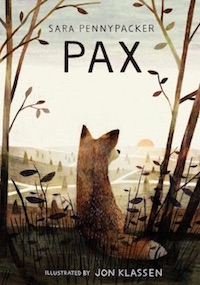
Pax by by Sara Pennypacker and illustrated by Jon KlassenThe environment has become a critical issue for a majority of people around the world. There are a number of ways to address the issue, and one of those ways is through an eco-cosmopolitan perspective. Eco-cosmopolitanism is “an attempt to envision individuals and groups as part of planetary ‘imagined communities’ of both human and nonhuman kinds” (Heise, 2008, p. 61). In children’s literature, we often get the perspective of an animal or insect. From Peter Rabbit (Potter, 1999) to Watership Down (Adams, 2014) to Charlotte’s Web (White, 2012) to more current texts such as Alice’s Farm (Wood, 2020) and Pax (Pennypacker, 2019), readers are delighted by the antics and/or adventures found within these marvelous examples of non-human creatures interacting in the world. Humorous tales such as the two Skunk and Badger stories (Timberlake, 2020; 2021) make us laugh, while Pax (Pennypacker, 2019), Pax Journey Home (2021) and Charlotte’s Web (White, 2012) can develop empathy for the living things outside the “human” realm. Continue reading

WOW Dozen: Korean Books Translated Into English

By HeeYoung Kim, West Texas A&M University, Canyon, Texas

Welcome abroad! This month’s WOW dozen takes readers on a journey to Korea. Each picturebook and novel in this column were originally published in Korea and later translated into English. These titles are written by Korean authors who speak Korean and live in Korea. Rudine Sims Bishop’s metaphor of mirrors and windows for multicultural children’s literature is an an invaluable tenet when reading global children’s literature too. Each book on this list introduces readers to the Korean culture as well as themes around imagination, love, loss and hope. Continue reading

WOW Recommends: Book of the Month

WOW Recommends: The New Rooster

A bright rooster runs while pulling a suitcase on wheels behind himThe New Rooster by Rilla Alexander is a universal and fanciful story about the challenges of communicating when many different languages are spoken. The story starts on the title page when Rooster, clutching his roller bag, parachutes from a plane. He has come a long way for his new job in a new country. We notice on the front endpapers that he has been hired to give the wake-up call at the ZZZ Hotel. But when he crows just as he had back home, no one is aroused. Even when he yells at the top of his lungs no one gets up. Repeated efforts until 3 p.m. fail to get anyone out of bed and the rooster figures he is out of a job. He realizes that he will need a good breakfast if he must make the long journey home. When the delicious smells of his cooking finally arouses the hotel guests they share a breakfast and chat. “They didn’t understand every word they heard, but they tried their best.” The ending will leave smiles on listener’s faces as this book makes a terrific read aloud. Don’t miss the punch line on the back endpapers — “Did you know the Rooster speaks pig latin?” Continue reading

WOW Recommends: Book of the Month

WOW Recommends: Blue

A Black girl with a crown hairstyle grinds plants to make the color blueBlue by Nana Ekua Brew-Hammond with illustrations by Daniel Minter is an informative and unusual nonfiction book. The beautiful illustrations extend the text that describes varied aspects of the color blue; the complicated history, impact on art, science and much more.

That history started way back in time. “As early as 4500 BC, diggers found blue rocks called lapis lazuli in mines deep below Afghanistan’s Sare-e-Sang valley.” Early sources of the color came from crushed rocks and “in the belly of a certain shell fish.” Later, dyers produced blue from the indigo plants. “In parts of Africa, some merchants used strips of indigo cloth to buy people, and sell them into slavery. … In this evil side of the trade for blue, landowners around the world abused or enslaved countless people just so they could grow more indigo.” In 1905, scientist, Adolf von Baeyer, won the Nobel Prize for “creating a chemical blue.” He made that achievement after forty years of trying. Continue reading