
 Now available in Spanish, this is the story of a Mexican American girl who learns to value the act of giving when she attends her first Swap Meet.
Family life
Fiesta Dress: A Quinceanera Tale
It s the day of Lolo’s big sister’s quinceañera party, and suddenly everyone is too busy to play with Lolo. But when she lets her dog Gobi runfree, everyone notices. Vivid illustrations in acrylics and watercolor by Martha Avile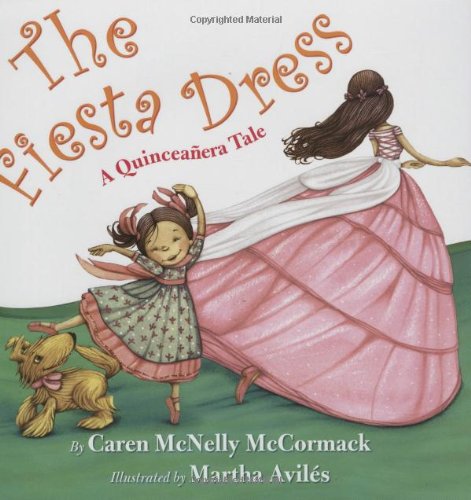 s skillfully portray Lolo using her fast feet and wits to outsmart Gobi and save her big sister’s special day!
Estrella’s Quinceañera
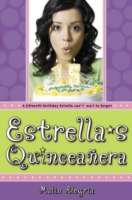
For as long as Estrella Alvarez can remember, her mother has been planning to throw her an elaborate quinceañera for her fifteenth birthday — complete with a mariachi band, cheesy decorations, and a hideous dress. Just thinking about her quince makes Estrella cringe. But her mother insists that it’s tradition. Estrella has other things on her mind, anyway — like dating Speedy. Does it matter that her new friends — and her parents — would never approve of aguy from el barrio? Estrella’s almost fifteen and wants to start making her own decisions. But is she ready to find out who she is — and who she really wants to be?
El Dilema De Trino
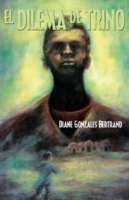
To be thirteen is worthless, Trino Olivares thinks. Trino has three little brothers he’s supposed to look after, but no father he can look up to. He rules at video games, but in the classroom, and out in the real world, he’s barely getting by—just like his mom, who scarcely manages to pay the bills and feed her kids by working all the time.Trino gets angry when he looks around at his terrible life. But when Rosca, an older teen with a vicious streak, invites him to start hanging with his crowd—and maybe make some quick money, too—Trino doesn’t know what to think. What kind of choices does he have, anyway? To run or die?
Tortilla Chronicles: Growing Up In Santa Fe
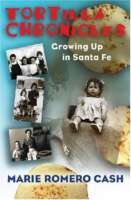
A family memoir full of New Mexico flavor, Tortilla Chronicles serves up a hearty helping of the “City Different” from the perspective of the humble, hardworking Romeros, a family honored for its contributions to regional folk arts. Marie Romero Cash, herself a renowned artist, poignantly sketches each family member using his or her own voice. Their stories present a rare glimpse into the life of a traditional Hispano family and provide an antidote to typical nostalgic tourist accounts of 1950s Santa Fe. One of the main characters is Santa Fe itself, and the narrative tours the city’s streets, shops, plaza, and surrounding hills and arroyos in astounding detail. The ancestry and rituals of family life, the culture and religion of northern New Mexico, and the growth of a neighborhood and its children are all part of the recipe.
Too Many Tamales
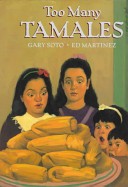
While preparing dough for her family’s Christmas tamales, Maria discovers that she has lost her mother’s prized diamond ring somewhere in the dough and sets out to eat her way through the many finished tamales to find the missing ring.
Grandma’s Records
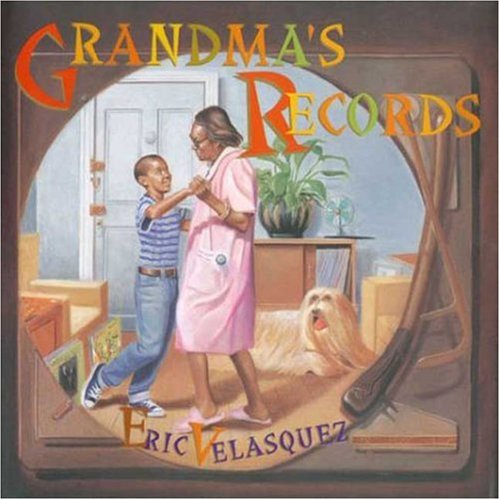 The author describes his boyhood summers spent at his grandmother’s apartment in Spanish Harlem where she intoduced him to the sounds and steps of the merengue and the conga and told him stories of Puerto Rico.
Chicken Foot Farm
On the eve of World War II, young Alejandro comes of age on his family’s South Texas farm, known as Chicken Foot Farm because of how his mother marks her chicks. “Mama held the chick against her breast and splayed its left foot between her thumb and index finger. With her free hand she… quickly cut off the end of the chick’s shortest toe.” Rich with the customs and traditions of rural, Mexican-American life, Chicken Foot Farm depicts a multi-generational family in flux as change crawls relentlessly toward their land and lifestyle. As the seasons–and loved ones–come and go and misfortunes befall the family, Alejandro learns the lessons of life: the importance of family, honesty, hard work, and compassion. When the kitchen burns down one night, Alejandro feels they have lost something integral to their family unity. But his father promises they will build another kitchen, the new one better than the old. As Abuela Luciana ages, she begins to behave erratically, burning tortillas, forgetting to add water to the beans she is cooking, and even disappearing from the farm. She is certain someone has cursed her–put mal de ojo on her. How can the family cure her when she is the curandera, the one who has always taken care of them? Most importantly, Alejandro works hard to win his father’s approval, even though Papa generally ignores him in favor of the eldest son, Ernesto, who Papa says will inherit the farm. When Ernesto joins the Army, the family must face the possibility that he may not return as the entire country is thrown into the uncertainty of war. Following the attack on Pearl Harbor, young Alejandro notices something new in his family’s kitchen: a framed United States flag now hangs on the wall. “It’s something I can do for the war,” his Abuela Luciana tells him. Not understanding, she explains to him, “I can remind people that we are Americans.” In these poignant images of a time and place long gone, Anne Estevis sketches a tight-knit, Mexican-American community on the cusp of a new way of life as tractors replace mules and modern science competes with superstitious beliefs.
The Smell Of Old Lady Perfume
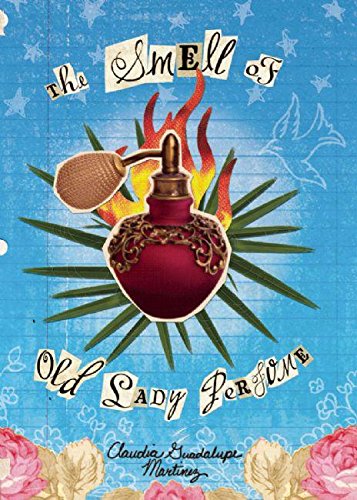 Claudia Guadalupe Martinez’s debut novel for young adults is a bittersweet story about death, family, and the resilient emotional strength of the human heart. Chela Gonzalez, the book’s narrator, is a nerd and a soccer player who can barely contain her excitement about starting the sixth grade. But nothing is as she imagined-her best friend turns on her to join the popular girls and they all act like Chela doesn’t exist. She buries herself in schoolwork and in the warm comfort of her family. To Chela, her family is like a solar system, with her father the sun and her mother, brothers, and sister like planets rotating all around him. It’s a small world, but it’s the only one she fits in.But that universe is threatened when her strong father has a stroke. Chela’s grandmother moves in to help the family. The smell of her old lady perfume invades the house. That smell is worse than Sundays. Sundays were sad, but they went just as sure as they came. Death was a whole other thing, and Chela doesn’t understand that’s what everyone is waiting for. In her grief and worry, Chela begins to discover herself and find her own strength.Claudia Guadalupe Martinez was born in El Paso, Texas. She learned that letters form words from reading the subtitles of old Westerns for her father. She went on to graduate from college and moved to Chicago to become one of the city’s youngest nonprofit executives.
Surprising Cecilia
Surprising Cecilia is the second novel-following the success of Cecilia’s Year-about a girl whose dreams carry her far beyond the small farm community she lives in. Both novels are set in the rich Hispanic culture of the Rio Grande Valley in the 1930s. Cecilia has worked hard so that she can go to high school. Now it’s September-the school bus is bringing Cecilia to the new adventures, surprises, and responsibilities of growing up. Susan Gonzales Abraham and Denise Gonzales Abraham are the daughters of Cecilia Gonzales Abraham, the hero of the Cecilia books. Cecilia’s Year has been selected as the Best Book for Young Adults in 2004 by the Texas Institute of Letters.