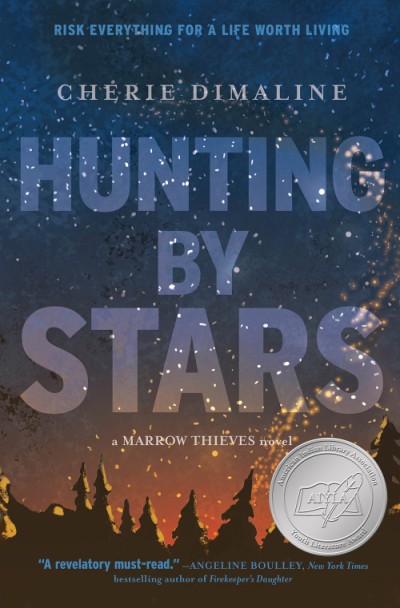
Hunting by Stars, a YA novel by Métis writer Cherie Dimaline, was released as a sequel to The Marrow Thieves, which was honored with many awards. The protagonist, French, of the new novel never expected to see his brother, Mitch, again. After witnessing his brother’s abduction by the Recruiters at the beginning of The Marrow Thieves, French thinks surely they had taken Mitch to die at the new kind of residential school, where Indigenous peoples are harvested for their bone marrow. That’s where the dreams live, and in this dystopian future, the only people who are still able to dream are Indigenous peoples of North America. All others suffer a sickness because of their lack of dreaming. Mitch survives because he becomes one of them after capture, a Recruiter, working on the side of those abducting and harvesting Indigenous peoples. When French and Mitch reunite, it is not a happy reunion, as French has himself been abducted and taken to the school, where he realizes his beloved brother is alive but also, in a sense, his enemy. French has to grapple with the pain of choosing who to fight for, who to protect and support – family by blood or by bond – and how to escape from the school and reunite with his chosen family. Continue reading
Marching Towards Justice for All: Part I
by Daliswa Kumalo and Charlene Klassen Endrizzi
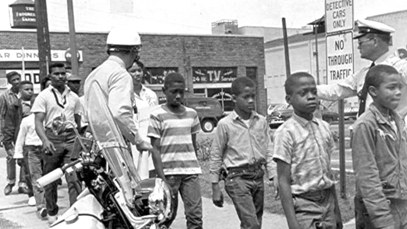
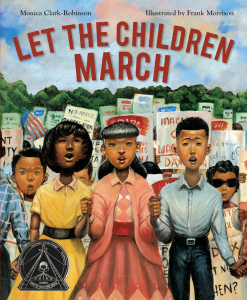
Two years ago, Daliswa “Didi” Kumalo shared a compelling picturebook, Let the Children March, with third graders during our School of Education’s annual African American Read-In. She recently revealed the impetus for crafting this engagement. “When I was younger, my dad always told me that ‘history tends to repeat itself.’ As much as I wished that wasn’t the case, as I get older the connections to the past have never felt closer.” Through our blog post, I (Charlene) reveal Didi’s ability to connect 8- and 9-year-olds to the Civil Rights child foot soldiers featured in Monica Clark-Robinson and Frank Morrison‘s award winning book. We believe this literature engagement highlights the value of building bridges to our nation’s past. When teachers initiate hard conversations surrounding unresolved racial struggles, children can begin to consider their power to create much-needed change today. Continue reading
A Dozen Poetry Books
By Deanna Day-Wiff, Washington State University, Vancouver, WA
Poetry is all around us and is fun to read aloud and share with children of all ages. Poetry builds literacy skills with its figurative language, different forms and structures as well as its rhythm and rhyme. This past year I had the honor of serving on the NCTE Notable Poetry Books and Verse Novels Committee. I read over 300 titles—individual poems, anthologies, narrative poems, biographical poems and verse novels. The committee discussed the differences between poetry and prose and then chose 30 titles that reflected the Notable Poetry Books Criteria. This WOW Dozen focuses on some of the books that were considered but did not make the 2022 NCTE Notable Poetry Books and Verse Novels list. Nevertheless, children and adolescents will still enjoy hearing or reading them. Why not bring poetry to life in your classroom by sharing more of it in March, April for National Poetry Month and every day? Continue reading
A Dozen Books on Activism
By Deanna Day-Wiff, Washington State University, Vancouver, WA
Children and adolescents are taking action and making a difference in their communities and across the globe each day. This WOW Dozen highlights titles around the theme of activism. Each picturebook or novel shows how young people are working for change on causes that matter to them such as: saving a lending library, turning a vacant lot into a natural space for butterflies or creating light for a community in the dark. Other titles may inspire readers to speak up for climate change, demonstrate peacefully or sing for transformation. Reading aloud these titles could encourage K-8 readers to think about the needs or changes in their own communities to change our world. Continue reading
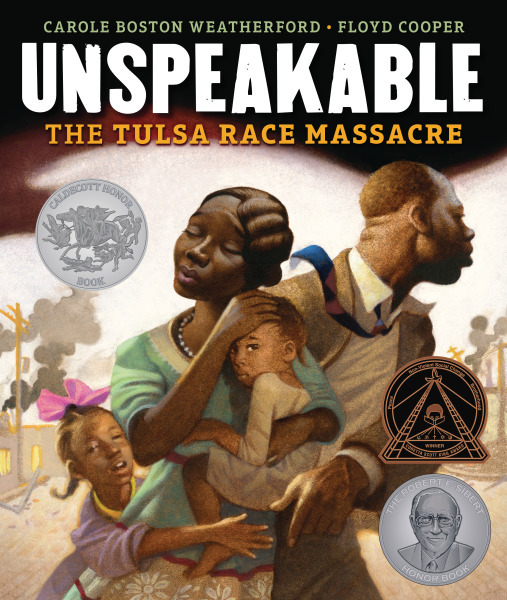
WOW Recommends: Unspeakable
Unspeakable: The Tulsa Race Massacre chronicles the murderous hostility, humiliation and hope of this largely suppressed historical event in United States. The devastation occurred in 1921 when a white mob attacked the Black community in Tulsa, Oklahoma. This third person informational text narrates the incidents that occurred in one of the worst racially violent cases in U.S. Tulsa, during this time, was a prosperous segregated town, where descendants of “Black Indians, from formerly enslaved people, and from Exodusters” thrived in their Greenwood community, once known as Black Wallstreet. “Once upon a time” near Tulsa, is a phrase that is eloquently repeated to depict the prosperity that the people in the Greenwood community created. Then one day, the massacre stemmed from one elevator ride where a 17-year-old white elevator operator accused a 19-year old Black shoeshine man of “assault for simmering hatred to boil over.” This incident resulted in 300 Black people who died, and more than 8,000 left homeless, “…hundreds of businesses were reduced to ash.” It took over 75 years to launch an investigation, which uncovered that “police and city officials had plotted with the angry white mob to destroy the nation’s wealthiest Black community.” Continue reading
Children Draw Themselves: Self-portraits from All Over the World In Times of Covid
As COVID-19 began its spread around the world, the International Youth Library (IYL) in Munich, Germany, invited children to portray themselves during this unusual time. The response was overwhelming. Over 800 self-portraits from 42 countries and every continent arrived at the IYL. Children aged 3 to 18 depict themselves grey and frightened or colorful and lively, sometimes with a face mask and sometimes without–mostly with big, alert eyes. A curated portion of these self-portraits make up the exhibit Children Draw Themselves: Self-Portraits from All Over the World In Times of Covid, now on display in Worlds of Words: Center of Global Literacies and Literatures (WOW) in the UArizona College of Education.
Continue reading
WOW Recommends: Borders
Questions of sovereignty, citizenship, and who gets to decide are the central issues in Borders (2021), a graphic novel with expressive colorful illustrations representing a realistic sensibility. A first-person narrative told from the perspective of a young boy, readers follow along on a road trip between the Blackfoot Reserve in Canada to the border between Canada and the United States. Upon reaching the border, those wishing to cross the border either for returning to their own country or entering the visiting country must declare their citizenship. When asked for her citizenship, the boy’s mother responds, “Blackfoot.” This creates a dilemma for the border guards, as she is expected to answer either “Canadian” or “USA.” Because she refuses to claim any citizenship other than her tribal affiliation, the boy and his mother are not allowed in the USA, and are turned back. But once they return to the border crossing into Canada, they not allowed into Canada because the boy’s mother responds in the same way when asked her citizenship. Continue reading
Picturebooks: The Wisdom Found in Ages
By Holly Johnson, University of Cincinnati, Cincinnati, OH
The last week of December, and of 2021, is a great time to think about wisdom, and what we can learn not only from the past year, and from those who have lived many years. Four picturebooks highlighted during the last 12 months include the wisdom of the ages—three grandparents and one country leader. I Dream of Popo is the story of a young girl who misses her grandmother when her family moves to the United States from Taiwan. The young protagonist remembers what her grandmother means to her, and what she learned from her grandmother. And while they are able to use technology to “visit” one another, there is still the longing to be with, and to continue to learn from, this very special person. Readers can relate to the wisdom of their own grandparents or older family relatives. There are their family stories to be heard, memories to hold, and love to take with them as they venture out seeking further knowledge and perhaps, wisdom as they grow. Continue reading
Government Practices & Policies, and the Dangers to Individuals
By Holly Johnson, University of Cincinnati, Cincinnati, OH

The four novels this week address issues of government practices and policies and how those initiatives impact human beings. The Firekeeper’s Daughter, Your Heart, My Sky, The Beatryce Prophecy, and Unsettled as a text set are a blend of historical realities, fable/fairytale, as well as legends and cultural traditions. The power of these novels is the ability of the authors to create realistic contexts that are often too familiar while highlighting individuals and their responses to that political context. Each of these narratives invite questions about government programming and the gaps within the lived reality as well as the historical documentation of that programming provides entrée into the study of history itself. Who and what is fore fronted? Who or what is silenced or rendered invisible? How can history be re-envisioned, and in what ways can more of the “story” of history be brought into view? How can students of history look beneath the official narrative and, perhaps, bring about change? How do people actually live within the history given? How does one make a life in dangerous times? Continue reading
Historical Conflicts and the Toll on People and Other Living Things
By Holly Johnson, University of Cincinnati, Cincinnati, OH
Four of the books from WoW Recommends 2021 address the toll of historical conflict: Cane Warriors, Brother’s Keeper, Cat Man of Aleppo, and They Called Us Enemy. All offer spaces of contemplation and discovery, discussion and decision-making. All are great reads. Continue reading