
Stealing Little Moon: The Legacy Of American Indian Residential Schools: The Legacy Of American Indian Residential Schools

Little Moon There Are No Stars Tonight was four years old when armed federal agents showed up at her home and took her from her family. Under the authority of the government, she was sent away to a boarding school specifically created to strip her of her Ponca culture and teach her the ways of white society. Little Moon was one of thousands of Indigenous children forced to attend these schools across America and give up everything they’d ever known: family, friends, toys, clothing, food, customs, even their language. She would be the first of four generations of her family who would go to the Chilocco Indian Agricultural School.

Dan SaSuWeh Jones chronicles his family’s time at Chilocco–starting with his grandmother Little Moon’s arrival when the school first opened and ending with him working on the maintenance crew when the school shut down nearly one hundred years later. Together with the voices of students from other schools, both those who died and those who survived, Dan brings to light the lasting legacy of the boarding school era. Part American history, part family history, Stealing Little Moon is a powerful look at the miseducation and the mistreatment of Indigenous kids, while celebrating their strength, resiliency, and courage–and the ultimate failure of the United States government to erase them.

Tales From Gold Mountain: Stories Of The Chinese In The New World (A Groundwood Book) (A Groundwood Book)

Through eight original tales, readers gain insight into the hardships faced by the first Chinese immigrants in America. In “Spirits of the Railway,” a young man endeavors to appease the restless ghosts of railroad workers who were never properly laid to rest, shedding light on the sacrifices made by laborers in building the nation’s infrastructure. In “Forbidden Fruit,” a father’s bias threatens to tear apart his daughter’s chance at love and happiness, highlighting the impact of cultural traditions and familial expectations on individual lives.

Indigenous America (True History)

American schoolchildren have long been taught that their country was ‘discovered’ by Christopher Columbus in 1492. But the history of Native Americans in the United States goes back tens of tens of thousands of years prior to Columbus’s and other colonizers’ arrivals. So, what’s the true history?

Makoons (Birchbark House)

In this award-winning sequel to Chickadee, acclaimed author Louise Erdrich continues her celebrated Birchbark House series with the story of an Ojibwe family in nineteenth-century America.Named for the Ojibwe word for little bear, Makoons and his twin, Chickadee, have traveled with their family to the Great Plains of Dakota Territory. There they must learn to become buffalo hunters and once again help their people make a home in a new land. But Makoons has had a vision that foretells great challenges—challenges that his family may not be able to overcome.Based on Louise Erdrich’s own family history, this fifth book in the series features black-and-white interior illustrations, a note from the author about her research, and a map and glossary of Ojibwe terms.

Chances In Disguise

“In this sequel to Evangelina Takes Flight, the young girl who left her home during the Mexican Revolution to start over in a small Texas border town is now seventeen. She has had several years of medical training with her mentor, Doc Taylor, but when a doctor from a neighboring town finds her helping an Anglo woman in labor, he is enraged. He calls her a dirty Mexican and kicks her out. The next day, Evangelina is arrested for murder. The racist sheriff and many of the townspeople believe Mexicans are inferior and that Evangelina must be guilty of using witchcraft to kill the pregnant woman. But she isn’t all alone. Doc Taylor believes in her innocence, as does Cora Cavanaugh, the spirited daughter of a wealthy businessman. And there’s Selim Njaim, a young Muslim with whom she has a forbidden relationship. Soon La Liga Protectora Mexicana assigns someone to represent her, but will Joaquín Castañeda be able to convince the jury that Evangelina is not a murderer? Set in Texas in 1915, this eye-opening historical novel for young adults reveals the racial inequity in the justice system, the discrimination experienced by Mexicans and other non-whites and the limitations placed on women. Teens will relate to the theme of finding confidence and bravery in times of uncertainty, while learning about the harassment, torture and killing of innocent Mexicans and Tejanos in the early part of the twentieth century.”

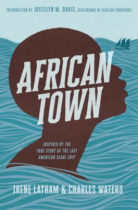
African Town

Chronicling the story of the last Africans brought illegally to America in 1860, African Town is a powerful and stunning novel-in-verse.

In 1860, long after the United States outlawed the importation of enslaved laborers, 110 men, women and children from Benin and Nigeria were captured and brought to Mobile, Alabama aboard a ship called Clotilda. Their journey includes the savage Middle Passage and being hidden in the swamplands along the Alabama River before being secretly parceled out to various plantations, where they made desperate attempts to maintain both their culture and also fit into the place of captivity to which they’d been delivered. At the end of the Civil War, the survivors created a community for themselves they called African Town, which still exists to this day. Told in 14 distinct voices, including that of the ship that brought them to the American shores and the founder of African Town, this powerfully affecting historical novel-in-verse recreates a pivotal moment in US and world history, the impacts of which we still feel today.

Dead Man’s Gold And Other Stories: And Other Stories

Ten ghost stories about Chinese people who, having come to North America to make their fortunes, encounter ghosts who either help or hinder their success.

Staking A Claim, The Journal Of Wong Ming-Chung, A Chinese Miner, California, 1852

In 1852, during the height of the California Gold Rush, ten-year-old Wong makes the dangerous trip to America to live with his uncle, exchanging the famine and war of his native country for brutal bullies and grueling labor in America, Wong joins his uncle and countless others in the effort to strike it rich on the great Golden Mountain. Unfortunately, he, and most of the rest of the dreamers, soon discover that there’s no such thing as a Golden Mountain, only dirt, mud, and occasionally tiny flecks of gold dust flecks that are to be turned over to the owners of the mines, in return for barely livable wages. However, someone as clever and resourceful as Wong will have to find other ingenious ways of making money if they’re going to make it in America. But can they overcome the bitter, racist white Americans to find success?