Susan Corapi, Trinity International University, Deerfield, IL
Ready for the next description of peace based on the book Peace Begins with You by Katherine Scholes and Robert Ingpen? The fourth way they describe peace involves the choices that we all make that either threaten or support peace. Scholes and Ingpen go on to say, “working for peace may be harder than using force. You may have to be braver and stronger. You may have to learn new skills, new ways of thinking and planning.” The focus this week is on characters whose choices threaten or support peace. For many of the characters, that involves a shift in perspective.




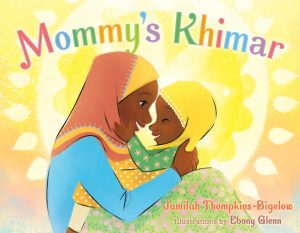 The sparkling picture book, Mommy’s Khimar by Jamilah Thompkins-Bigelow with illustrations by Ebony Glenn, is a delightful, warm story about an African-American, Muslim family. The girl who tells the story celebrates her love for her mother and the khimar that her mother wears. On the first page she tells us, “A khimar is a flowing scarf that my mommy wears. Before she walks out the door each day, she wraps one around her head.” The girl loves to play dress-up or pretend games wearing her mother’s yellow khimar. She becomes a queen with a golden train, a shooting star, a mama bird or a super hero in a cape, “dashing from room to room at the speed of light. Daddy snatches me up and I fly. Mommy can’t stop laughing when his bristly beard tickles my cheek with a kiss.” Sometimes Mom-Mom (her grandmother) visits after her Sunday service when the girl wears the khimar, Mom-Mom “sings out ‘Sweet Jesus’ and calls me Sunshine. Mom-Mom doesn’t wear a khimar. She doesn’t go to the mosque like Mommy and Daddy do. We are a family and we love each other just the same.”