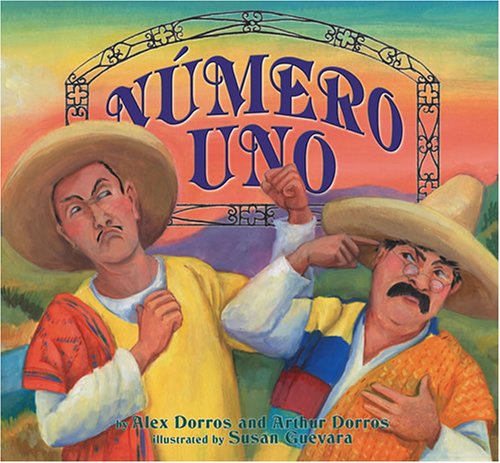
 A bilingual picture book that will be #1 this spring! From a talented team, this hilarious tale of competition run amok is told with a sprinkling of Spanish and a heaping spoonful of charm. Which is better, brains or brawn? In a small village, Hercules is known for his great strength and Socrates for his keen intelligence. Whenever the villagers have a problem, they go to one or the other for help. Each man believes that he is the most important person in town. And the two fight about it constantly. Who, their neighbors wonder, will resolve the question that instigates all this bickering? The villagers realize they must settle the argument once and for all by finding out who is “número uno.” They devise a clever test, and Hercules and Socrates, each sure he will win, go along with it. The answer is a surprise for everyone “I came up with the idea for Número Uno in sixth grade when the class was asked to write fables. I thought that these two characters, one with outstanding intelligence and one with exceptional brawn, would together create an entertaining story. It could also carry a valuable lesson, as fables do. The story was originally set in China, but to me it is universal. We later decided to change to a Spanish-speaking setting, which I am more familiar with. “I grew up bilingual, speaking English and Spanish, and have visited many Latin American countries, including going to school there for a short while. I’m now sixteen years old and am enjoying living in Seattle. I spend much of my free time going to the nearby mountains (like Hercules and Socrates do in the book), in my case to snowboard. I also create my own stories through taking photographs, a few of which have now been published. I stay busy with playing baseball and going to high school. “As we wrote the book, the story stayed essentially as I originally had it, though we went through seemingly endless numbers of revisions and ended up changing details in the process. Writing a book with your dad is definitely not the easiest of tasks. At some points we reminded ourselves of the bickering characters in the story. Ultimately we were able to work together to create what I hope is a book you’ll enjoy.”—Alex Dorros on the creation of Número Uno with his father Arthur Dorros