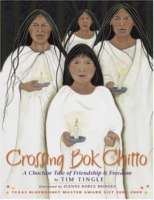
Crossing Bok Chitto: A Choctaw Tale of Friendship and Freedom

Kids of all ages are always asking Joe Hayes, “How can it snow tortillas?” Now they’ll know where to find the answer: at long last, Joe’s signature book The Day It Snowed Tortillas is appearing in a new bilingual edition. Bloomsbury Review listed the original English-only edition as one of their fifteen all-time favorite children’s books. This bilingual edition has all the original stories as they have evolved in the last twenty years of Joe’s storytelling. It also has new illustrations by award-winning artist Antonio Castro. Storytellers have been telling these stories in the villages of New Mexico since the Spanish first came to the New World over four hundred years ago, but Joe always adds his own nuances for modern audiences. The tales are full of magic and fun. In the title story, for instance, a clever woman saves her silly husband from a band of robbers. She makes the old man believe it snowed tortillas during the night! In another story, a young boy gladly gives up all of his wages for good advice. His parents think he is a fool, but the good advice leads to wealth and a royal marriage. The enchantment continues in story after story—a clever thief tricks a king for his kingdom and a prince finds his beloved in a house full of wicked step-sisters. And of course, we listen again to the ancient tale of the weeping woman, La Llorona, who still searches for her drowned children along the riverbanks.

Featured in Volume I, Issue 4 of WOW Review.
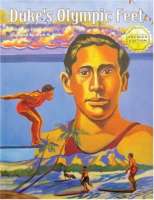
Duke’s Olympic Feet

Duke Kahanamoku was the twentieth century’s top waterman, and is known as the “father of international surfing.” The first Hawaiian to win an Olympic gold medal, Duke represented the United States in the Olympic Games in 1912, 1920, 1924 and 1932, winning gold, silver and bronze medals. Born in 1890, Duke grew up next to the ocean in Waikîkî. After school, he and his sister and brothers would hit the water. “I was only happy when I was swimming like a fish,” Duke said. Duke and the other beach boys gathered under a hau tree in Waikîkî. They rode the waves at Castles, a prime surf spot, on their sixteen-foot solid wooden surfboards. Years of swimming, surfing and canoe paddling made Duke a fine athlete. He had a strong body, long arms, powerful legs and his hands were said to be as big as buckets. Some claimed he had feet as big as fins and could steer a canoe with his feet alone. Duke knew that he was a very fast swimmer and he trained constantly. He said that God had given him a gift and a whip. “The whip,” he said with a grin, “is to flog myself into getting the most out of the gift.” He felt that, just maybe, he could be a champion and win Olympic gold for Hawai‘i. His chance came August 12, 1911, at Alakea Slip in Honolulu Harbor, when he demolished the world amateur record for the 100-yard freestyle. His excitement was crushed when mainland AAU officials refused to believe his time. “What are you using for stopwatches over there in Hawai‘i?” they asked. “Alarm clocks?” The AAU officials doubted that a virtually untrained swimmer could break a world record. It was up to Duke to prove he could go up against the world’s fastest swimmers and beat them. Along with his athletic accomplishments, Duke is remembered for his concern for others, humility in victory, courage in adversity and good sportsmanship.

Take a closer look at Duke’s Olympic Feet as examined in WOW Review.

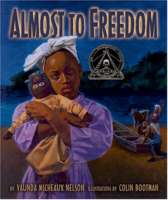
Almost To Freedom

Tells the story of a young girl’s dramatic escape from slavery via the Underground Railroad, from the perspective of her beloved rag doll.

(Coretta Scott King Illustrator Honor Book)

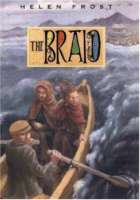
The Braid

Two sisters, Jeannie and Sarah, tell their separate yet tightly interwoven stories in alternating narrative poems. Each sister–Jeannie, who leaves Scotland during the Highland Clearances with her father, mother, and the younger children, and Sarah, who hides so she can stay behind with her grandmother–carries a length of the other’s hair braided with her own. The braid binds them together when they are worlds apart and reminds them of who they used to be before they were evicted from the Western Isles, where their family had lived for many generations.

An author’s note describes the poetic form in detail.

Featured in Vol. I, Issue 4 of WOW Review.

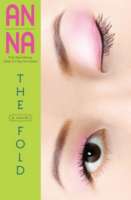
The Fold

Joyce never used to care that much about how she looked, but that was before she met JFK—John Ford Kang, the most gorgeous guy in school. And it doesn’t help that she’s constantly being compared to her beautiful older sister, Helen. Then her rich plastic-surgery-addict aunt offers Joyce a gift to “fix” a part of herself she’d never realized needed fixing—her eyes. Joyce has heard of the fold surgery—a common procedure meant to make Asian women’s eyes seem “prettier” and more “American”—but she’s not sure she wants to go through with it. Her friend Gina can’t believe she isn’t thrilled. After all, the plastic surgeon has shown Joyce that her new eyes will make her look just like Helen—but is that necessarily a good thing? Printz Award–winning author An Na has created a surprisingly funny and thought-provoking look at notions of beauty, who sets the standards and how they affect us all. Joyce’s decision is sure to spark heated discussions about the beauty myths readers confront in their own lives.

Featured in Volume I, Issue 4 of WOW Review.
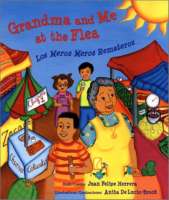
Grandma And Me At The Flea / Los Meros Meros Remateros

Every Sunday Juanito helps his grandmother sell old clothes at the flea market. Romping from booth to booth among the rainbow-colored tents under the sun, Juanito and his friends fulfill Grandma’s vision of the flea market as a sharing community of friendly give and take. With every trade and barter, Juanito learns firsthand what it means to be a true rematero — a flea marketeer — and discovers that the value of community can never be measured in dollars.

Featured in Volume I, Issue 3 of WOW Review.

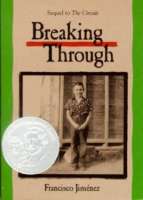
Breaking Through

At the age of fourteen, Francisco Jiménez, together with his older brother Roberto and his mother, are caught by la migra. Forced to leave their home, the entire family travels all night for twenty hours by bus, arriving at the U.S. and Mexican border in Nogales, Arizona. In the months and years that follow, Francisco, his mother and father, and his seven brothers and sister not only struggle to keep their family together, but also face crushing poverty, long hours of labor, and blatant prejudice. How they sustain their hope, their goodheartedness, and tenacity is revealed in this moving sequel to The Circuit. Without bitterness or sentimentality, Francisco Jiménez finishes telling the story of his youth.

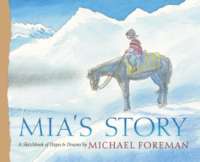
Mia’s Story: A Sketchbook of Hopes & Dreams

From award-winning picture book artist Michael Foreman comes the uplifting tale of a girl whose search for a lost puppy leads to some wondrous wildflowers — and a magical way to transform her barren village. In a bleak little village in Chile, Papa comes home from his day of selling metal scraps with a wonderful surprise for his daughter, Mia. It’s a puppy she names Poco, who follows the little girl everywhere — until one day, as puppies will do, Poco wanders away. As Mia searches for her pup, she finds herself all alone at the top of the highest mountain, where she gathers a clump of snow-white flowers to plant by her home. Soon Mia’s fragrant flowers have spread through the village and blanketed the once-ugly dump. Before long, she is selling her flowers in the city square, telling crowds of customers that “they come from the stars.” But wherever the flowers are, Mia is always reminded of Poco. Is it possible the flowers may bring back her beloved dog after all?

Take a closer look at Mia’s Story as examined in WOW Review.

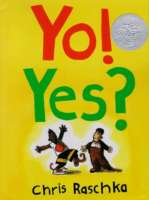
Yo! Yes (Caldecott Honor Book)

With a mere 19 words (yo appears twice, yes six times) the author/artist of Charlie Parker Played Be Bop presents a spirited conversation on a city sidewalk that is, in itself, a complete drama. Two boys meet as strangers. One hails the other, who is cautious. The first persists. The other responds. Gradually they begin to talk and end up as friends. Full color. 1994 Caldecott Honor Book.

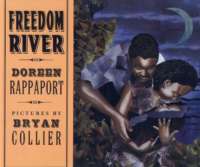
Freedom River

Describes an incident in the life of John Parker, a formerly enslaved person who became a successful businessman in Ripley, Ohio, and who repeatedly risked his life to help other slaves escape to freedom.

Coretta Scott King Illustrator Honor Books